
On 8 December 1891 the United States Patent Office granted Samuel O'Reilly, a tattooist working in New York, patent number 464,801 for an electric tattooing machine adapted from Thomas Edison's electric pen. Not quite eighty years later the music that would cover more forearms than any other arrived from Birmingham. The heavy metal tattoo is what happened when the two met.
Built round a pair of electromagnetic coils that yank an armature bar down and let a spring throw it back up, the coil machine drives its needles into the skin something like a hundred times a second, a drum part no double kick could keep pace with, played on a human arm, each stroke punching through the surface and leaving a charge of pigment a millimetre or so below it. What stays is not decided by the needle. The body decides.
The ink lodges in the dermis, and the body's own sentries, the white cells called macrophages, swarm the pigment and swallow it whole to carry it away, fail, and die holding it, and when each one dies the next generation of sentries swallows the same grain again and sits where the last one sat. A team in Marseille watched that cycle of capture, release and recapture in tattooed mice in 2018. The guard is replaced for decades. The grain never leaves the post. A riff heard at fourteen lodges the same way.
The Aston singer who worked that lesson out on his own hand as a teenager, pricking his name across his knuckles with India ink and a needle at about fifteen, by his own account to Inked magazine in 2020, was Ozzy Osbourne, and the name stayed there through more than half a century of Black Sabbath, solo records and reunions. The two Zs, he said, never quite lined up.
What the heavy metal tattoo borrowed from the docks
The designs were older than the music. Skulls, daggers, snakes wound round swords, panthers, roses and hearts with a banner across them came off the flash sheets that tattooists pinned to shop walls in port towns long before 1970, and the man most often named when that style is traced to its source is Norman Collins, the Honolulu tattooist who worked as Sailor Jerry until his death in 1973. Heavy metal did not invent the skull. It inherited the sheet.
What the music added was the name. Where a sailor had a ship or a sweetheart inked on the forearm, a fan from the late seventies on put the band there, the logo exactly as it stood on the sleeve, and after the logos the mascots. The choice turned out to be the same one fans were making with a record collection and a jacket, told at length in the wider story. The difference was the medium. A jacket can be sold.
The commonest heavy metal tattoos fall into a handful of kinds:
- the logo, lettered exactly as on the record, usually on the forearm or across the shoulder blades;
- the mascot, above all Iron Maiden's Eddie in one of his many costumes and Motörhead's war pig, Snaggletooth;
- a whole sleeve painting copied onto the back or the upper arm, the most expensive and the slowest to finish;
- the old flash motifs, skull, blade and serpent, worn without any band name at all.
The guard is replaced for decades. The grain never leaves the post.
A song for the tattooed
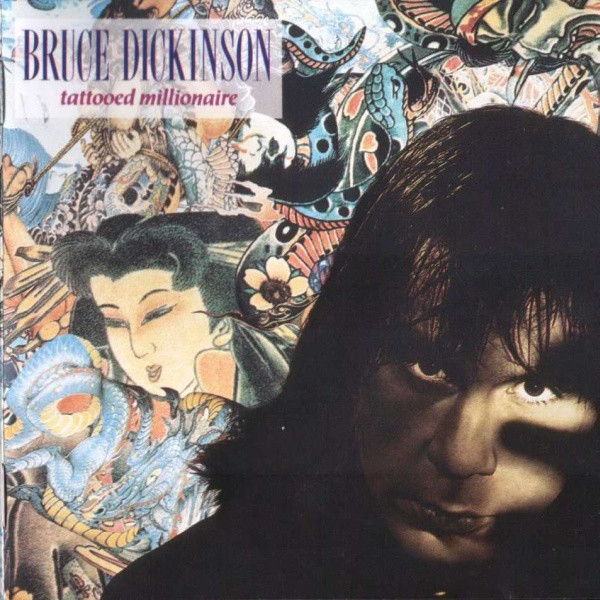
The best-known heavy metal hit with the tattoo in its title came from the singer of Iron Maiden, working on his own. Released by EMI in May 1990, recorded with the guitarist Janick Gers, who was asked to join Maiden during the sessions, the debut solo album carrying "Tattooed Millionaire" belonged to Bruce Dickinson. The title track reached number 18 on the UK singles chart that spring.
The song is a sneer, not a salute. Its target is the rich rock star with ink bought as costume. Reviewing the album in the Georgia Straight in August 1990, Steve Newton heard a stab at the excesses of the Los Angeles rock lifestyle, and at Mötley Crüe above all. The riff is plain hard rock and the chorus is built to be shouted. The irony is that a whole generation of fans with band logos on their arms sang it back without a second thought.
The needle behind the stage
By the nineties the heavy metal tattoo had its own artists, and one studio in particular became a place of pilgrimage for the faithful. Known for dark, painterly work in black and grey, demons and skulls rendered like old engravings, the New York tattooist whose Last Rites studio counted members of Slayer and Pantera among its clients was Paul Booth. Musicians who had worn the flash of the docks now wore work that could hang in a gallery.
The black and grey shading behind that work was not born in the music either. It grew up in California's prisons, where homemade machines ran a single needle and black ink thinned with water gave the greys, and it reached the street through the Chicano shops of East Los Angeles in the seventies. It suited the sleeves of heavy metal records better than the bright colours of the old flash ever had. Grey smoke, grey stone, grey bone. The palette of the music found its way onto the skin.
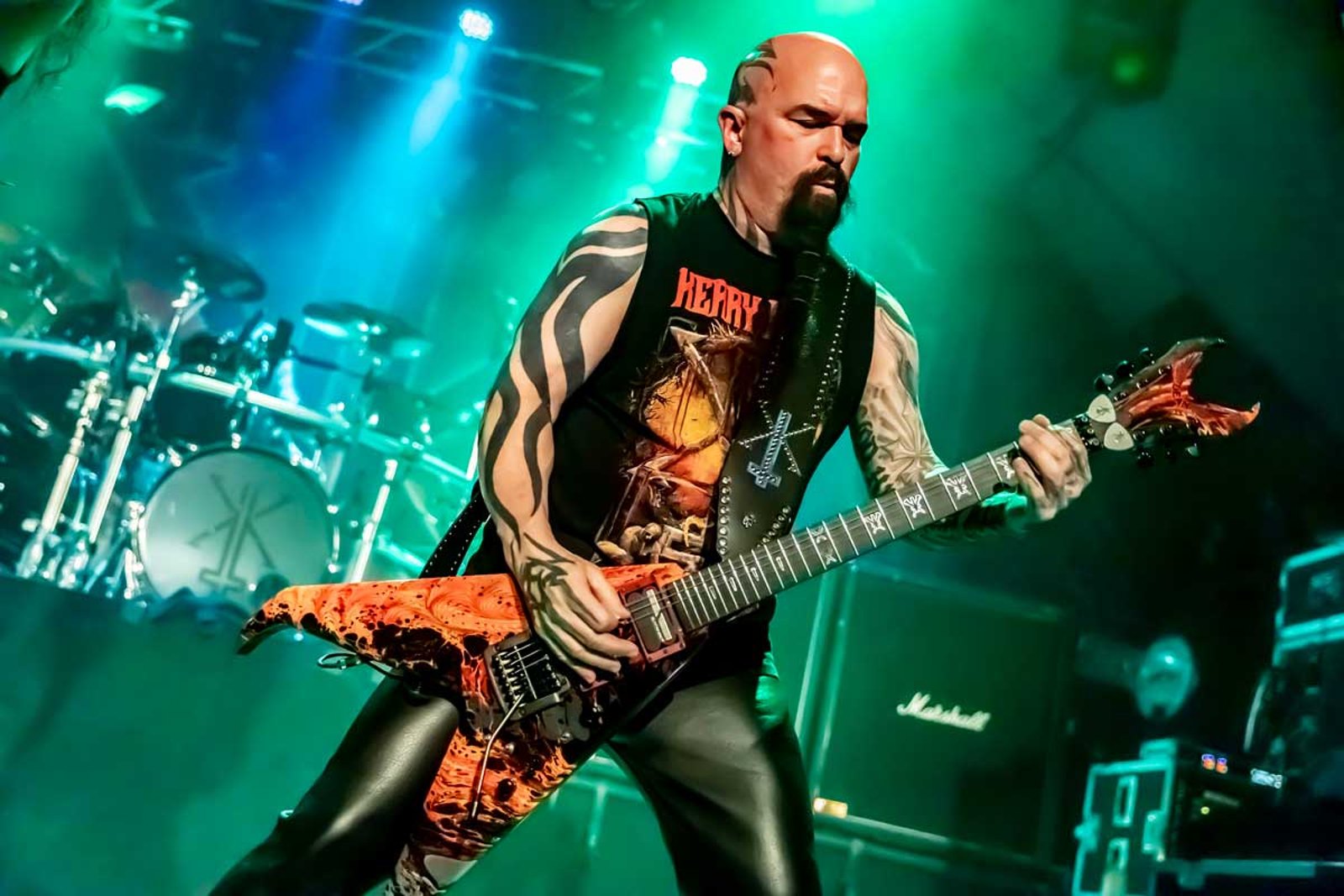
On stage the ink grew as the costumes fell away. Where the bands of 1980 wore leather and studs and kept their arms covered, the bands of the nineties played in T-shirts or bare to the waist, and the tattoos took over the job the jacket had done, carrying the band's banners on bare skin and telling a crowd forty rows back what creed the man on stage kept. The Slayer guitarist who had Booth tattoo his shaved head was Kerry King, and his costume could not be taken off after the show.
A patch is a promise you can unpick. The ink is the one covenant in this music that holds whether the band splits, reforms or sells the name.
Declan Rourke, KaosMetal
Letters that last, and letters that close up
Heavy metal lettering is the hardest thing to tattoo well. Over the decades the pigment drifts deeper into the dermis, so the tight counters of blackletter, the thin hairlines of a thorn logo and the small type of an album title slowly fill in, and a name that read cleanly at thirty can blur into a dark smear at sixty. Tattooists who know the music letter it large and leave space between the strokes. The good ones will refuse a logo drawn too small.
The cheap ones do worse damage. A band name pricked into a forearm in a back bedroom with a needle and drawing ink lands at no steady depth, fading in one stroke and spreading in the next. It decays the way iron gall ink decays on an old manuscript, where the acid in the ink eats slowly into the paper until whole letters crack and drop out, leaving holes in the shape of words. Plenty of the logos inked at school in the eighties went that way. The cover-up trade has lived off them ever since.
The mascots age better than the letters. The figure that holds up best on skin is beyond dispute Iron Maiden's Eddie, painted by Derek Riggs to be read from across a record shop, bold in outline and heavy in shadow, and those same qualities keep a tattoo of him legible for decades. The war pig on a Motörhead sleeve was drawn in hard black lines, which is exactly what a needle holds longest. Petagno and Riggs drew for cardboard. They drew, without knowing it, for skin.
The ink rarely stands alone. It goes with the patched jacket, the tour shirt and the boots, the whole kit that is laid out as heavy metal fashion. Of all of it, the tattoo is the one piece that cannot be taken off at the door of the office.
Records get sold and jackets get lost. The band may split. The logo stays.
