
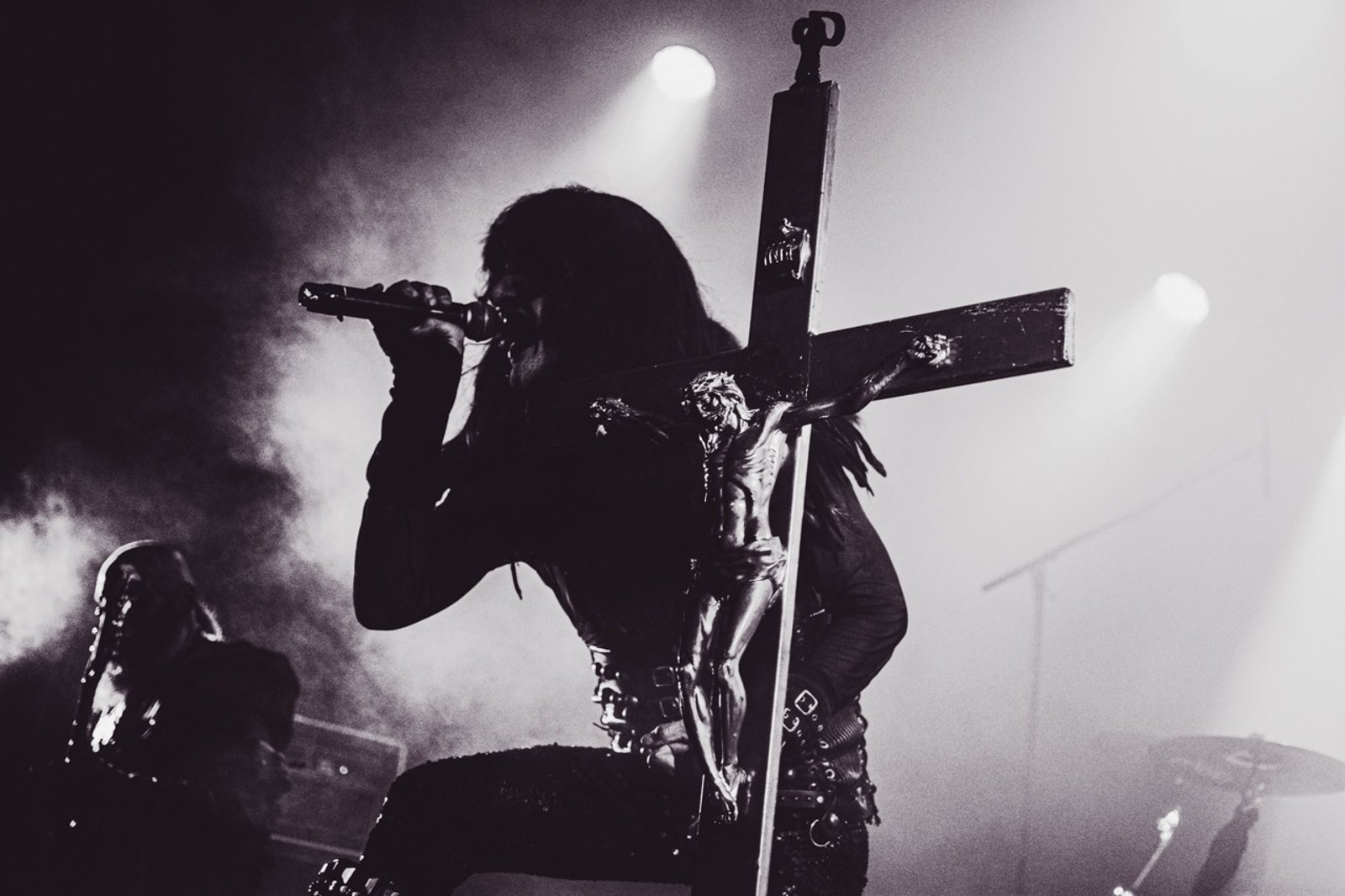
Thirteen years separate the first rehearsal from the first album, and in Italian heavy metal that is not a delay. It is the standard term. Formed in Piombino in 1974 as a covers band called Omega Erre, renamed in 1980, and kept alive on rehearsal tapes while thrash and then the new speed bands kicked the old heavy records out of the shop racks, the Tuscan band that finally put its long Etruscan songs on vinyl in 1987 was Dark Quarterer.
The pattern holds up and down the peninsula. The band that Enrico and Riccardo Paoli, brothers, put together in Piombino in 1983, the same steelworks town on the Tuscan coast that had already produced Dark Quarterer, and that waited until 29 September 1997 to release a debut, Champion Eternal, built on Michael Moorcock's Elric stories, was Domine, its members moving to Florence to finish the job. The record runs close to an hour and has been filed under power metal ever since, though the swords on it are Moorcock's and the mood is closer to a funeral than a parade. Fourteen years. Nobody in Piombino thought it strange.
In the cold water off Greenland swims the longest-lived vertebrate yet measured, a shark that adds about a centimetre of length a year, does not breed until it is well past a century old, and often carries a parasite hooked into each eye that eats away at the cornea until the animal hunts half blind. When scientists dated the lenses of its eyes by radiocarbon, the oldest female came out at close to four hundred years. The quick fish of those waters are netted, gutted and replaced. The slow one is still down there.
Italian epic heavy metal grew at a centimetre a year. Thirteen, fourteen, sixteen years between the first rehearsal and the first record, while the quick trade next door bred a brighter product every season and sold it off, and what came up out of that long dark has outlived nearly everything that was bred to be sold.
Italian heavy metal before the epic
The first wave was not epic at all. The Milan five put together in 1979 went out as Vanadium, with Stefano Tessarin on guitar, Ruggero Zanolini on keyboards and Pino Scotto singing, and A Race with the Devil, released in 1983, set a Hammond organ that could have come off a Deep Purple record against riffs that had plainly been listening to the British singles of 1980. It was hard rock with its sleeves rolled up. Around it stood Strana Officina in Livorno and the costumed horror of Death SS in Pesaro, whose monsters belong with the darker bands. The epic had not arrived yet.
"Streets of Danger", the opening track on Vanadium's 1984 studio album Game Over, gave its name the following year to On Streets of Danger, the live album taped near Paris on the December 1984 tour and mixed at Regson Studio in Milan, and shows what the band was for: a chorus built for a hall, the organ swelling under the guitar, and Scotto's rasp out in front of both. Vanadium lasted until 1996 with Scotto at the front. The Milan scene around it, Bulldozer included, belongs to speed and thrash and is told in another silo.
Etruscan ghosts and a record for Charlemagne
The long form arrived with Dark Quarterer, and the band kept it through every loss. Recorded for Cobra Records after the label's Giorgio Mangora came calling, The Etruscan Prophecy followed the debut in 1988, and then the band lost its guitarist and chief writer, Fulberto Serena, which should have ended it and did not. Gianni Nepi, on bass and vocals, held it together, and War Tears, recorded at Delta Studios in Wilster, northern Germany, and issued by Gorgon in 1993, carried a song called "Darkness" that the band later recast in Italian as "Oscurità".
"Oscurità" is the rare moment the scene sings in its own language, and the band still carries it into its sets, a slow song taken slower in the mother tongue, with Nepi's voice holding the long lines the way it has since 1987. Serena, meanwhile, built Etrusgrave in 2004 and went straight back to the Etruscan dead.
The Milan band formed in 1986 that recorded its only record of the decade at Bips Studio in April 1988, dedicated it to Charlemagne, and watched it come out on Metalmaster that October as Irae Melanox was Adramelch. Its reputation was made abroad. Copies of that one vinyl pressing now change hands in Germany and Greece at prices the band never saw in royalties, which says more about where the audience for Italian epic metal lived than any review.
The ancients had a story for that kind of object. Struck out of the sky by Jupiter's thunderbolt for losing control of the sun's chariot, Phaethon fell burning into the Eridanus, the river the Romans took for the Po, and his sisters, weeping on the bank, turned into poplars whose tears hardened into amber, which the river carried away to be sold to people who had never seen the place. Irae Melanox is that amber: one season of a Milan band caught whole in a single pressing, sealed, and traded north and east ever since.
The records were made in Italy. The buyers were somewhere else.
The second wave, and the power metal next door
The louder success arrived in 1997, when Rhapsody put orchestras and film-score choirs over double bass drums and took the country's name abroad in a form that belongs to the power metal silo. The epic creed went the other way, underground and slower. The Varese project founded that same year by a musician who called himself Deathmaster, meant from the start to play medieval epic metal in the manner of the American band Warlord, was Doomsword, and by Let Battle Commence, released on Dragonheart in 2003, it had a full band and a sound built on doom tempos. It never hurries. It has never stopped either.
The Sardinian band that began in Sestu as Hell Forge in 1994, took its present name in 1996, and on 12 September 2008 released Hellenic Warrior Spirit on Dragonheart, a whole album given over to Leonidas and the pass at Thermopylae, is Holy Martyr. It sets the Mediterranean past where Doomsword set the northern one. The pedigree is the same.
Then Holy Martyr went east. Invincible, released on 23 May 2011, moved the war stories to feudal Japan, Sekigahara, Takeda Shingen and the Seven Samurai, and "Zatoichi", its song about the blind swordsman of the Japanese films, cuts through the old Spartan phalanx riffs with a sword in a walking stick. The subject changed. The march underneath it did not.
The longest wait of all belongs to a band named after the one-eyed god. Formed in 1988 by Vanni Ceni on vocals and Marco on guitar, circulating a first demo, Thunderstorm, only late in 1993 and a second, Under the Sign of Odin's Crows, in 2000, the band that finally recorded its debut at Conquest Studio, the room Doomsword worked in, and released it as Carmina Barbarica in 2004 was Wotan. Sixteen years from the first rehearsal. The standard term, stretched again.
| Band | Home | Formed | First album | Year |
|---|---|---|---|---|
| Dark Quarterer | Piombino | 1974 | Dark Quarterer | 1987 |
| Vanadium | Milan | 1979 | Metal Rock | 1982 |
| Domine | Piombino | 1983 | Champion Eternal | 1997 |
| Adramelch | Milan | 1986 | Irae Melanox | 1988 |
| Wotan | Italy | 1988 | Carmina Barbarica | 2004 |
| Holy Martyr | Sestu, Sardinia | 1994 | Still at War | 2007 |
| Doomsword | Varese | 1997 | Doomsword | 1999 |
Where Italian epic metal is heard
The audience never moved home. Doomsword took the stage at Keep It True in Germany in 2003 and Dark Quarterer followed in 2004, and the festival that plays the old cult bands to the faithful did for the Italian scene what its own country's promoters had not. The vanguard of Italian epic metal was always an export, in the sense of the chapter above: pressed at home, bought abroad.
The labels came last, and they came the other way. Cruz del Sur Music, started in Rome by Enrico Leccese in 2003, now releases epic heavy metal for bands from Germany, Canada and beyond, Atlantean Kodex, Gatekeeper and Smoulder among them, so that the country whose own epic records had to be bought abroad now presses other countries' epic records at home. The same slow, war-bound storytelling that the north practised before its own music turned savage is the subject of Scandinavian heavy metal before the extremes.
No Italian epic band has ever been in a hurry. Not one of them has yet been talked out of the next record.
