
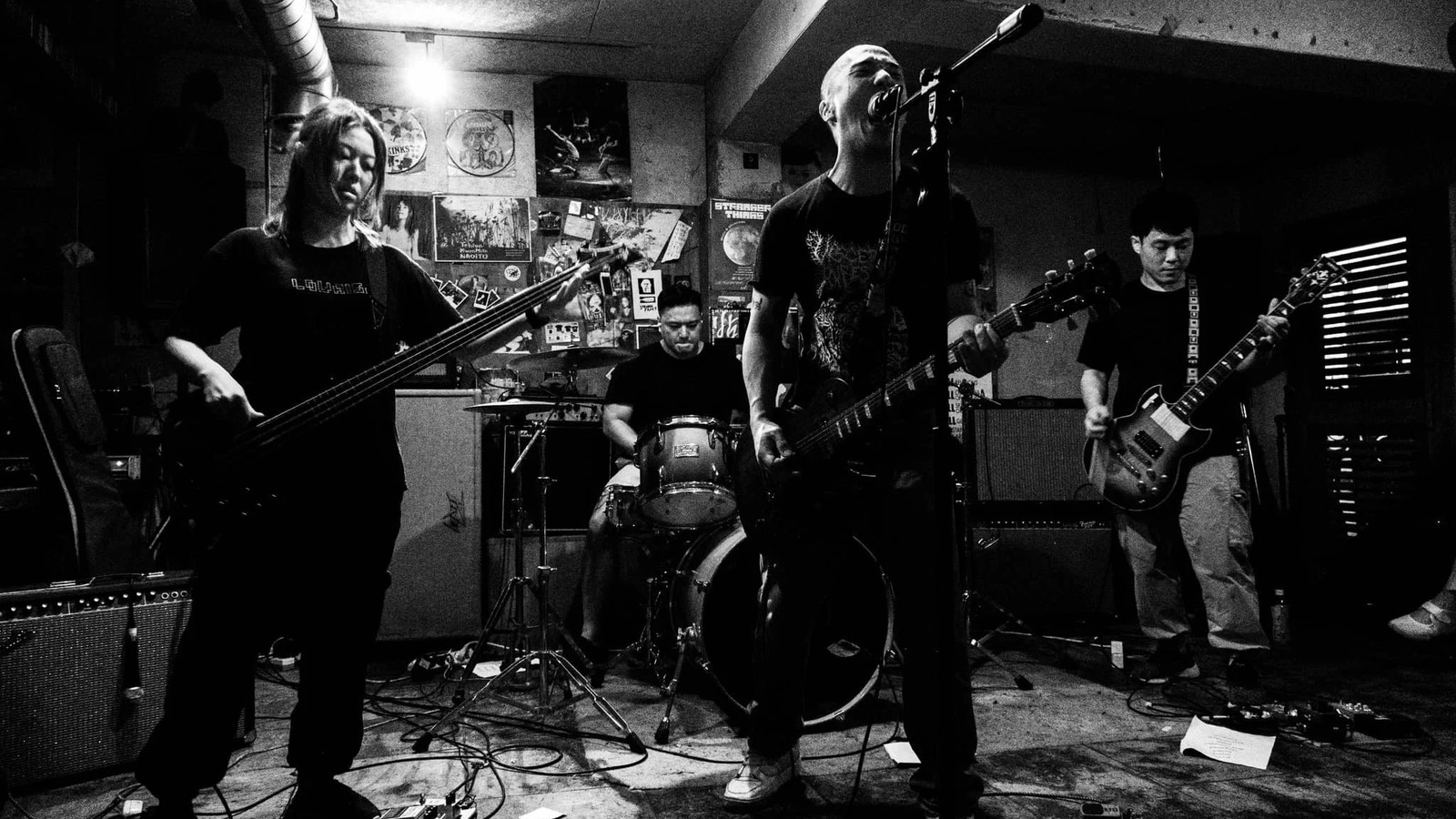
Four tracks of cassette tape were enough to hold it. When the Seoul band Leper Temple put its first recording online on 15 October 2018, five songs running a little under twenty-nine minutes from the seven-minute "Honey Piss" to "Acetone Breath", every note of it had been captured by Garrett Belair on a four-track cassette machine at a space called SHARP, which is to say that a whole record of Seoul doom fitted on the same machine a bedroom band uses for its first demo. Four tracks. No more were needed.
We begin with that number because it sets the scale honestly. Korean doom metal, as a body of recorded work, is not a movement with a founding decade and a canon behind it. It is a few bands already playing Seoul by 2018 or formed there by 2020, a few rehearsal rooms, a run of self-released records and, in time, small labels abroad willing to press them. A reader arriving from the band list, where the genre is read out across five decades, has to change the lens: here the history is counted in single years, and in the distance between a session and the day anyone outside the room could hear it.
The bassist and singer who founded Varim in 2020, Ju Hyeon Yoon, named the difficulty plainly when the webzine Doomed Nation put its Doomed Confessionary questionnaire to him on 18 February 2025. Seoul, he said, has a lot of metalcore musicians, as expected from a country that is "fast, fast"; musicians who play mid-tempo, long-winded music are hard to find, and doom metal and stoner rock musicians are harder still. The slow bands have had to find one another first.
In a country that values speed and efficiency (even music!), playing slow music was a big challenge.
Ju Hyeon Yoon of Varim, interviewed in Doomed Nation, 18 February 2025
Leper Temple and the first tapes
The slow bands of Seoul had already found one another by the week Leper Temple's tape went online. On 16 October 2018 the Korea Times listed Leper Temple and Gawthrop, both billed as doom metal bands, for Saturday 20 October at GBN Live House in Mullae-dong, the local end of a two-day tour built around the Japanese band Guevnna and the Chinese band Alpaca. The promoter, Dan Orozco, called the community very small and tight knit.
Moving from those four tracks of tape to a real studio inside a year, the band the Korea Times would bill as sludge and doom, Leper Temple, released Opulent Castigations on 6 October 2019, recorded by Kirk Martin and Jeff Moses at Thunderhorse Studios in Seoul and mixed and mastered by Martin, with Isaac Millar on vocals, Graham Parkinson on guitars and Jared Berg on drums, the only three players its credits name.
The running order tells its own story. "The Trudge" lasts eleven minutes and forty-seven seconds, close to twice the length of anything else on the record, and it sits fourth of five, a leaden sledge set across the middle of the album so that the whole thing has to haul itself over that one song before it is allowed to reach the end. Nothing on the record gets past it quickly.
Mullae-dong, 30 November 2019
Brought to GBN Live House in Mullae-dong, the district the Korea Times called Seoul's metal district when it previewed the show that week, by the promoter Lee Yuying, with advance tickets at 45,000 won, the New Orleans band Eyehategod played Korea for the first time on 30 November 2019, and beneath it on the bill stood three local names: Leper Temple, the young sludge trio Gawthrop, and the stoner and psychedelic blues band The Bong Cheon Dong.
For one night the line of descent ran straight across a single stage. The band that had dragged hardcore down to a crawl on Take as Needed for Pain in 1993 played after a Seoul trio that Echoes and Dust, reviewing its first album almost six years later, still introduced through that support slot. The two Seoul bands had shared a bill in the same room thirteen months earlier. This time they shared a poster with one of the founders of the music they play, in front of a crowd that had paid to hear the founders.
Varim: a rehearsal room that became a label
Founded in Seoul in 2020, amid the pandemic, by Yoon, and run through what the guitarist Christopher Bubp called a revolving door of members before it settled with Bubp on guitar and vocals, Barend Harris on drums and, a later arrival, Jose Kim on lead guitar, the multicultural quartet took the name Varim from an art term for colour gradation and shading, the vignette in which colours fade to black. Speaking to Jon Dunbar for a Korea Times feature published on 15 August 2023, Bubp defined doom in his own words as going back to the source, Black Sabbath and 1970s rock, and not trying to catch current trends, and remembered the band as something meaningful built during the pandemic that the government restrictions could not destroy.
After the Demo Live EP of 24 December 2020, the band's next release was a live one. Recorded at Suspicious Warehouse on 16 April 2022 and posted two days later, Live at Suspicious Warehouse carries four songs, "From Dust", "While We Burn", "Event Horizon" and the eight minutes of "Echoes", and it was followed by "Die Or", a song first released on that 2020 demo and issued as a single on 12 July 2023, with a release party at Club Bender near Hongik University on Saturday 19 August. Bubp told the Korea Times that the song is about choosing to put distance between yourself and toxic people.
Behind all of it stands one room. Doom Saloon, Yoon's rehearsal space and recording studio, had by 2023 also released music by GetBetter and by Pigeon Grinder, his other band, and it is where Varim made The Signpost, the three-song EP released through Doom Saloon Records on 22 August 2025, engineered there by Yoon, mixed by Bubp, mastered by Seung Hee Kang at Sonic Korea Mastering and sleeved in Harris's artwork, with "Delusion" set between the title song and "From Dust", which Doom Saloon Records had issued as a single, with a video, early in 2025. A band that owns its rehearsal room owns its clock, and Varim releases on that clock, song by song. In the Doomed Nation interview Yoon said he had finished demos for the next Varim album and wanted to see through the trilogy of albums he had envisioned.
A band that owns its rehearsal room owns its clock.
Gawthrop and the long road to Kuboa
Formed in Seoul in 2018, credited on its first label release as a trio of Hyunwoong on guitar, Sunggun Jang on bass and vocals and Owen on drums, and grown by the time of Kuboa into a quartet, with Jang moving to guitar and Minhwi taking the bass, Gawthrop spent its first years the way this music is usually spent, in small formats: a three-song demo in 2019, reissued with the bonus song "Irene" as a self-titled EP by the Irish label Cursed Monk Records on 31 January 2020, the split Far East Nihilism Front, where "Jimmy" first appeared, and the three-song Jumbo, recorded at Studio Cogason in June 2021 and released by Cursed Monk on 14 March 2022. Sentient Ruin collected the 2019 demo and Jumbo, on the LP Deterioration on 26 May 2023, and named Corrupted, Meth Drinker, Noothgrush, Hell, Grief and Thorr's Hammer as the weight the band carries forward.
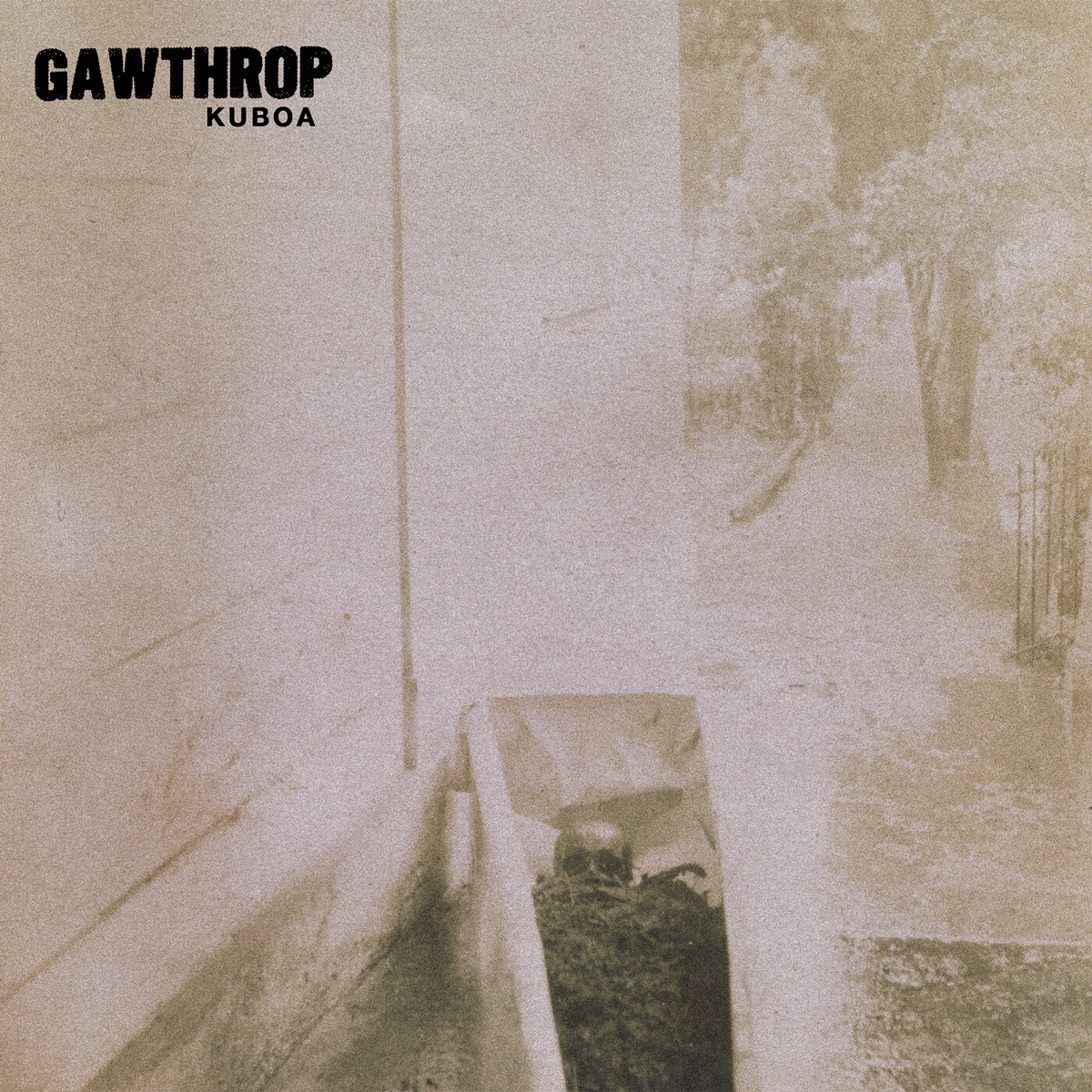
Written during the COVID lockdown, when, as the band told Toilet ov Hell in August 2025, the weekly practice sessions were one of the few things that still gave its members a sense of normality, recorded at Studio Cogason in Seoul in February 2022 and released by Sentient Ruin on 19 September 2025 on LP, CD, cassette and digital, Kuboa runs seven tracks in about thirty-six minutes, from "Bulbocapnine" through "Hogweed", "Granfalloon" and "Jumbo" to "In Heaven". The reviews agree on its weight. Emily Bellino, premiering "Jimmy" in Decibel on 9 September 2025, heard very heavy, downtuned and blown-out sludge that recalls Corrupted, Noothgrush and Meth Drinker; Toilet ov Hell set "Hogweed" beside Bongripper and the voice of Corrupted's Llenándose de gusanos; and Matt Butler of Echoes and Dust heard vocals rising from a pit far below the ground. On that reading the riffs are poured like tar into the lowest register and left there to set, and the drums follow them down as a dirge follows a coffin, one blow at a time.
| Released | Band | Release | Label or source |
|---|---|---|---|
| 15 October 2018 | Leper Temple | Leper Temple | Self-released, four-track cassette |
| 6 October 2019 | Leper Temple | Opulent Castigations | Self-released, Thunderhorse Studios |
| 31 January 2020 | Gawthrop | Gawthrop (EP) | Cursed Monk Records |
| 14 March 2022 | Gawthrop | Jumbo (demo) | Cursed Monk Records |
| 18 April 2022 | Varim | Live at Suspicious Warehouse | Self-released |
| 26 May 2023 | Gawthrop | Deterioration | Sentient Ruin Laboratories |
| 22 August 2025 | Varim | The Signpost (EP) | Doom Saloon Records |
| 19 September 2025 | Gawthrop | Kuboa | Sentient Ruin Laboratories |
Heat from beneath the floor
A traditional ondol floor is warmed by a fire lit in a firebox reached from an adjoining room, its smoke drawn by a chimney on the opposite outside wall through passages running under slabs of stone and a layer of clay, and the floor keeps its heat so well that the fire is usually put out before sleep and the room stays warm until morning. The slow music of Seoul has been heated the same way, from fireboxes in other rooms, Doom Saloon, Thunderhorse, Studio Cogason, rooms the listener never enters. The records hold that heat long after the sessions that lit them have gone cold.
The heat has begun to spread past the doom core and past Seoul. The Busan quartet baan, whose own Bandcamp page promises "Doom but not boring", released its second album, Neumann, on 15 May 2025; The Progressive Subway heard noisy, atmospheric sludge metal driven by fuzzed-out guitars, Korean Indie heard post-rock, shoegaze and noise. The record stands at the edge of this history, not at its centre.
No record in this story has yet entered the wider canon of doom, and none of these bands has asked to be measured that way. What they have laid down in eight years is a thin sediment of demos, EPs, a split, a live recording and two LPs on Sentient Ruin, enough to show that the slow riff took root in Seoul. Of the bands here, Gawthrop is the one whose record now stands in the same conversation as the New Sludge Metal Bands from Europe and America, with Kuboa reviewed in the same outlets and pressed by the same kind of label. The floor is warm. The fire is still being fed.
