
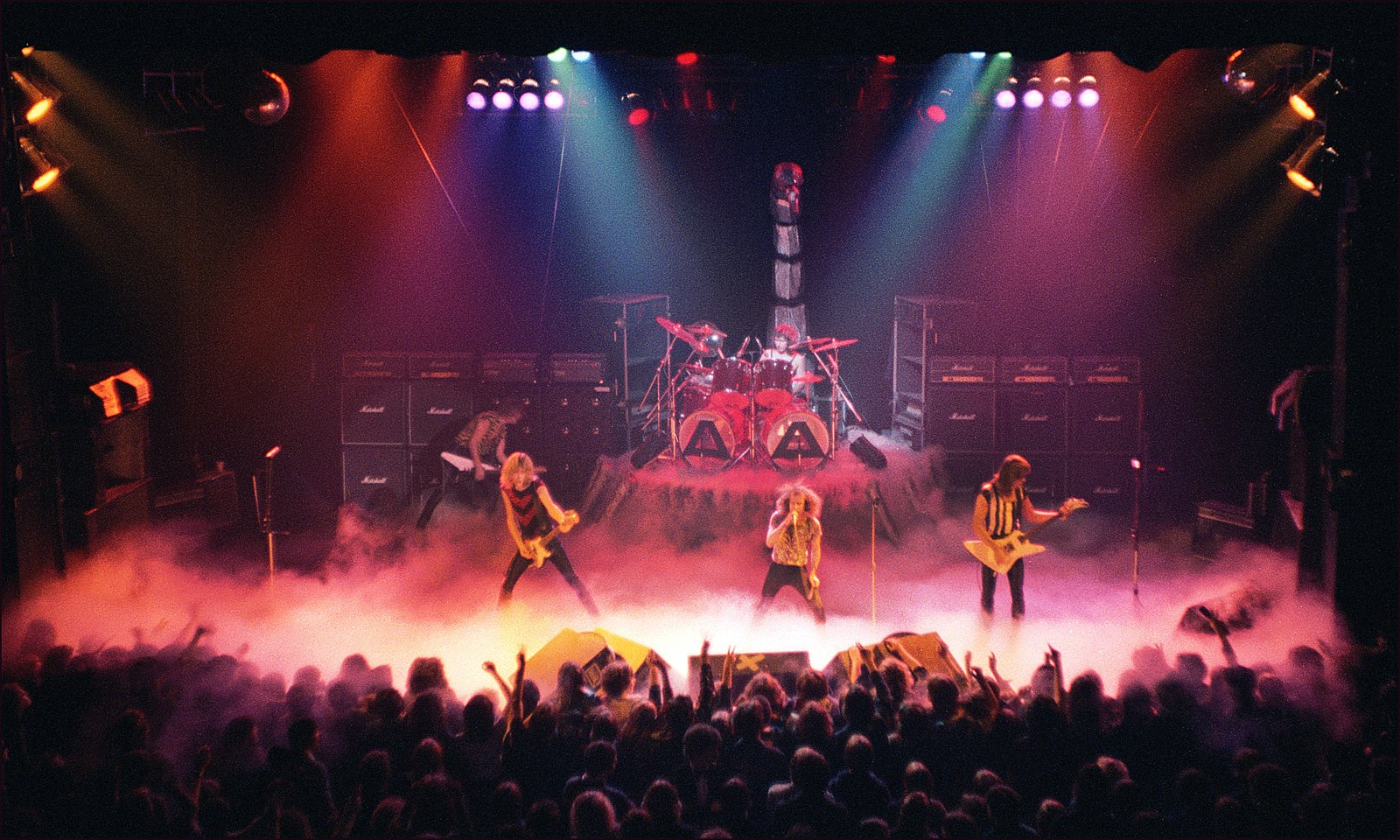
On Saturday 16 August 1980 a motor racing circuit in north west Leicestershire sold tickets to a crowd that had come for something with no engines in it. Booked as the closing British date of a Rainbow tour rather than as a festival with a life of its own, run on one stage with no camping, no second field and nothing to do between sets except wait in the sun, monsters of rock 1980 put seven bands in front of the Donington Park grandstands from the early afternoon until well after dark. The promoter who wanted one large outdoor payday at the end of a long campaign was Paul Loasby.
A hop garden stands eleven months of the year as almost nothing: chestnut poles, a grid of wire ten feet up, bare ground underneath that a stranger reads as a failed orchard. Then the pickers come in their hundreds, and for three weeks the field is a town with a kitchen, a foreman and a wage. The bines are cut through at the root with a hook, dragged down off the wires in one long tearing pull and stripped bare, and by the end of the month the poles carry nothing again.
Donington ran on that calendar for sixteen summers. The first of them set the shape of the rest.
The new wave of British heavy metal already had a weekly paper, a late night radio show, a pub disco with a chart of its own and several hundred seven-inch singles behind it, all of which are laid out in the full chapter. What it had never had until that August was a field. A field is the only place where a movement finds out how large it is.
What monsters of rock 1980 actually sold
No national radio station in Britain played this music during the day and no television programme carried it at all, so the ticket was sold exactly as the singles were sold: an advertisement in the weekly papers, a mention on Friday night, and several thousand conversations in record shops and school corridors. A ticket cost seven pounds fifty in advance. For that the buyer got seven bands and the better part of eight hours, three or four times the length of any indoor bill that year.
The logic of the bill was commercial and plain. A headliner with a hit single to protect, a British band at the top of its own year, a German band with an American contract to justify, a Canadian band to hold the middle of the afternoon, and, in the two earliest slots, American groups the British audience knew from imports and from reviews rather than from a stage. Every one of them had to play in daylight except the last two.

The guitarist whose tour this was, and who had put the whole afternoon on the calendar so that it would finish somewhere worth finishing, was Ritchie Blackmore. Rainbow had spent the year on Down to Earth, a record aimed squarely at the singles chart with Graham Bonnet in a short haircut and a plain shirt at the front of it, and the closing set leaned on that material rather than on the long pieces the band's older audience had come out of Deep Purple to hear. The reception was mixed and has stayed mixed. Nobody left early.
The bill, and the band the afternoon belonged to
| Band | From | Where they stood that summer |
|---|---|---|
| Rainbow | England | Headline; touring Down to Earth |
| Judas Priest | England | Second; British Steel released that April |
| Scorpions | West Germany | Touring Animal Magnetism |
| April Wine | Canada | Touring Harder... Faster |
| Saxon | England | Two albums inside eighteen months |
| Riot | United States | A British cult built on imported copies of Narita |
| Touch | United States | Opened the day on a debut album |
The Birmingham five who went on second, in the year British Steel put nine songs and two hit singles into every record shop in the country, were Judas Priest, and that second slot is still argued over, because a band with that much new material and that much leather, in daylight, either takes a field or hands it to somebody else. They took it. Rob Halford rode a Harley-Davidson onto the stage for the opening number, and Loasby was still calling Rainbow's closing set one of Donington's best headline performances decades later. The headliner closed the day and did not take it back.
The Yorkshire five who went on in the middle of the afternoon, with Wheels of Steel behind them and Strong Arm of the Law already recorded, were Saxon, and of everybody on that stage they were the only band the new wave could call entirely its own, its vanguard on a bill otherwise built from older acts and imports. What they did afterwards is the part that matters. They wrote the day down, put it out as a single, and watched a song about a crowd standing in a field become the biggest hit of their career.
A song about a crowd standing in a field became the biggest hit of their career.
The crowd nobody counted
The New York band that opened the afternoon proper, carried into Britain almost entirely by import shops and by the weekly papers, was Riot, and part of what it played at Donington that day survives on tape and has been issued since, which makes it one of the few sets from the first Monsters of Rock that anybody can now check against memory. Very little else from that stage was recorded. Most of what is written about the day is written from the floor.
The attendance is the clearest example. The figure in general use is around thirty five thousand, and it turns up in that form almost everywhere, but no ticketed gate count for 16 August 1980 has ever been published, the site had no fixed capacity for a music event, and the figures quoted afterward ranged as high as seventy thousand. The record shows a range rather than a total. What can be said flatly is that it was the largest single crowd this music had drawn in Britain outside a London arena.
What the day left standing
One stage and seven bands means short sets, no soundcheck worth the name for anybody below the top two, and a sound engineer working with a rig built for the headliner. The bands at the bottom of the bill were handed something under half an hour in full sun, in front of a crowd that had walked in an hour earlier and had nowhere to stand but on grass. That is the exchange the whole format rests on, and it has never changed: the small band trades conditions for a crowd fifty times the size of any room it could sell out on its own.
What the day proved to the record companies was cruder than anything a chart could have told them. Thirty thousand people had paid cash to stand in a Leicestershire field for a music no daytime broadcaster in the country would touch, which meant the audience existed, could be reached without radio and would travel. Within three years the same name was being put on fields in West Germany, and by the middle of the decade the summer, not the album, was setting the touring year.
The music those bands carried onto the grass had been built out of a very few moves, worked out in rehearsal rooms above pubs across the north and the Midlands between 1978 and 1980, and what those moves actually were is taken apart in the NWOBHM riff. On 16 August 1980 the wave found out that there were enough people to hear them.
By common consent the first Monsters of Rock was not the best day the festival ever had, and that judgement is fair. The bill was uneven, the headliner was in the middle of its most commercial phase, and two of the seven bands meant nothing at all to the British audience before they walked on. The verdict is that a festival built as an afterthought to a tour ended up outliving almost every band that played it, and gave a music with no access to the airwaves the one thing it could not buy: a place to be counted.
