
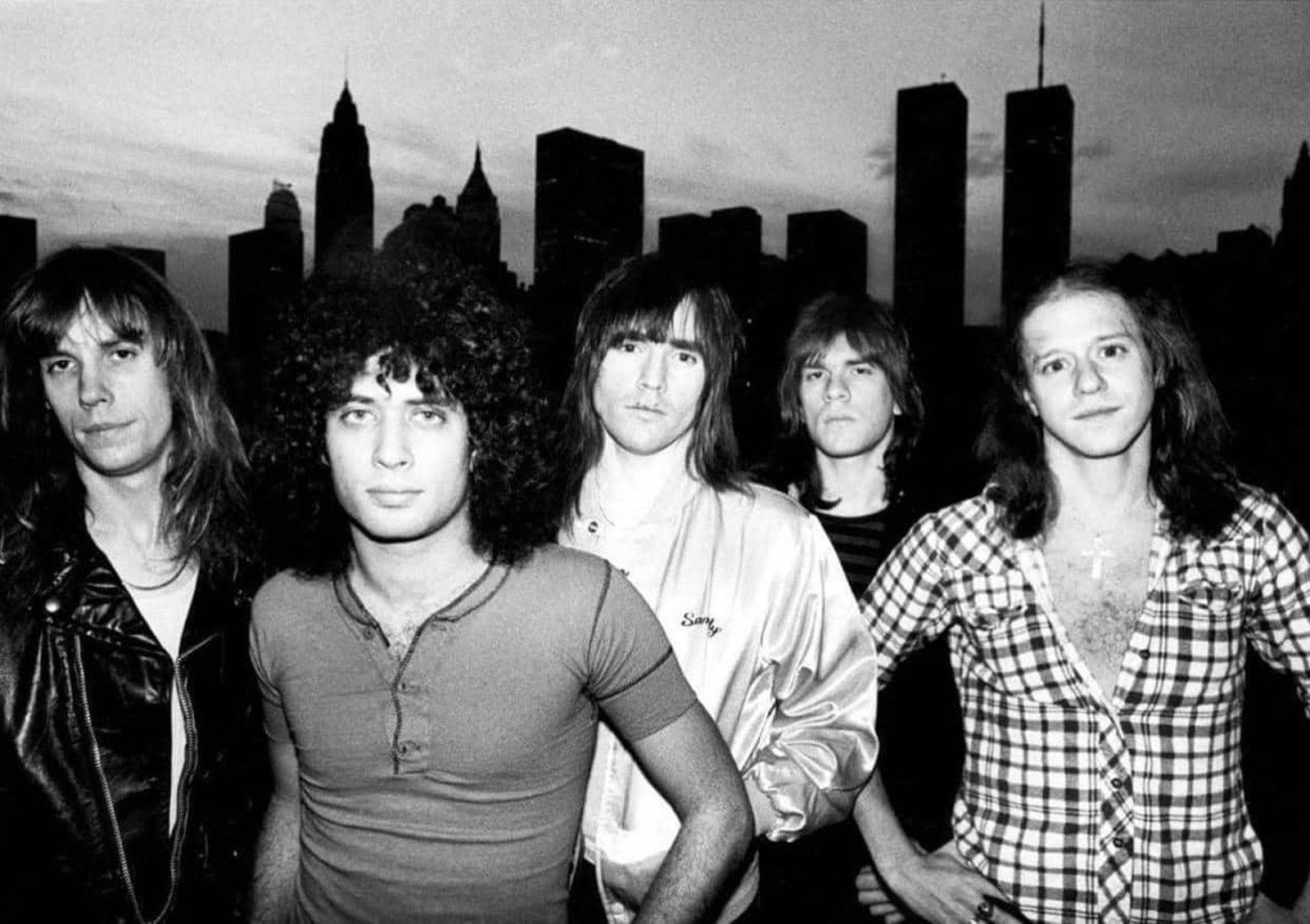
On 17 December 1982, in a television studio in Newcastle upon Tyne, five men from Long Island in smeared greasepaint and torn spandex played live on the Christmas heavy metal special of The Tube, the new Friday teatime music programme on Channel 4, and halfway through the set two guests walked out of the wings to tear into a Rolling Stones song with them. The Englishman who lent his name to five strangers that night was Lemmy, and the strangers were Twisted Sister. Atlantic Records, whose offices stood in Midtown Manhattan, a train ride from the bars where the band had played for ten years, signed them within months. It took a British camera to do it.
That is the whole of New York heavy metal in a single transaction: a scene the city itself could not see until somebody abroad pointed at it. Under the streets of Manhattan runs the largest commercial steam system in the world, more than a hundred miles of pipe carrying heat from riverside plants up into the towers, and the city notices it only where it breaks the surface. A white plume leaks from an orange and white chimney set over a manhole. The rest of it climbs the risers forty floors into Midtown and hammers at the radiators of offices whose tenants have never once seen the riverside plant that feeds them.
The music ran the same way, under the record companies in Midtown and the punk clubs on the Bowery, and it reached Midtown only as heat, from plants on the far banks that nobody in the offices ever went to see. Nobody in Manhattan put it there. Nobody in Manhattan could stop it either.
Where New York heavy metal actually lived
Every address the music needed sat outside Manhattan. L'Amour, the club in Bensonhurst, and the Zazulas' record stall at a New Jersey flea market already stand in the longer account of the world's scenes, and the geography is the point. The majors had their head offices in Midtown, CBGB had punk sewn up on the Bowery, and heavy metal was a music of the boroughs, the Long Island suburbs and the far bank of the Hudson.
The lineage goes back further than the eighties. The four who played their first shows at the end of January 1973 at the Popcorn Club in Sunnyside, renamed the Coventry soon after, before fewer than ten people, and who within three years had turned greasepaint into an arena franchise, were Kiss. Out on the North Shore of Long Island, around the campus at Stony Brook, Blue Öyster Cult had already shown that a band from the suburbs could write for Columbia without ever moving into the city. The suburbs were the vanguard. Manhattan was the market.
Every address the music needed sat outside Manhattan.
The next generation took the suburbs literally. Long Island and New Jersey ran a circuit of bars that hired bands by the night and paid them to play other people's songs, so a group could live for a decade on covers of Judas Priest and Led Zeppelin and never be asked for a record at all. It made the players hard and the songwriting slow. Twisted Sister spent the whole of the seventies on that circuit and wrote their own anthems in the gaps between the sets they were paid for.

Produced by Stuart Epps and released by Atlantic in 1983, You Can't Stop Rock 'n' Roll was the band's first record for an American company and still broke first in Britain, where "I Am (I'm Me)" climbed to number 18 on the singles chart. Ten years of Long Island bars had built a band that could hold any stage on earth. The city had watched none of it.
The title song is the bar circuit set to tape: a slow build, a chorus pitched so that a room of drinkers could shout it back after one hearing, and Dee Snider running the whole thing like a foreman who has done the same shift four hundred times and still refuses to let anybody sit down. Nothing in it is subtle. Nothing needed to be.
Upstate steel and a Bronx guitar
The bassist who spent 1980 working as a technician on Black Sabbath's Heaven and Hell tour, hauling somebody else's gear into somebody else's arenas night after night, was Joey DeMaio from Auburn, upstate, and on that tour he met a guitarist from a Bronx punk band called the Dictators, then playing in the support act Shakin' Street, Ross Friedman, Ross the Boss on every sleeve. The band the two of them founded that year answered to the name Manowar, with Eric Adams singing. A punk guitarist and a road crew man. Out of that came the most solemn creed in the music.
"Metal Daze", from the 1982 debut Battle Hymns, states the programme before the fur and the swords had fully arrived: a mid-paced stomp with more seventies hard rock in it than epic, and a chorus that chants the music's own name back at it until the room joins in. The hard rock never left the guitar. It simply put on armour.
What tied Manowar to the city was the label. Released by Megaforce in America on 1 July 1983 and by Music for Nations in London, Into Glory Ride came out through the company the Zazulas had grown out of their flea market stall, which that same month pressed the debut of a young Californian band, and the two sides of the Atlantic that would take a record about warriors and their gods were a New Jersey market hall and a London independent. No Midtown office would touch it.
Queens, Brooklyn and the open hydrant
On a July afternoon somewhere in the boroughs, somebody takes a spanner to a fire hydrant, wrenches the nut round until the cap bursts off, and within a minute the whole block, the kids from both ends of the street who never speak to each other, is standing under the same freezing torrent. The hardcore matinees of the middle eighties did that to New York's punks and metalheads. They were never meant to share a floor. The water did not ask.
The Queens band formed in Bayside in 1981 around a rhythm guitarist and a bassist was Anthrax, its founders Scott Ian and Dan Lilker, and Fistful of Metal, released by Megaforce in January 1984, is still a heavy metal record in the plainest sense, Neil Turbin's high screams laid over riffs that gallop more than they thrash. Within a few years the band had pulled on the shorts and was heading straight for thrash. From there the story is another music.
The Brooklyn trio built out of the wreck of an earlier local band, Fallout, playing a slow doom crawl and a hardcore sprint inside the same song, was Carnivore, with Peter Steele out front on bass. Its debut came out in November 1985 and Retaliation followed on Roadrunner in September 1987, with a new guitarist and the same pitch-black humour. The songs slam a crawl into a sprint and back again without a bar of warning.
Overkill in Old Bridge, Nuclear Assault, which Lilker formed after leaving Anthrax, and the whole crossover wing led the same crowd toward thrash, and that road runs out of heavy metal altogether. What stayed in the older tradition went quiet in the boroughs and loud everywhere else. Riot kept releasing records into Japan and Europe, Manowar played to fields in Germany, and New York's own clubs filled up with the faster bands.
What New York left standing
New York never produced one sound, and anyone looking for a single riff that means the city will not find it. It produced a shared condition: bands raised in the bars and clubs of the outer boroughs, turned away by the companies in Midtown and signed by someone in London, a New Jersey market or a Tokyo office, and every one of them came out harder for the refusal. Twisted Sister got the anthem, Manowar the sermon, Anthrax the pit and Carnivore the joke nobody laughed at.
The last of those turned into something else. Carnivore came apart after Retaliation, and the band Peter Steele formed next with childhood friends went through two other names before it settled on Type O Negative, whose slow, gothic records took the Brooklyn sense of humour and the Sabbath crawl into a decade that had no other use for either. The line from the Coventry to that band runs through nearly two decades and never once through a Manhattan office.
The trade was always the same. New York's bands had every stage they wanted and waited years for a label; the bands in Beirut, Istanbul and Tehran had the opposite shortage, and the story of heavy metal in the Middle East is the story of records made at home for listeners who could not see them play. Rooms without records, records without rooms. Between them sits most of the map.
