
"This must be the wood," she said thoughtfully to herself, "where things have no names."Lewis Carroll, Through the Looking-Glass (1871)
Filed at Metal Review on 21 October 2003 with a score of 6.9, written about a five-song EP that a brand new label founded by the singer of The Red Chord had just pressed, and reduced to pointing at The Red Chord, Animosity and Forever Is Forgotten because he had no single word for a barrage of frenetic blast beats slamming headfirst into breakdowns heavy enough to buckle a floor, all of it under a death metal voice, the critic who called the whole lot "chaotic, hardcore based grind" was Erik Thomas, and the band on the disc was Deadwater Drowning.
He had every part. He did not have the word.
Nobody did, not yet. Between 1998 and 2003 a handful of bands in Texas, North Carolina, the Bay Area, New England and Montreal cut records that dragged death metal riffing onto a hardcore floor, sold them off folding tables at shows where half the room had paid to see the other band, and watched the shops rack them under metalcore, grind, Christian metal or nowhere at all. Those discs are the proto deathcore records. Taken one at a time, as recordings rather than as careers, each of them carried one working device out into the world, and the line running out of each one either snapped or held.
Picture the steel toolbox that lives at the side of the stage in every all-ages hall on the circuit, a dented red chest with its drawers rusted half shut, and picture each of those bands slinging one tool into it on the way out the back door, a sledge with tape wound round the handle it split on a stage riser, a bolt cutter with one arm bent, a hacksaw on its last blade, a pipe wrench with somebody's initials gouged into the jaw, every one worn to the shape of a single job, the blast that tips into the drop, the grind that stops dead for a breakdown, the lead guitar running over the chug, and not one of them labelled, so that the band that kicked the drawers open in 2005 found everything it needed to gut a room down to the concrete already in there, chipped and rusted and waiting.
How the two scenes behind these records found each other at all, the Long Island slow part, the Syracuse breakdown and the Orange County boom, is the history it belongs to. The records are the evidence, and the evidence is louder than the argument.
1998: the death metal band that tuned up
Start in Texas, where the story runs backwards. Reviewed by Doug Van Pelt in the September and October 1998 issue of HM, the Christian hard music magazine, and again by Chris King at The Phantom Tollbooth on 17 February 1999, the record both critics expected to win over the metal side and the hardcore side of the fence at once was Embrace the Eternal by Embodyment, and King caught the detail that every later argument skips: the guitars were tuned higher than on the band's demos, and the deep death metal growl had been thrown out for a harsh, throaty hardcore voice.
The earliest record in this set tuned up.
Van Pelt came at it from a different angle. He passed on a crack doing the rounds about the band, that it burned through nearly an album's worth of riffs inside a single song, and he admitted it was close to the truth: a riff, a time change, a different groove, another, with the occasional slow and beefy riff dropped in among them. Played like that, the riffs go into a song the way scrap lumber goes into a burn barrel behind a church hall after a show, an armful at a time, each board flaring up and caving into the coals before the next one lands, until the slow part comes down on the barrel like a boot stamping the lid shut and the whole drum rings.
Two of the ten tracks came over from the demo and were re-recorded in the new tuning and the new voice, "Religious Infamy" and "Golgotha", and King, who missed the death metal band of the demos, still called those two probably the best songs on the disc. That makes "Golgotha", seventh in the running order and the longest track at five and a half minutes, the plainest document of the crossing on tape: a death metal song written one way and played back the other. King's own label for what came out was brutal metallic modern hardcore.
The device it carried was exactly that: death metal riffing chopped into short lengths and dropped under a voice from the hardcore side. The line snapped on the band's own next record. The Narrow Scope of Things came out in 2000 with a different singer and a lighter sound, and the parts Arlington had put together stayed on a Christian label's shelf, left there by the band that made them.
1999: a lead guitar over the chug
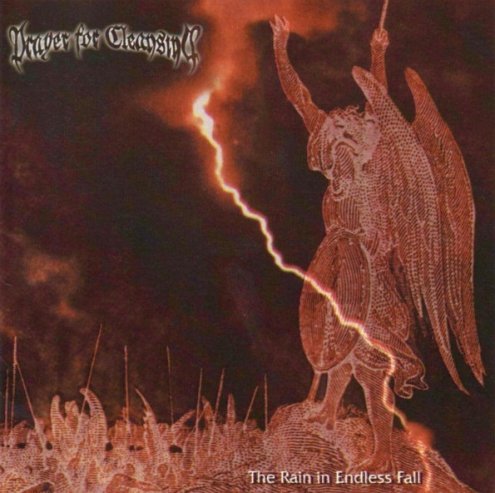
Tracked from February through May 1999 at the Grooveworks studio with Ian Schreier recording and mixing, released that year as the very first record on a new label called Tribunal, and finished in under thirty-eight minutes, the debut that hung melodic death metal leads and black metal riffing over chugs straight out of Slayer was The Rain in Endless Fall by Prayer for Cleansing. Two Metal Archives reviewers, one writing in June 2018 and one in November 2024, describe the same machine from opposite ends of their opinion of it. A salvo of fast riffing in the Gothenburg manner on top. A chugging breakdown underneath. Then the riff again.
"Sonnet", fifth on the disc, is the song the kids of 1999 lost their minds over, by the memory of the reviewer who liked the record least, and it opens on the kind of rangy guitar figure that, in his words, every metalcore guitarist of that year wanted to be able to play, before it dives into breakdowns on the open strings. Heard that way the lead runs over the chug like the ceiling fan in a rented hall on a July afternoon, blades blurring up near the plaster while the joists under the floor take every stamped beat, until one breakdown heavier than the rest jolts the fan off its bracket and leaves it swinging on its wires, still turning.
That is the device: a melodic lead kept alive on top of a hardcore breakdown instead of taking turns with it. The 2024 reviewer heard a couple of passages in "A Dead Soul Born" lean further still, toward something close to a slam.
The line held, but it ran sideways. The band split in 2000, Paul Waggoner, Will Goodyear and Tommy Rogers ended up in Between the Buried and Me, and the lead-over-chug idea went on into melodic metalcore and, in the 2024 reviewer's reckoning, into the melodic end of deathcore. The record itself has had more lives than the band: a remix and remaster on Tribunal in 2003 and a limited vinyl pressing on Seventh Dagger in 2004. Back in March 1999, Eighteen Visions released Yesterday Is Time Killed on Cedargate, and that Orange County line turned the same way faster, toward the sung chorus.
2001 to 2003: the Bay Area cuts it short
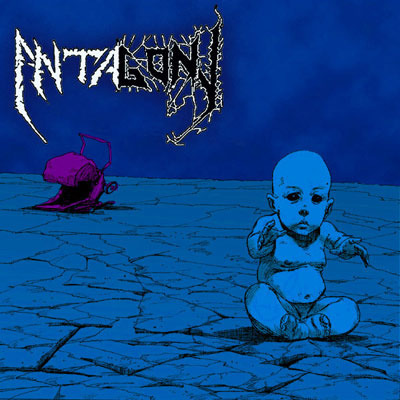
Pressed by the band itself in 2001, with Nick Vasallo and Ben Orum both on guitar and vocals, Carlos Saldana on bass and Justin Hughes on drums, the record whose track list threads a sequence numbered one to five between its stand-alone songs, from "I. Birth / A Killing" at the top to "IV. Undo This World V. Peace of Mind" at the bottom, is See Through These Eyes by Antagony. Metal Archives files the band's early years under grindcore, and the one review that No Clean Singing found still standing in January 2013, a grindgore.net write-up, heard death-grind and hardcore diversity, very high screams twisted around deep guttural roars, and involved song structures. "Useless Fake", the second song, is gone in fifty-six seconds.
The numbered titles keep coming back between the songs like the same kid at a Saturday matinee hauled out the side door by the bouncer five times in one afternoon, climbing back in through the bathroom window every time with a fresh bruise and his shirt torn wider, so that a disc of short grind blasts keeps getting hauled back to the numbering, whatever the songs around it are doing.
The earliest record in this set tuned up.
Its device is the scream and the roar traded inside songs cut to grind length, and its line held without a break, though it held through a person rather than through the disc. Orum had sung and played guitar in the band from the start, in 2002 he co-founded All Shall Perish, and the lineage ran on from there into the records the next wave actually heard.
Elsewhere in the Bay Area a band of teenagers took a different piece. Released by Tribunal in 2003, recorded by Zach Ohren and done in twenty-two minutes over ten songs, the debut that Scott Alisoglu of Blabbermouth later described as a death metal base crossed with thrash and hardcore, with nothing tuneful in it beyond the odd harmony and a Slayer-style lick, was Shut It Down by Animosity. Its device was brevity: death metal riffing delivered at hardcore length, ten tracks and not one of them past three minutes.
That line broke toward the other parent. By Empires on Black Market Activities in 2005, in Alisoglu's reading, the band had gone much further into death metal, with the hardcore left over as brief breakdowns and the occasional gang shout.
New England and Montreal: the blast that runs into the floor
Cut with Andrew Schneider over the turn of December 2001 and released by Robotic Empire on 19 March 2002, the nine-song debut that a Punknews.org reviewer heard in March 2004 as death metal, hardcore and grind at once, with circus-like riffs, a singer and a guitarist ranging between them from high screech to low growl, and breakdowns that left him breathless, was Fused Together in Revolving Doors by The Red Chord. Its device was grind that makes room for the breakdown, the hardcore stop dropped into a blast-speed song.
That line ran toward mathcore. Up in Montreal the same pull took Breathing Is Irrelevant by Ion Dissonance, out on Willowtip on 2 September 2003, into dissonance, and that line broke away into mathcore for good. The Red Chord's singer had another job that mattered to deathcore more directly. Black Market Activities, the label Guy Kozowyk started, put out the Deadwater Drowning EP that Erik Thomas could not name.
"Sleepwalking With a Knife" opens it, and Thomas heard five minutes of tech-heavy staccato blast beats, a hint of metalcore melody and a huge breakdown, with the rest of the five songs following the same plan. The melody stays on a short chain, like the guard dog at the towing yard next door to a venue, allowed one lunge at the fence when the van pulls in, the chain-link bowing and the post jumping in its concrete, before the breakdown comes down on the whole lot. He picked "Getting Sentimental on That Ass" for the best breakdowns of the five.
On paper, blast beat, breakdown, death metal voice and a melody kept on a chain, it is the closest any of these discs comes to the parts list of 2005. The band was gone by 2004, before most people had heard the EP. The line held anyway, through its players, who scattered into a handful of bands that hauled the same parts into the MySpace years with an unsparing appetite for the breakdown.
Where proto deathcore ends
The edge of the proto deathcore period is a date: 5 April 2005, when Century Media put out The Healing Process by Despised Icon and the parts stopped being loose. A record made after that day was made by somebody who could hear the template. Through the Eyes of the Dead released Bloodlust on Prosthetic in 2005, and the record, which a Lambgoat reviewer that December called metalcore that leans on the metal side, sits on the far side of that line.
| Record | Year | Label | The device | The line |
|---|---|---|---|---|
| Embodyment, Embrace the Eternal | 1998 | Solid State | Death metal riffs cut short under a hardcore voice | Snapped on the band's next album, 2000 |
| Prayer for Cleansing, The Rain in Endless Fall | 1999 | Tribunal | A melodic lead running over the chug | Ran sideways into melodic metalcore and progressive metal |
| Antagony, See Through These Eyes | 2001 | Self-released | High scream and low roar in grind-length songs | Held, through Ben Orum to All Shall Perish |
| The Red Chord, Fused Together in Revolving Doors | 2002 | Robotic Empire | The grind blast that stops dead for a breakdown | Ran toward mathcore |
| Animosity, Shut It Down | 2003 | Tribunal | Death metal riffing at hardcore length | Turned to death metal on Empires, 2005 |
| Ion Dissonance, Breathing Is Irrelevant | 2003 | Willowtip | Blast and breakdown pushed into dissonance | Broke away into mathcore |
| Deadwater Drowning, Deadwater Drowning EP | 2003 | Black Market Activities | Blasts into breakdowns under a death metal voice | Band gone by 2004; held through its players |
Set side by side, the seven lines make the pattern plain. Five of them broke or wandered off into a neighbouring genre, and the ones that held, held through people who changed bands rather than through records that sold. Year by year, the dates on either side of 2005 are set out in a deathcore timeline, from these discs to the arena tours.
What came after the line is the part everybody knows: Job for a Cowboy, Suicide Silence, Whitechapel, three guitars, a profile page and a pit that never closed. The arc that runs from a Texas death metal band tuning up to festival main stages is the genre in full.
The narrower point is the one these seven discs make by themselves. Deathcore was not invented once. Its devices were built separately, in Texas, North Carolina, California, New England and Quebec, by bands that mostly never crossed paths, and the bands of 2005 used them because they worked. Nobody had to name a device for it to work.

