
'So careful of the type?' but no. From scarped cliff and quarried stone she cries, 'a thousand types are gone: I care for nothing, all shall go.'Alfred Tennyson, In Memoriam A. H. H., 1850
Nobody who made the records in this article called them doom. The word did not name a style of metal until the middle of the 1980s, and proto doom metal is a label applied afterwards, by collectors and by later bands searching for their ancestry. We use it strictly: a record earns its place here because it carried weight, dread or a dragged tempo that doom later took up, not merely because it was loud. That is why Blue Cheer, the San Francisco trio whose Vincebus Eruptum flattened Eddie Cochran's "Summertime Blues" on its way to number eleven on the Billboard 200 in 1968, stands at the edge of this story rather than at its centre. The volume is ancestral. The tempo is not.
The way to read these records is the way a quarryman reads the shapes his saw has opened in a fresh face of limestone: the curve of a jaw, a run of vertebrae, the coil of a shell, pressed into the rock by creatures that fed and fought and died long before anyone arrived with a Latin name to pin on them. Unnamed, the animal was no less an animal, and the absence of a word in 1971 changes nothing about the bone. The reference fossil, the one every other shape in the wall is measured against, is the debut of Black Sabbath, released by Vertigo on 13 February 1970 with its funereal title song. The Aston quartet's own story belongs to the chapter on Birmingham and what followed; here it stays the measuring rod and not the subject.
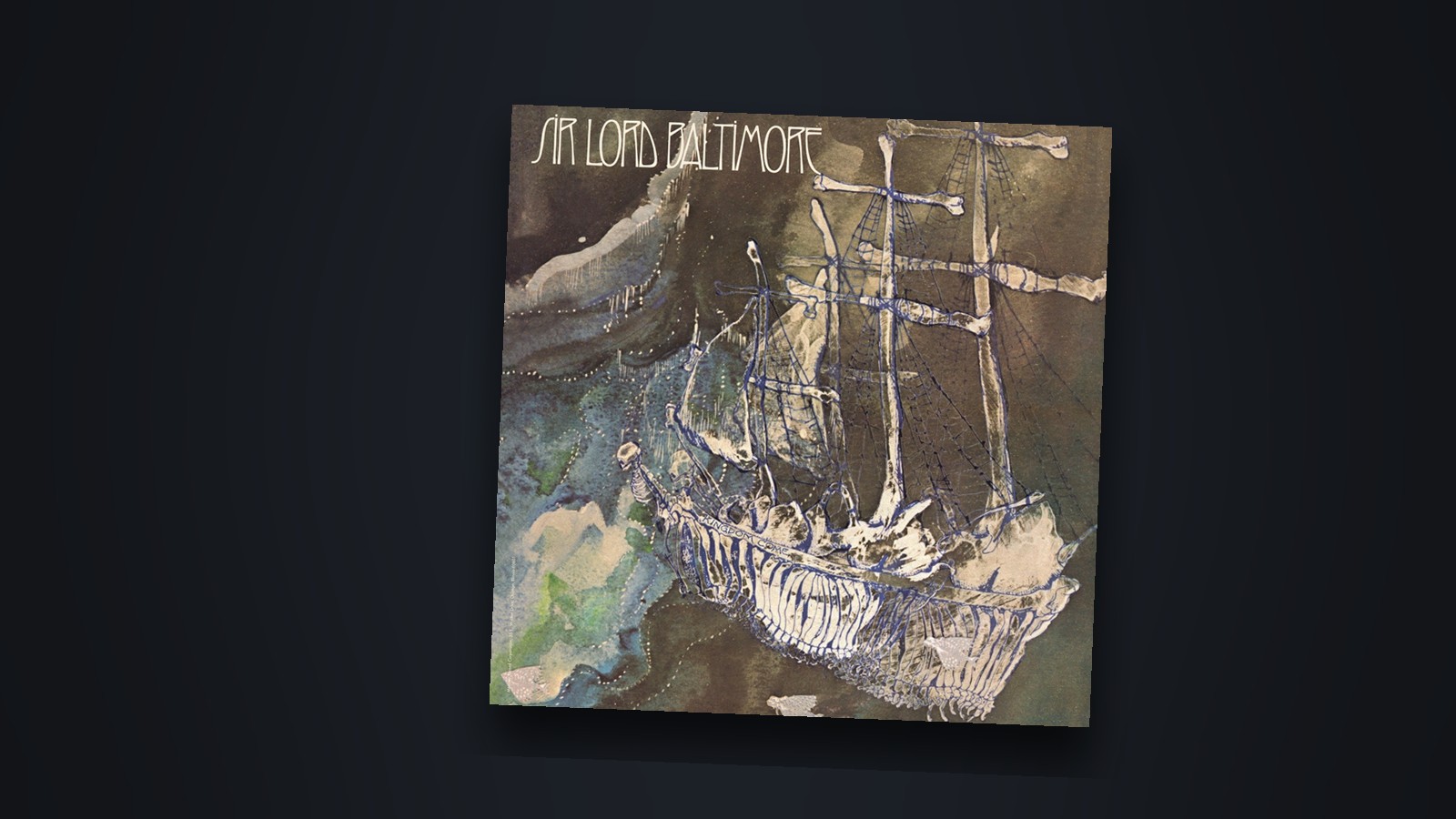
Sir Lord Baltimore and Kingdom Come
Formed in Brooklyn in 1968 around a drummer who also sang, with Louis Dambra on guitar and Gary Justin on bass, the trio whose first album gave an American rock monthly one of its earliest occasions to use heavy metal as the name of a style, Sir Lord Baltimore, recorded Kingdom Come at Vantone Studios in New Jersey, with Mike Appel and Jim Cretecos producing, before Eddie Kramer mixed it at Electric Lady in New York. Mercury released it in December 1970. In 1971 it reached number 198 on the Billboard 200, two places above the floor of the American album chart.
Its ten songs run from "Master Heartache" to "Ain't Got Hung on You", and the title track, at six and a half minutes, is the longest of them. It is not a slow album. Reviewing it in Creem in May 1971, Mike Saunders wrote that the band "seems to have down pat most all the best heavy metal tricks in the book". The tricks are on the tape: distortion on the guitar and in places on the bass, and guitar parts stacked by multi-tracking. The drummer's position alone says what kind of band this was: a singer bawling his lines from behind his own kit, like a man shouting orders from inside a demolition he is also operating, every fill he struck knocking the floor out from under the vocal he was trying to deliver. That is why the trio counts. The heavy apparatus was assembled and running before anyone had agreed what the machine was for.
Unnamed, the animal was no less an animal.
On 19 and 20 February 1971 the band opened two nights at the Fillmore East in New York on a bill with the J. Geils Band and Black Sabbath. It did not survive its sales figures. After a second album, Sir Lord Baltimore, made in 1971 with a second guitarist added, Mercury dropped the band, and its members later named drugs, poor sales and unpaid royalties among the reasons it came apart. The singing drummer died of liver failure on 5 December 2015, aged 63; Louis Dambra died in 2019.
Shelved by Capitol, sold for a fortune: Bang and Leaf Hound
Formed in Philadelphia in 1969 by the bassist and singer Frank Ferrara, the guitarist Frank Gilcken and the drummer Tony Diorio, the trio called Bang recorded its intended debut in 1971, a concept record called Death of a Country with songs such as "No Trespassing" and "Life on Ending", and Capitol buried it, judging a heavy concept album no commercial way to introduce a new band. It stayed in the vault until reissue labels dug it out, the English label Rise Above among them, and its title song alone runs past ten minutes. A band's first statement, finished and then sunk out of sight for more than three decades like an animal caught in a tar pit, every bone held in place by the very thing that swallowed it, is the purest case of proto doom we know of.
What Capitol released instead, in February 1972, was Bang, with "Lions, Christians", "Future Shock" and "Questions", the last of which reached number 90 on the Billboard Hot 100 while the album stalled at 164. The trio is filed today among doom's forerunners for its early debt to Black Sabbath.
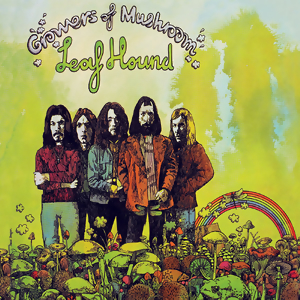
Assembled in 1970 from the remains of the blues band Black Cat Bones, with Peter French singing and Mick Halls on lead guitar, Leaf Hound recorded its album in a single eleven-hour session at Spot Studios in Mayfair late in 1970. Telefunken issued a seven-song version first, in West Germany and under the band's name, and Decca released all nine songs in Britain in October 1971 as Growers of Mushroom, by which time the band had broken up and Decca took the group for Americans. The record sank without trace, "Freelance Fiend" and "Stagnant Pool" with it.
Alexandria, Virginia: Pentagram and Bedemon
Formed in 1971 by the singer Bobby Liebling and the drummer Geof O'Keefe, the band from Alexandria, Virginia, that tried Macabre, Virgin Death and Wicked Angel as names between 1972 and 1974 and landed no record contract in that decade, Pentagram, put nothing on sale in the 1970s but a handful of singles on small labels, from "Be Forewarned", credited to Macabre on Intermedia in 1972, to "Livin' in a Ram's Head" on High Voltage in 1979. The rest waited until Relapse issued First Daze Here in 2001, and why the band waited so long is the subject of our article on pentagram.
Out of the same circle, around 1973, came something slower. Put together to record the songs of the guitarist Randy Palmer, with his friend Mike Matthews and the two Pentagram founders Liebling and O'Keefe, the side project whose name was welded out of two rejected ones, Demon and Behemoth, Bedemon, cut "Child of Darkness", "Serpent Venom" and "Frozen Fear" at its first session and came back together in 1979 to record three more songs. The Italian label Black Widow gathered the tapes as Child of Darkness in 2005, three years after Palmer died of injuries from a road accident. Of every recording in this article, these are the ones in which the shape pressed into the stone is most plainly the shape doom would take.
Far from Birmingham: Houston, Hamburg, Sydney and Tokyo
Pressed in 1970 by the small label Hookah, Dead Man by the Houston band Josefus closes on a title track of about seventeen and a half minutes, nearly a whole side of vinyl surrendered to a single song, and in March 2007 Classic Rock placed the band among the lost pioneers of heavy metal. In Hamburg in 1970 the British singer John Lawton and four former members of The German Bonds formed Lucifer's Friend, whose debut Philips released in January 1971 with "Ride the Sky" and "Toxic Shadows"; its heavy sound and dark lyrics keep it on lists of doom's forerunners, although by Banquet in 1974 the same musicians were playing orchestral jazz fusion. Captain Beyond, with the former Deep Purple singer Rod Evans, released its debut on Capricorn in July 1972, its "Raging River of Fear" a heavy cousin of the lineage rather than a member of it.
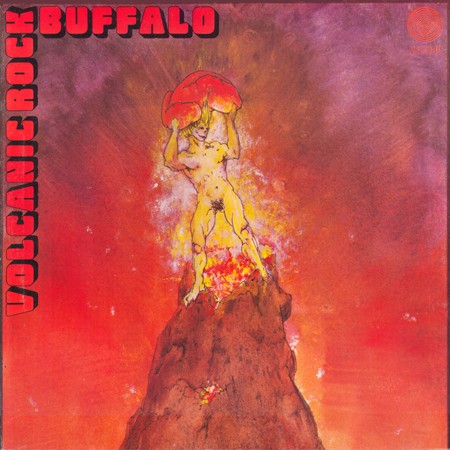
Formed in Sydney in August 1971 by the singer Dave Tice, the guitarist John Baxter, the bassist Peter Wells and the drummer Paul Balbi, with Alan Milano as a second singer, the Australian quintet called Buffalo released Dead Forever... on Vertigo in June 1972 and followed it in 1973 with Volcanic Rock, produced by Spencer Lee, from "Sunrise (Come My Way)" to "Shylock". AllMusic's Eduardo Rivadavia wrote that it was "about as raw as heavy metal got in the early 1970s", and the historian Ian McFarlane heard dense, occult riffing married to progressive blues chops. Of the records made outside Britain and America, it sits nearest to what doom became.
Released by Atlantic in Japan on 5 April 1971, Satori by Flower Travellin' Band, the quartet around the singer Joe Yamanaka and the guitarist Hideki Ishima, is five long movements under a single title. Julian Cope put it first among the fifty albums in his 2007 book Japrocksampler, and Sputnikmusic heard in it a formidable and ominous sound that would become the essence of doom metal.
| Year | Band | Record | Label |
|---|---|---|---|
| 1968 | Blue Cheer | Vincebus Eruptum | Philips |
| 1970 | Josefus | Dead Man | Hookah |
| 1970 | Sir Lord Baltimore | Kingdom Come | Mercury |
| 1971 | Lucifer's Friend | Lucifer's Friend | Philips |
| 1971 | Flower Travellin' Band | Satori | Atlantic Japan |
| 1971 | Bang | Death of a Country, issued decades later | Capitol, shelved; Rise Above |
| 1971 | Leaf Hound | Growers of Mushroom | Decca |
| 1972 | Pentagram, as Macabre | "Be Forewarned" single | Intermedia |
| 1972 | Captain Beyond | Captain Beyond | Capricorn |
| 1973 | Buffalo | Volcanic Rock | Vertigo |
| 1973 | Bedemon | First session tapes, issued 2005 | Black Widow |
What the quarry gives back
Most of the records in that table reached their present listeners through a reissue, and the reissues came from specialist labels: Relapse for Pentagram, Rise Above for Bang, Black Widow for Bedemon, Aztec for Buffalo, Repertoire for Leaf Hound. Rise Above was started in 1988 by Lee Dorrian, who went on to sing in Cathedral, so part of the excavation was carried out by the descendants themselves. That is the honest meaning of proto doom: a set of shapes that became legible only once there was a living animal to compare them with. Measured against the Black Sabbath debut, the strongest claims belong to the Bedemon tapes, the shelved Bang album and Volcanic Rock, with Kingdom Come beside them for its volume and for the name it helped fix, not for its tempo. What happened once the word arrived is told in KaosMetal's history of doom.
