
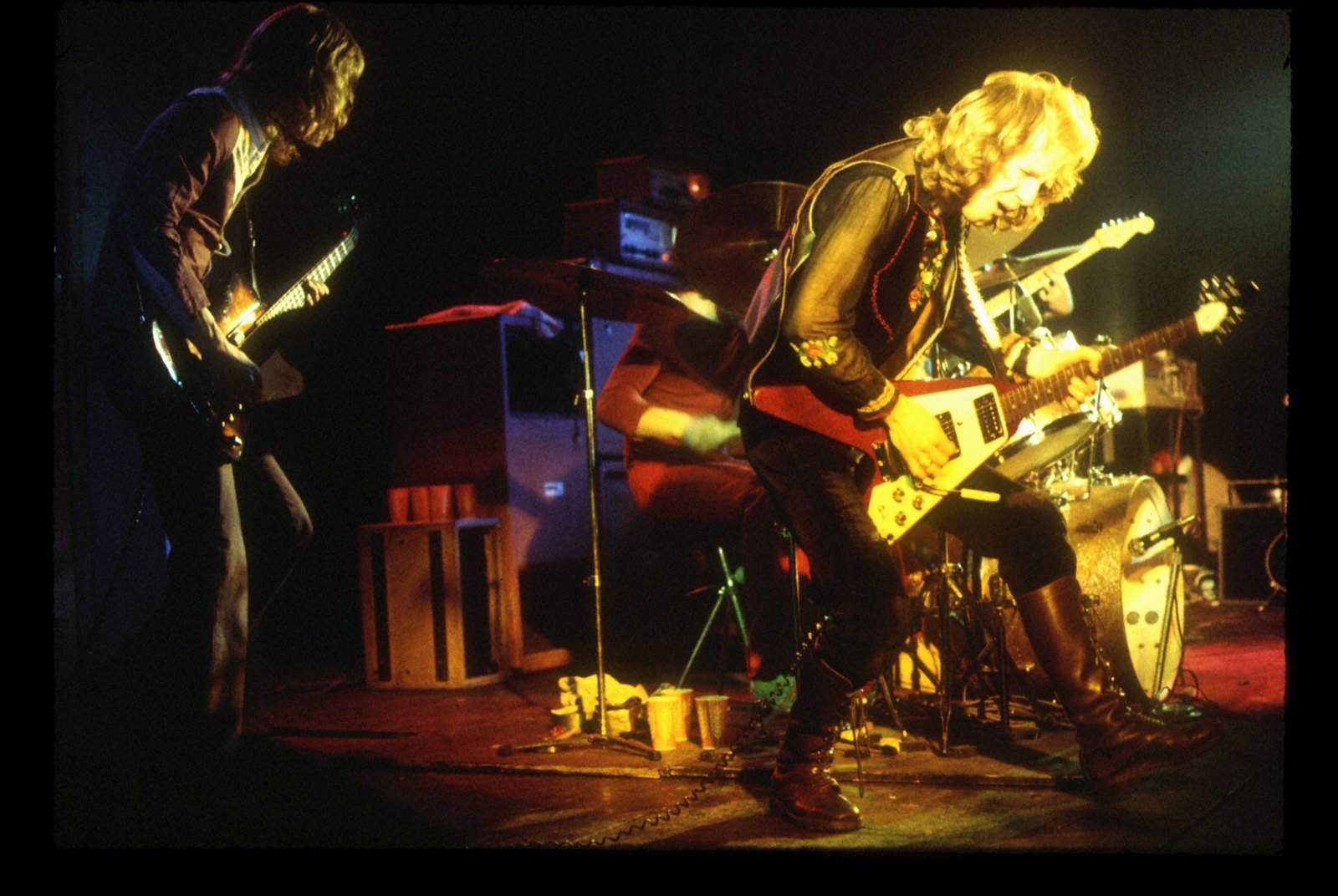
On 24 September 1969 a hard rock band walked onto the platform of the Royal Albert Hall to find the Royal Philharmonic Orchestra already seated behind it, Malcolm Arnold raised the stick, and for three movements a string section and a wall of amplifiers were set against each other inside the same bars of a concerto the band's own organist had written for the night. The man who had spent that year scoring for an orchestra he could not sit in was Jon Lord, and the band was Deep Purple.
Nothing followed from it. The parts went back into their folders, the score was lost the following year, and two decades passed before anyone in metal built an album on the same idea. That is the shape of proto power metal: one part supplied early, by people with no interest in what it would be bolted to, and left lying where it fell.
A genre assembled that way arrives the way a concert grand arrives at a hall with no stage in it yet. An iron frame is poured in one foundry, a spruce soundboard is crowned under a press until the grain cracks, hammers are felted in a third town, keys are cut in a fourth, and somebody walks the row of crates with a mallet to hear what answers him. Every crate rings. None of them is a piano.
Where the whole inheritance came from is this part of the history. The ledger is narrower work and less flattering to the records on it, because it puts the same two questions to each one. Which part did you hand over. Which parts did you keep.
What proto power metal has to mean
Six things have to be in the room before the later music can exist. Sixteenth notes on two kick drums at a tempo between 160 and 200. A clean voice living at the top of the tenor range. Harmony leaning on major keys and on the raised seventh of the harmonic minor. Two guitars carrying the tune a third apart. A chorus the whole song exists to reach. A libretto of heroes, quests and last stands.
Nothing recorded before the middle eighties holds all six, and the prefix belongs to the records that hand over one or two and withhold the rest. The withholding is the half worth writing down. A record that supplied the lot would not be proto power metal at all.
The danger is hearing backwards. Once an ear knows what 1987 sounds like, every fast clean record of 1976 starts to sound like an ancestor, and the only defence is to name what each one does not contain.
An orchestra and a choir, twenty years early
The concerto handed over two things and neither was speed. One was the orchestra itself, hired, seated and written for across three movements. The other was the organ. Jon Lord spent the early seventies arguing with a lead guitar on equal terms instead of filling the gaps behind it, and the keyboard player's right to that front seat is the loudest thing power metal ever took out of a British band.
What Deep Purple kept back is just as clear. Gillan's scream comes out of the blues and stays there, and the band improvised at length where power metal would compose every bar.
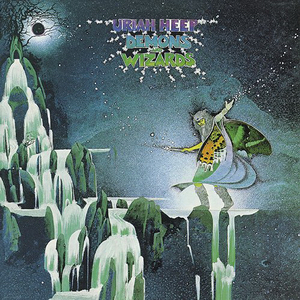
The London five whose keyboard player wrote the songs, stacked the backing vocals and pulled hymn tunes out of a Hammond were Uriah Heep, and Demons and Wizards, released by Bronze on 19 May 1972 inside a Roger Dean gatefold, put the whole subject matter of the genre on a shelf before anyone needed it. A wizard. A quest. A bright refrain built to be sung back by a room.
"The Wizard" carries the case alone. Ken Hensley and Mark Clarke wrote it, David Byron sang the lead in a trained and frankly theatrical tenor, and the voices stacked behind him go four and five deep where a hard rock band of 1972 left the space empty. Byron is a light opera tenor wheeled out of the operetta house and stood in front of an amplifier stack, holding the same vibrato at a volume that shakes the greasepaint off him. The one phrase that climbs past his reach goes to Clarke, singing two lines of his own bridge.
The withholding is as plain. The tempos sit between slow and middling, Mick Box plays blues shapes from the first bar to the last, and no second guitar ever answers him in harmony. The choir came from here. The tenor came from here. The speed did not.
1975 and 1976, when the parts came thick
The guitarist who walked out of one band in the spring and had another whole group under contract by the summer was Ritchie Blackmore, and Ritchie Blackmore's Rainbow, out on Oyster on 4 August 1975, played by four former members of Elf and sung by Ronnie James Dio, is where the libretto acquires its finished vocabulary. Rainbow supplied the words and the postures.
What the record refuses is the engine underneath. Gary Driscoll swings where a power metal drummer would run, there is no second bass drum anywhere on it, and the riffs are blues shapes in a minor key wearing a medieval hat. Unarguably the libretto. Not yet the music.

Eight months later the Birmingham band with two lead guitarists and a singer who could cross an octave and a half inside one bar delivered the component nobody else was holding. Judas Priest put out Sad Wings of Destiny on Gull in March 1976, the 23rd by Metal Archives' count and the 26th by Wikipedia's, and the guitars of Glenn Tipton and K. K. Downing are composed counterpoint rather than two men soloing over each other.
"Victim of Changes" runs to nearly eight minutes and does the other half of the job. Rob Halford writes a soprano line and a chest line onto the same stave and then takes both of them himself, and the paper is gouged through where the nib crossed from one to the other.
Priest kept the tempo back. Alan Moore plays one bass drum on every track, and the harmony stays at the dark end of the minor. The twin lead and the range went to Hamburg almost untouched. The speed came from somewhere else.
The third donor of that spring is not a metal band. Thin Lizzy closed Jailbreak, out on Vertigo in March 1976, with "Emerald", where Scott Gorham and Brian Robertson run the tune a third apart from the opening bar, and Wishbone Ash had already built Argus, released in 1972, on the same harmonised lead-guitar principle, Andy Powell and Ted Turner interweaving one line between two players rather than one man soloing alone. The harmonised lead is not decoration in either band. It is the melody, two tubes of a double flute fed by one mouthpiece, with no way to play either of them alone.
A record that hands over one part is not an early version of the genre. It is a donor.
Hanover, Stockholm and the parts that came last
What Germany gave before it had a genre was neither speed nor a riff. It was idiom. The Hanover band whose lead guitarist practised classical fingerings and whose singer sang English with no seam showing was Scorpions, and In Trance, produced by Dieter Dierks in 1975, is where both land on one record. That is a German workshop writing Italian opera so idiomatic the pit in Venice takes it for local work. What the band withheld was the subject matter and the tempo, both of which stayed comfortable.
Sweden had the libretto before Hamburg did. The Stockholm band whose two brothers wrote, sang, played and finally pressed their own records was Heavy Load, and Death or Glory, put out on their own Thunderload label in October 1982, sets Viking subject matter, clean high singing and a chorus in the major into the same songs years before the Germans got there. No velocity, no virtuoso, no budget to buy either.
The London trio that recorded at Roundhouse Studios in the autumn of 1980 and had a debut out on Bronze by December was Angel Witch, a scion of the same movement and its most melodic writer. The title track keeps its hook in the minor and never lets it resolve, a tuning peg given another quarter turn at every chorus until the string parts across the nut. The voice is what it lacks. Kevin Heybourne sings it himself, low and plain, nowhere near the altitude the genre would make compulsory.
The last part to arrive was length. Iron Maiden's debut, released by EMI on 14 April 1980, carries "Phantom of the Opera" at seven minutes, five sections, a full stop in the middle and a gallop out of it, the architecture every German epic of 1987 would be built on. Killers followed in February 1981. The tenor was not in the band yet, Paul Di'Anno barked where Bruce Dickinson would later sing, and the harmony stayed grey. How the rest of that movement handed its parts down is how the NWOBHM fed power metal.
The ledger, and the two parts nobody handed over
| Year | Record | The part it supplied | The part it kept back |
|---|---|---|---|
| 1969 | Deep Purple, Concerto for Group and Orchestra | A real orchestra, written for in full | Tempo, and a composed song |
| 1972 | Uriah Heep, Demons and Wizards | The stacked choir, the theatrical tenor, the quest | Speed, weight, harmonised guitars |
| 1975 | Rainbow, Ritchie Blackmore's Rainbow | The finished fantasy vocabulary | The double kick and the running tempo |
| 1975 | Scorpions, In Trance | Classical lead lines and unaccented English | Subject matter and speed |
| 1976 | Judas Priest, Sad Wings of Destiny | Composed twin leads and the vocal range | Tempo and any brightness at all |
| 1976 | Thin Lizzy, Jailbreak | The harmonised third as the tune itself | Weight, altitude, the heroic subject |
| 1980 | Angel Witch, Angel Witch | A melodic hook carried by the guitars | The voice, and the major key |
| 1981 | Iron Maiden, Killers | The long multi part song and the gallop | The tenor and the bright harmony |
| 1982 | Heavy Load, Death or Glory | Heroic lyrics with a clean high voice | Velocity and virtuosity |
Read down the last column and the same two absences turn up in every row. Nobody had yet run sixteenth notes on two kick drums as a floor under a whole song rather than a trick for one track, and nobody had set a clean tenor on a chorus in a major key and made that chorus the purpose of the song. Everything else was on the shelf by 1982, attested on pressings anyone can still buy.
Which is why the succession here is real and partial at once. Every record above is a donor rather than a draft, and calling any of them an early power metal album flatters it and insults the work that came after. The practitioner who takes six parts out of six rooms and makes them sound like one band has done something none of the donors did.

