

Writing at MetalBite in October 2022, a reviewer with little patience for Megadeth allowed that Dave Mustaine never made a better contribution to metal than the job he did behind a desk in Seattle, which is an awkward thing to agree with and an odder thing to find at the head of a whole branch of a genre. The five men whose demo went round a college radio station before it went round a single record company were Sanctuary, and Sanctuary Refuge Denied, cut in 1987 at Steve Lawson Productions with Megadeth's guitarist producing and Terry Date at the desk, is the American album of its decade whose best known quality nobody in the band chose. Epic took the tapes away from all of them and remixed the record before it reached a shop, officially in April 1988, though the exact release date is disputed, some pressings dated a year earlier.
Twelve fifths tuned pure, stacked one on the next, come home a hair sharp of the seven octaves they should have closed on, and that hair will not divide evenly, will not go away and has to be buried in the scale somewhere, so every tuning ever laid out for an instrument in Europe is a decision about which interval takes the wound. Put the whole of it into one fifth and that fifth howls, loud enough that the trade named it the wolf, and any cadence that lands there cracks the soundboard under a held note. Spread it thin across all twelve and nothing howls and no key sounds like anywhere in particular. Hand the same instrument on to a second man with ideas of his own and he undoes the first one's work, buries the wound in intervals the first man had left clean, and sends back something in tune by a different reckoning entirely. The one interval neither of them may go near is the octave. Meddle with that and what comes back is not another tuning. It is a wrecked instrument, and the first ear in the room hears it before the second note.
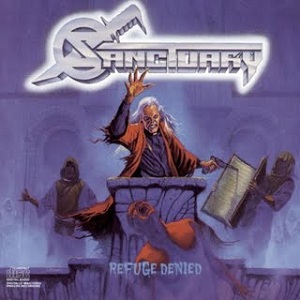
What the producer left on it is audible without help. The riffing sits closer to thrash than anything the American branch had yet carried onto a major label, the songs are short, the tempos hold level instead of surging, and the guitars are voiced dry and mid-heavy rather than wide, which is why the album still turns up on lists of essential thrash records drawn up by people who would never file it under power metal at all. Then the label remixed it. Neither hand could touch the pitch the singer sang at. The bloodline of the American style runs back through a choice made by a thrash guitarist and a choice made by an office, and through nothing the five men in the room could argue with, which is where the wider story begins.
The voice Sanctuary Refuge Denied leaves in the open
Battle Angels opens the album and settles the matter inside ninety seconds. The songwriting is arguable, the mix is arguable and so is whether the thing is thrash at all, and the singer is not: a very high, very steady tone that goes up and stays up, with no tremble in it at the top and no retreat into a lower line when the chorus comes round again. It is not a decoration laid over the arrangement. It is the arrangement's ceiling, and everything underneath is written to keep out of its way.
One throat at the top, and an entire arrangement built to keep out of its way.
The man sent to the top of that range for forty minutes was Warrel Dane, and three things are audible in him: an unusually wide vibrato, long sustains that arrive from nowhere, and a top register that sounds schooled rather than simply pushed. The top of that register is not where most voices live. It is where his was sent. The forebear the American branch actually used was the singer of Judas Priest, and a chorus built on that model is shouted up at rather than sung across, which is a different musical object from the one Germany was assembling in the same years and gets confused with it constantly.
A crescendo borrowed from Ravel
Track six is a cover, and it is the strangest decision anybody made here. White Rabbit was written by Grace Slick in the mid-1960s, the year itself disputed between 1965 and 1966, as one unbroken crescendo, a device lifted openly from Ravel's Bolero and stretched across two and a half minutes over a Spanish march figure in the bass. Jack Casady has said plainly that he led the bass part out like Bolero, ripping off Ravel without apology. Bolero's device is a ramp with one moving part and nothing on it but the climb, and a cover version inherits the tune, not the ramp: it has to build its own climb or go without one. On this record the one guitar solo that belongs to somebody else's song rather than the band's own goes to Mustaine.
Access was never what the branch lacked
The easy account of why American power metal stayed small says that nobody could get near a major label, a real studio or a tour, and this record is the counter-example that pulls the account apart. The touring that followed ran alongside Megadeth, Savatage, Testament, Flotsam and Jetsam and most of the rest of the American bill, and the press came in split rather than hostile, with three stars out of five in one American reference and nine out of ten in Rock Hard. None of it put the record onto the Billboard 200.
The door had opened in a hotel corridor rather than in an office. The band put a cassette into Mustaine's hands after a Megadeth show in the city, he offered to produce what was on it, and his own manager, Keith Rawls, financed the sessions and then took the band on, which is how a five-piece with one demo and a college radio slot arrived at Epic with a thrash name in the production credit. Nothing in that sequence is ordinary for this branch, and nothing in what followed can be blamed on the doors staying shut.
Two neighbours were on major labels in the same years and neither held this shape for long. The other Washington band that took the riff down into a lower register and slowed it until the high line had nowhere left to sit was Metal Church, while Queensrÿche spent the decade walking out of metal in the direction of concept records and radio, which is why the question is Queensrÿche power metal takes longer to answer than it looks. The third of them, the one that kept the ceiling, is the one that did not last. In the judgement of the people who kept the style alive afterwards, it is also the one they point at.
Where the top of that range went

Lay a finger across a stretched string exactly halfway along its speaking length and the fundamental is killed where it stands, and what goes on ringing is a thinner, steadier note high above it with nothing underneath it at all. Take the finger off and the whole length speaks again, lower and broader and easy, a note a man can lean on all evening without thinking about it. The second album answers the first by lowering it. Into the Mirror Black, cut in the same Seattle building in 1989 with Howard Benson producing and issued by Epic on 27 February 1990, moves the weight down: slower, darker, the riffs longer, and a singer working the middle of his instrument for whole songs at a time. It shifted more than thirty four thousand copies worldwide in its first week and put Future Tense onto Headbangers Ball, the MTV programme that decided what an American teenager saw of this music, which is further than the debut ever reached. The high register is still on the record. It is no longer the point of it.
Then the label asked for something else entirely. Epic pushed the band toward the sound of the city it happened to live in, the arguments broke it apart in 1992, and the singer and the bassist walked into Nevermore, where the same throat worked a fourth lower for the next twenty years. Song publishers used to issue a favourite in three keys, high, medium and low, and let the editions that stopped selling go quietly out of print. The high edition of this voice went out of print in 1992, and when the band came back in 2010 and took four more years to cut another album, only three songs on it were set in that edition.
So the most exposed high voice the American branch produced arrived on a record whose sound was settled twice over by people who were not in the band, and it was carried by a singer who did not stay in it. The branch is usually explained by what it went without: no budget, no studio, no distribution, no audience left by 1991. This one had the budget, the producer, the tours and the reviews. What it never had was a second record in the same voice, and no epigone supplied one. Thirty eight years on, the high line is unarguably the thing the branch is remembered for, and it was never anybody's plan.

