
On 29 July 1954 George Allen and Unwin published The Fellowship of the Ring, and the first thing to go off in it is a firework. The old wizard who rolls into Bilbo Baggins's birthday party with a cart of rockets and fountains, and sends a dragon of sparks roaring low over the heads of the guests, is Gandalf. Tolkien metal has been lighting its fuses from that cart ever since.
What the style mostly took from the books was not the plot but the vocabulary. Packed into band names from the seventies onwards, the invented tongues of Middle-earth went into heavy metal the way metal salts go into a star shell, strontium for the red, barium for the green, copper for a blue no display crew ever gets right, a pinch of Elvish or Black Speech rammed into a paper casing, hurled over a rehearsal room on distortion and burst into a colour no English word could burn. The stories mostly stayed on the shelf.
The first sightings, Led Zeppelin's hobbits and the Californian band named after the spider's pass into Mordor, sit in the long inventory of what the songs are about. The account kept running long after them, in three columns: the names, the stories told end to end, and, very late, a voice that had been inside the film.
Tolkien metal before anyone called it that
The paperbacks crossed the Atlantic before the music did. Printed without the author's consent by Ace Books in 1965 and answered within months by an authorised Ballantine edition carrying a note from Tolkien himself, the three volumes went into American student bags by the hundred thousand, and by the end of the decade the words Frodo Lives were painted on walls and subway cars from Berkeley to Manhattan. The generation that would plug in first had read the book in bed.
The Birmingham quartet that put the first wizard onto a heavy metal record were Black Sabbath. On their Vertigo debut of February 1970, "The Wizard" rides in on Ozzy Osbourne's harmonica and walks a benevolent sorcerer through a village of frightened people who cheer up as he passes, a figure Geezer Butler later said he had drawn from Gandalf. Butler named the wizard as his model in a 2005 interview with Metal Sludge. The riff tramps. The magic is kind.
The Midlands band's older rivals had got to the book a little earlier and a little more slyly. Released on Led Zeppelin IV in November 1971, "Misty Mountain Hop" is a song about a police raid on a crowd of hippies in a park, and only at the very end does it turn for the hills, borrowing the name of the range that the dwarves of The Hobbit crossed with a dragon waiting on the far side. It is a joke with a map folded inside it.
Across the border, the Toronto trio still filed under hard rock was Rush, and it closed the first side of Fly by Night in 1975 with "Rivendell", an acoustic song for the house of Elrond, and the elves turned out not to need amplifiers at all. That was the whole problem with the books as lyric material. They were long, gentle, full of songs already written, and very little in them was loud until the armies arrived.
The names on the flyer
The armies are what the Norwegians wanted. Sold to a generation of teenagers who had read the appendices of The Return of the King like a rulebook, the dark half of the map became a trade catalogue after 1990, and bands took Mordor apart the way a tannery takes apart a hide, the lime pit, the scraping blade and the stretching frame, until nothing of the animal was left but its name nailed up on a black and white flyer.
| Band | Country, formed | What the name is in Tolkien |
|---|---|---|
| Burzum | Norway, 1991 | The Black Speech word for darkness, from the inscription on the One Ring |
| Gorgoroth | Norway, 1992 | The volcanic plateau at the heart of Mordor |
| Amon Amarth | Sweden, 1992 | The Sindarin name of Mount Doom |
| Summoning | Austria, 1993 | No borrowed name; songs sung in and about Middle-earth |
| Battlelore | Finland, 1999 | No borrowed name; every album set in Middle-earth |
The one-man project that took its name from the inscription on the One Ring, where the Black Speech word for darkness is burzum, was Burzum, and its founder Varg Vikernes signed himself Count Grishnackh after Grishnákh, the orc captain of Book Three. He was convicted in 1994 of murder and of arson against churches. The name outlived any interest in its source.
The Swedish five who named themselves after the mountain where the Ring was forged answered to Amon Amarth, formed in 1992, and then spent three decades singing about Vikings instead, keeping the elvish name the way a family keeps the name of a house long after the house was sold. The Austrian duo that went furthest the other way, singing from inside Mordor rather than naming a band after it, was Summoning, whose second album of 1995 took its title from Minas Morgul, the tower of the Ringwraiths, and slowed black metal to the tread of an army on a long march. Gorgoroth, from 1992, never pretended to be interested in the plateau at all. Tolkien metal, at this end of the shelf, was a dictionary rather than a library.
Tolkien metal, at this end of the shelf, was a dictionary rather than a library.
The Tolkien metal bands that told the story
The other column is thinner and far more loyal. The German speed metal band that sang about the Ring eight years before it attempted the whole of The Silmarillion was Blind Guardian, and the faithful still argue over which of the early albums carries the purer devotion.

Released in 1990 on No Remorse Records, Tales from the Twilight World spends most of its length flattening everything in front of it at speed metal tempo, twin guitars tearing through "Traveler in Time" and "Welcome to Dying" like a log splitter through a cord of birch. Then it stops dead for "Lord of the Rings", an acoustic ballad about the weight of the thing and the hand that carries it, sung by Hansi Kürsch as though the whole band had sat down around a fire. The speed was the day job. The ballad was the vocation.
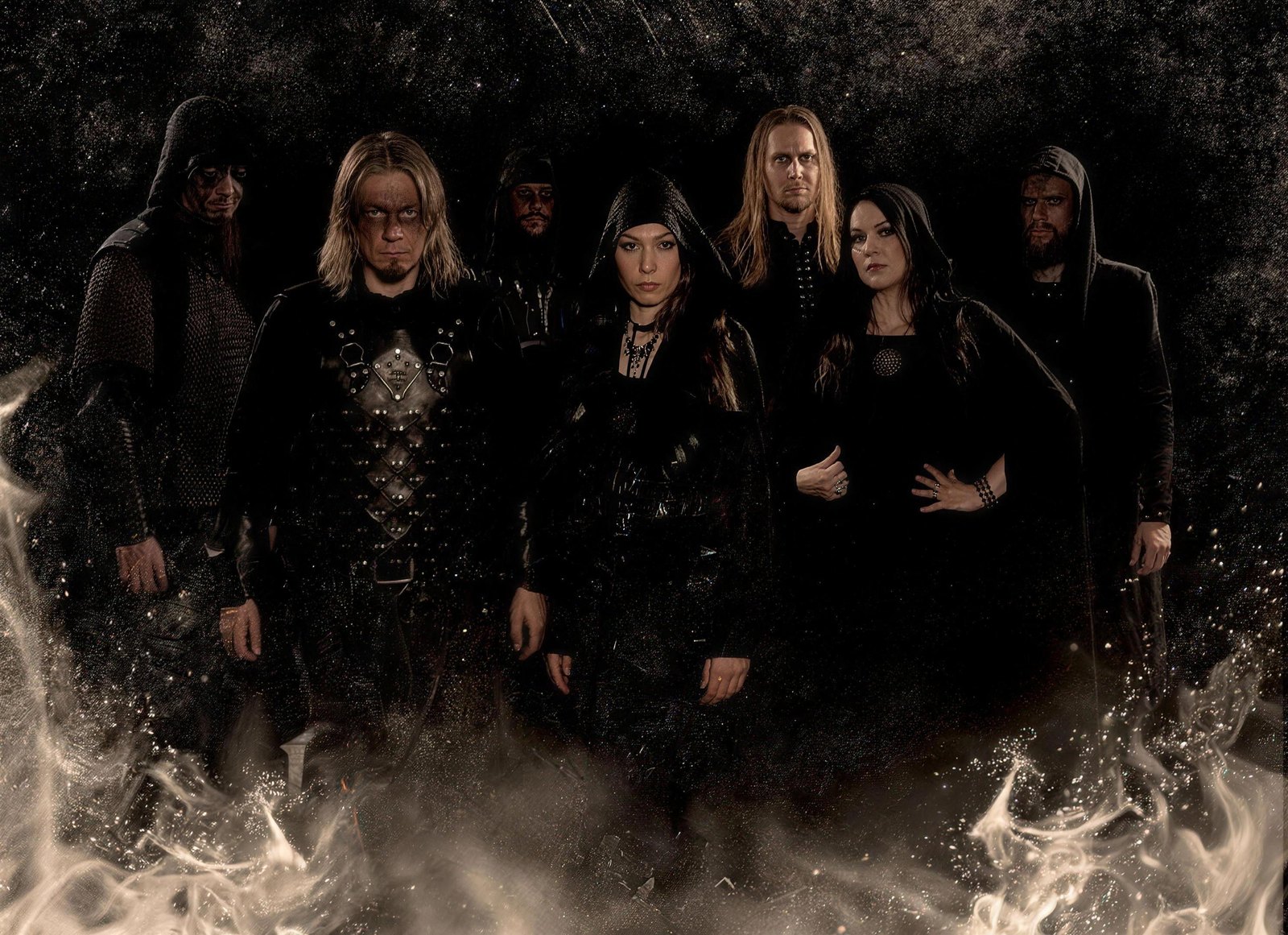
Two years later "The Bard's Song", with its hobbit companion piece, turned the band's audiences into choirs across Germany, and by the time Peter Jackson's films arrived between 2001 and 2003 a whole second wave was waiting for them. The Finnish sextet that set every one of its albums in Middle-earth, from its Napalm debut onwards, splitting the voices between a growl and a soprano and adding flute where the Rohirrim would have wanted trumpets, went by the name Battlelore, founded in Lappeenranta in 1999 and signed to Napalm for its 2002 debut. Nobody else stayed on the map so long, or carried its banners so far.
The wizard who sang back
The last column holds one man, and the lineage of wizards that began with a harmonica in 1970 ends with him. The actor who had played the fallen wizard Saruman in all three of Jackson's films, and who by his own account was the only member of the cast who had ever met Tolkien, was Christopher Lee, and in his eighties he turned his bass baritone on heavy metal. He narrated for the Italian symphonic band Rhapsody on Symphony of Enchanted Lands II, released 27 September 2004.
Then he made records of his own. Charlemagne: By the Sword and the Cross came out in 2010 as a symphonic metal opera about his claimed ancestor, and Charlemagne: The Omens of Death followed in 2013, where Faulkner's riffs kick the timbers out from under the orchestra and leave an old voice standing on bare heavy metal. It was not a Tolkien record. It hardly had to be. Christopher Lee died on 7 June 2015, aged 93.
The books themselves have not been staged whole since Blind Guardian's Silmarillion record, and probably never will be; they are too long, too sad and too full of walking. What the music keeps is the pantheon of names, and the Black Speech at least was written down, so nobody had to guess what the singer meant. Plenty of plain English has fared much worse between the stage and the listener's ear, which is the story of misheard metal lyrics.
