
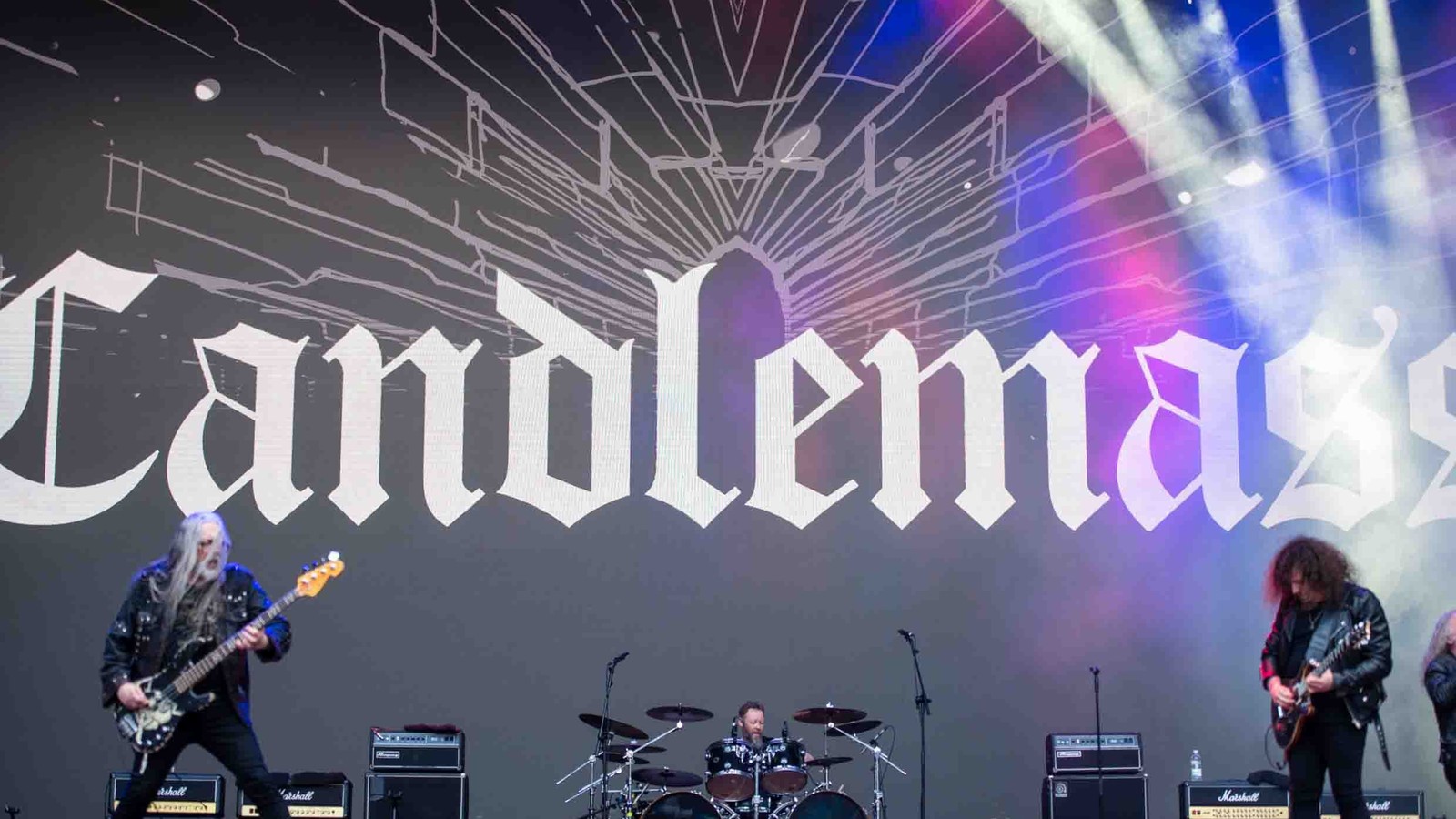
On 3 September 2018 Candlemass announced that Johan Längqvist was their singer again, thirty-two years after he had sung their first album as a hired voice and gone home. "The circle is closed," the band wrote, and it was a strange circle, because the man it closed on had never been a member of the group whose debut he defined, and in the years between he had been followed at the microphone by Messiah Marcolin, Thomas Vikström, Björn Flodqvist, Marcolin again, Robert Lowe and Mats Levén, while the only member present in every line-up the band had ever fielded was the bass player who had written nearly every song.
The bass player and the borrowed voice
Born in 1963 and already on his third band before he was twenty-one, Leif Edling had founded Nemesis in 1982, watched it leave behind a single five-song mini-album, The Day of Retribution, in 1984 and come apart, and late that year, with the rhythm guitarist Mats "Mappe" Björkman and the drummer Matz Ekström, he put together in Upplands Väsby, a suburb north of Stockholm, a band named after a Christian feast day whose purpose was to take the riffs of early Black Sabbath and drag them further down than Black Sabbath had ever gone. The timing was perverse. Sweden in the middle of the decade wanted speed.
What Edling was writing sat outside that market altogether, a slower, grander and more theatrical music that the scene would later file as epic doom metal, and the American bands working a similar seam, Saint Vitus and Pentagram among them, were separated from it by an ocean and by a record industry that had no more use for them than for a Swedish quintet with seven-minute songs. The offer, when it came, was a one-record deal from Black Dragon Records, a small independent label in Paris that had been sent a demo of "Demon's Gate" and "Black Stone Wielder" recorded in November 1985 with Edling himself at the microphone.
Recorded in February 1986 at Thunderload Studios in Stockholm, produced by the band with Ragne Wahlquist of the Swedish heavy metal group Heavy Load on a budget reported at eighteen hundred dollars, and sung by Längqvist, a session vocalist who had not heard any of the band's music before he arrived, Epicus Doomicus Metallicus was made by a group with no permanent singer, a borrowed lead guitarist in Klas Bergwall and no money to fix anything it did not like. Black Dragon released it on 10 June 1986.
But I struck one chord of music, / Like the sound of a great Amen.
Adelaide Anne Procter, "A Lost Chord", Legends and Lyrics

The six songs are where the organ comes in. The riffs of "Solitude" and the nine minutes of "Demon's Gate" work the way the longest pipe of a cathedral organ works, a note so low and held so long that it enters through the stone floor, the soles of the feet and the cage of the ribs before the ear has agreed that it is a note at all, so that by the time the listener understands something has been played the whole nave is already trembling with it. In the reading Chris Chantler gave it in Metal Hammer in 2020, each song, from the opening "Solitude" to the closing "A Sorcerer's Pledge", is virtually a template for epic doom, and AllMusic, which preferred the singer who came next, still heard the strongest and most consistent songwriting of the band's career.
None of this sold. Black Dragon dropped the band within the year, and Längqvist, who had never signed on, did not stay.
Messiah Marcolin and the robe, 1987 to 1991
The singer who replaced him auditioned by telephone, ringing Edling and singing "Solitude" down the line without accompaniment. Messiah Marcolin arrived in a band that had lost Ekström and Bergwall and gained the drummer Jan Lindh and the lead guitarist Lars Johansson, a core that plays together to this day. He brought an operatic voice, a monk's robe on stage and a stomping routine that became known as the doom dance, and he brought opinions: recording Chopin's funeral march was his idea, and so was the title Nightfall in place of Edling's working title, "Gothic Stone", which survived as the name of the short instrumental that opens the record.

Released by Axis Records on 9 November 1987 and licensed to Metal Blade for America the following year, Nightfall gave the riffs of the debut a throat equal to their weight, the singles "Samarithan" and "At the Gallows End" carrying Marcolin's bellow over guitars that set each chord down with the care of men lowering a load they cannot afford to drop, while "Mourners Lament" stretched the funereal pace past six minutes. Bernard Doe of Metal Forces called it an essential buy at the time, and Metal Storm, decades later, used the word masterpiece.
Two more albums followed in two years, and the pace showed. Ancient Dreams, out on 23 November 1988, was mixed in a hurry ahead of an American tour, and the band blamed the label for its sound; it still became their first record on the Billboard 200, the main American album chart, at number 174, with "Mirror Mirror" opening it and the seven minutes of "Bearer of Pain" at its centre. Metal Blade had given a home years earlier to an Illinois band that sang its faith at a similar tempo, the story of trouble and the Christian Doom Question.
Tales of Creation, issued on 25 September 1989, was built partly from material an early line-up had recorded in 1985 and remade "Under the Oak" from the debut, and the critics split over it, Rock Hard giving it nine out of ten and AllMusic two and a half out of five. In 1991, after personal differences with other members, Marcolin left.
Splitting, returning, splitting again
Chapter VI, released by Music for Nations on 25 May 1992 with Thomas Vikström singing, reached number 43 in Sweden but sold poorly, and within two years Edling had dissolved the band and moved on to Abstrakt Algebra with Mats Levén. In 1997 he put the name back on a new line-up with Björn Flodqvist for Dactylis Glomerata in 1998 and From the 13th Sun in 1999, and in 2002 the Nightfall line-up reunited for shows including Wacken Open Air, only to fall apart before a new album was finished.
| Singer | Years | Studio albums |
|---|---|---|
| Johan Längqvist | 1986 (session), 2018–present | Epicus Doomicus Metallicus, The Door to Doom, Sweet Evil Sun |
| Messiah Marcolin | 1987–1991, 2002–2006 | Nightfall, Ancient Dreams, Tales of Creation, Candlemass |
| Thomas Vikström | 1991–1993 | Chapter VI |
| Björn Flodqvist | 1997–2001 | Dactylis Glomerata, From the 13th Sun |
| Robert Lowe | 2007–2012 | King of the Grey Islands, Death Magic Doom, Psalms for the Dead |
| Mats Levén | 2012–2018 | none (EP Death Thy Lover, 2016) |
The second reunion, announced in November 2004, held long enough to make a record. Candlemass, released by Nuclear Blast on 3 May 2005, went to number 7 in Sweden on the back of songs like "Witches" and won hard rock of the year at the 2006 Grammis, the Swedish music industry's annual awards. In October 2006 the band confirmed that Marcolin had left for good.
The man who took the microphone next came from Texas. Robert Lowe of Solitude Aeturnus sang on King of the Grey Islands in 2007, on Death Magic Doom in 2009, whose "Hammer of Doom" had been its working title until a German festival of that name got in the way, and on Psalms for the Dead, released by Napalm Records on 8 June 2012 and announced as the last album. On 2 June, six days before it came out, the band said Lowe was out, citing the quality of the live shows. Mats Levén, Edling's partner in Krux, took the stage role and sang the 2016 EP Death Thy Lover. From 2014 Edling was off the stage, the band citing health issues in a statement of February 2015, and Per Wiberg or Jörgen Sandström played bass in his place until he returned to the stage in 2019.
Längqvist, Iommi and the return to the source
The singer of the first record came back to make the twelfth. Produced by Marcus Jidell and released by Napalm on 22 February 2019, The Door to Doom put Längqvist back in front of Björkman, Johansson, Lindh and Edling and handed a guitar solo on "Astorolus - The Great Octopus" to Tony Iommi, the man whose riffs Candlemass had spent thirty-three years grinding down into something slower and more leaden, so that the source of the whole tradition turned up as a guest of its most faithful heirs. It reached number 13 in Sweden and 18 in Germany, and at the 2020 Grammis it took the album award for hard rock/metal of the year.
Six singers came and went, and not one of them changed what the band was, because what the band was lived in the bass player's riffs, not in anybody's throat.
After the EP The Pendulum in March 2020 came Sweet Evil Sun on 18 November 2022, again produced by Jidell, announced with the video for "Scandinavian Gods" and opened by "Wizard of the Vortex". It reached 42 in Germany and 19 on the UK Rock and Metal Albums chart, with Blabbermouth giving it eight out of ten and Metal Hammer three stars out of five. On 21 March 2024, at the Hell's Heroes festival in Houston, seven of the eleven songs the band played came from Nightfall.
Forty years of the lowest note
The fortieth year brought Black Star, a four-song EP released by Napalm on 9 May 2025 with two new songs, the title track and "Corridors of Chaos", and covers of Black Sabbath's "Sabbath Bloody Sabbath" and Pentagram's "Forever My Queen", and on 13 September 2025 Marcolin stood with the band again, for the first time in nearly two decades, at Rock Hard Festival Greece in Athens, singing "Bewitched", "Samarithan" and "A Sorcerer's Pledge" among the ten songs of the night. Edling had set the terms in advance: "No recordings, no tours, nothing more, just one show," in the words Blabbermouth reported from him in April 2025.
In January 2026 Edling wrote on Facebook that he would spend the year writing and demoing new songs, and that if all went well an album might be recorded in 2027 for release early in 2028. It will be measured, as every Candlemass record since 1986 has been, against six songs cut for eighteen hundred dollars by a singer who had never heard them. The weighted dirge of that debut has outlasted half a dozen line-ups and two break-ups, and it is where the full story of doom in Europe turns. The longest pipe is still sounding. The building has not stopped shaking.
