
The alternative heavy metal bands were never a genre, and every attempt to rack them as one comes apart at the second record pulled off the shelf. They were a method. What they shared was an operation performed on the riff Black Sabbath had left standing in the field, and the operation was not demolition.
A hedge layer working a field boundary in February takes a billhook to each overgrown stem just above the ground and cuts it nearly through, leaving a hinge of bark and living sapwood, then forces it down almost flat along a line of stakes and weaves it in, and by April the wounded stem is throwing green shoots along its whole length, sideways, into ground it was never meant to reach. Between 1988 and 2001 a run of American bands did exactly that to the Sabbath riff. Nobody felled it. It was laid, and it grew.
Sold to teenagers who bought metal and hip hop records in the same week, and filed by the shops under a word borrowed from college radio, the San Francisco five who carried a rapped verse over a metal riff into the top ten of the Billboard Hot 100 in 1990 were Faith No More. The song was "Epic", and it peaked at number nine. It ends on a lone piano while Jim Martin's guitar is still ringing, which no heavy metal band of the decade would have allowed.
What made the alternative heavy metal bands alternative
Not volume. The riff stayed, tuned as low as anyone else's and played as loud. What went was the rest of the 1980 contract: the operatic singer, the solo as the summit of the song, the lyric about swords or the open road, and the leather. In its place came funk bass, jazz harmony, hip hop cadence, hardcore stops and odd meters, each band taking two or three and leaving the rest. The heresy was in the combination.
Every one of these bands still owned Paranoid, and most said so in public. How they stand against the older names that never left the trunk is argued in the chapter it belongs to, where the founders and the British wave hold the ground these bands walked off.
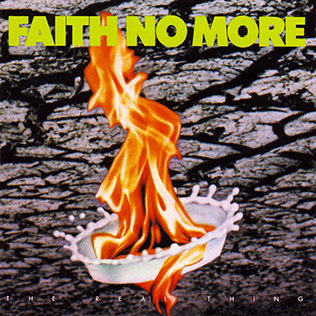
Recorded with a singer barely out of his teens who had joined only months before, and released by Slash in June 1989, The Real Thing set Mike Patton's rapped and crooned verses over Martin's riffs, Roddy Bottum's keyboards and Mike Bordin's drums, and closed, on the CD and cassette editions, on a straight cover of "War Pigs", a band from outside the lineage paying its respects to the source in front of everyone. Patton had joined the band that January, five months before release. The metal audience took the hint. It bought the record.
Funk bass, jazz solos and a Grammy
The New York quartet whose guitarist had played free jazz before he played metal, and whose bassist slapped the strings like a funk player booked for the wrong session, was Living Colour. "Cult of Personality", from Vivid, released by Epic in May 1988, rides a riff as heavy as anything on the metal charts that year, and Vernon Reid's solo on it tears off in every direction at once, scales and noise and feedback with no apology for any of it.
The song won the Grammy for Best Hard Rock Performance at the 32nd Annual Grammy Awards in February 1990. A band of four Black musicians had taken a hard rock prize in a category that metal still regarded as its own. The argument about who was allowed to play the riff lost a good deal of its air that night.
Harmonies, dub bass and the low string
The Houston trio that put a gospel call and response over a bass tuned down until it growled called itself King's X. On Gretchen Goes to Nebraska, released by Megaforce in 1989, "Over My Head" hangs Dug Pinnick's church shout on a riff he drags out of the low string like a man hauling a full bucket of clay up a well shaft hand over hand, and the band's three voices answer him in the chorus. The Seattle bands were listening. Pearl Jam's Jeff Ament said on MTV in the early 1990s that King's X had invented grunge.
The Los Angeles four who set Dave Navarro's metal leads under Perry Farrell's reedy high voice, with Eric Avery's bass running long dub lines beneath both, went out as Jane's Addiction. On Nothing's Shocking, released by Warner Bros. in 1988, "Ocean Size" and "Mountain Song" hang heavy guitar on grooves no metal rhythm section of that year would have played. The schism between the college stations and the metal racks narrowed with every copy it sold.
Stops, odd meters and a bass out front
The New York quartet whose leader had trained as a jazz guitarist before he tuned down and cut his hair short answered to Helmet. Hamilton held a master's degree in jazz guitar from the Manhattan School of Music. On Meantime, released by Interscope in June 1992 after roughly twenty labels had bid the band up toward a reported million dollars, every riff closes like a pair of secateurs on a green stem, one clean bite and then a silence long enough to hear the cut. There are hardly any solos. The stop was the hook.
The Los Angeles four who wrote in meters most metal drummers still counted on their fingers turned out to be Tool. On Ænima, released by Zoo and Volcano Entertainment in September 1996, Adam Jones's riffs wind round Danny Carey's drums the way bindweed winds round a fence post, one more turn every bar, until the post has vanished under the coil and only the growth is left holding the song up.
Every riff closes like a pair of secateurs on a green stem, one clean bite and then a silence long enough to hear the cut.
Further out stood Primus, from the San Francisco Bay Area, where Les Claypool played the bass as the lead instrument, slapped and strummed and bent, and Sailing the Seas of Cheese, released by Interscope in May 1991, sold metal fans a record whose riffs lived on the bottom string of a bass. It should not have worked. The RIAA certified it gold in March 1993.
Whispers and folk scales at the end of the century
The Sacramento band whose singer had learned more from the Cure and the Smiths than from any metal record, and whose guitarist ran his riffs so low they seemed to come up through the floor, was Deftones. "My Own Summer (Shove It)", from Around the Fur, released by Maverick in October 1997, swings between Chino Moreno's whisper and his scream while Stephen Carpenter drops the chorus riff like a sack of wet cement off a tailgate. White Pony, in June 2000, took the haze further still.
The last of them came out of the Armenian community of Los Angeles. The quartet that ran scales from a homeland few of its fans had ever seen through riffs that changed tempo three times in a verse was System of a Down, and Toxicity, released by American Recordings on 4 September 2001, debuted at number one on the Billboard 200 that same month, selling 220,000 copies in its first week. Daron Malakian wrote riffs that stopped, sprinted and fell silent inside a single bar.
| Band | Record | Year | What it changed |
|---|---|---|---|
| Living Colour | Vivid | 1988 | Jazz solos and funk bass on a metal riff |
| Jane's Addiction | Nothing's Shocking | 1988 | Dub bass under metal leads |
| Faith No More | The Real Thing | 1989 | Rap cadence and keyboards |
| King's X | Gretchen Goes to Nebraska | 1989 | Gospel harmony over a detuned bass |
| Primus | Sailing the Seas of Cheese | 1991 | The bass as lead instrument |
| Helmet | Meantime | 1992 | The stop as the hook |
| Tool | Ænima | 1996 | Odd meters and long forms |
| Deftones | Around the Fur | 1997 | Whisper, scream and haze |
| System of a Down | Toxicity | 2001 | Folk scales and sudden turns of tempo |
Their progeny arrived fast and in bulk. The rapped verse, the seven-string guitar and the stop went straight into nu metal, a style that kept the tricks and threw away most of the nerve, while the bands who had held the older line through the same decade belong with the heavy metal bands of the 90s. The two camps rarely shared a bill. They shared a riff.
On any honest reading, not one of these bands tried to kill heavy metal. They took the riff somewhere it had never been allowed to go, and it came back heavier. Nobody has since managed to take it off them.
