
Though much is taken, much abides.Alfred, Lord Tennyson, Ulysses
A football club that drops out of the top flight loses its television money first and its best players second, and by the next August it is playing in grounds a third the size, yet the away end still sells out, the travelling support sings louder for having less to sing about, and the youth team gets its chance because nobody can afford to buy anyone else. Heavy metal spent the nineties in the second division. The kids got their games.
Signed for the most part to European independents rather than to the American majors that had just dropped their elders, and booked into clubs of a few hundred where the previous decade had filled arenas, the heavy metal bands of the 90s ripped the keyboard stands out from under the power ballad, pushed the twin guitars back to the front of the mix and wrote for the faithful rather than for the radio. It cost them the money. It saved the music.
The founders and the stadium names, and which of them still matter, belong to the wider story. The decade itself belongs to the bands that started out with nothing to lose, and to two old voices that walked out of the biggest British bands and had to start again from the club circuit.
Old voices in new shirts
The singer who walked out of Judas Priest in 1992 and turned up the following year in front of a band tuned closer to Pantera than to anything he had sung before was Rob Halford, and Fight, with Scott Travis still behind the drums in Judas Priest too, put out War of Words on Epic in September 1993. "Nailed to the Gun" is the proof of the change, a clipped, down-tuned riff and a voice kept low and hard for most of the song, the scream kept in reserve until the song has earned it. It sold respectably. It sold nothing like Priest.
The two bands that had lost their singers hired from further down the bill. Iron Maiden took Blaze Bayley from Wolfsbane for The X Factor in 1995, and Judas Priest took Tim Owens out of a tribute band for Jugulator in 1997. In America the old names that stayed got heavier and slower instead, Megadeth taking Countdown to Extinction to number two on the Billboard 200 in 1992. None of it was the sound of 1985. None of it tried to be.
The American underground kept its own old guard. In Colorado Springs, Jag Panzer got its original singer, Harry Conklin, back for The Fourth Judgement in 1997, a record that played the US power metal of 1984 as if the intervening decade had been a rumour.
The nineties did not kill heavy metal. They stopped paying it, and found out who would play for nothing.
Declan Rourke, KaosMetal
Heavy metal bands, 90s vintage, that kept the chorus
The German independents did the work the majors had walked away from. Noise in Berlin carried Stratovarius, Century Media in Dortmund carried Iced Earth and Nevermore, and Nuclear Blast in Donzdorf would sign the Swedes who closed the decade. A band could now make a living without an American contract. It could not make a fortune.

The Krefeld quartet that had started out as a speed metal band called Lucifer's Heritage and ended the decade as the standard-bearer of German power metal was Blind Guardian, and Somewhere Far Beyond, released on Virgin and Century Media in the summer of 1992, set Hansi Kürsch's voice over guitars that ran at thrash speed and choruses built for a hall to sing back.
Out of Tampa, the Florida band built around the guitarist Jon Schaffer went out as Iced Earth, and Night of the Stormrider in 1991 set the pattern for the rest of the decade. Its records run on a right hand that works the triplet like a two-stroke engine pinned against its rev limiter, the same three strokes to the beat for minutes on end, while Matt Barlow, the singer from 1994, lays a baritone and a high scream across the top.
The Dark Saga, in 1996, is the one to start with. It turned a comic book antihero into a whole album, and "I Died for You", its ballad, shows what the decade's power ballad could be once the keyboards were gone: an acoustic figure, a vocal line that climbs instead of pleading, and the full band arriving like a verdict. Schaffer kept the guitars in charge. Nobody asked him to.
Florida had a second band worth the trip. The Tampa Bay group led by the brothers Jon and Criss Oliva was Savatage, and Edge of Thorns, in 1993, put a new singer, Zachary Stevens, in front of Criss Oliva's guitar and a title track that opens on piano and turns to steel inside a minute. Criss Oliva was killed in a car crash that October. The band went on without him.
From Helsinki to São Paulo
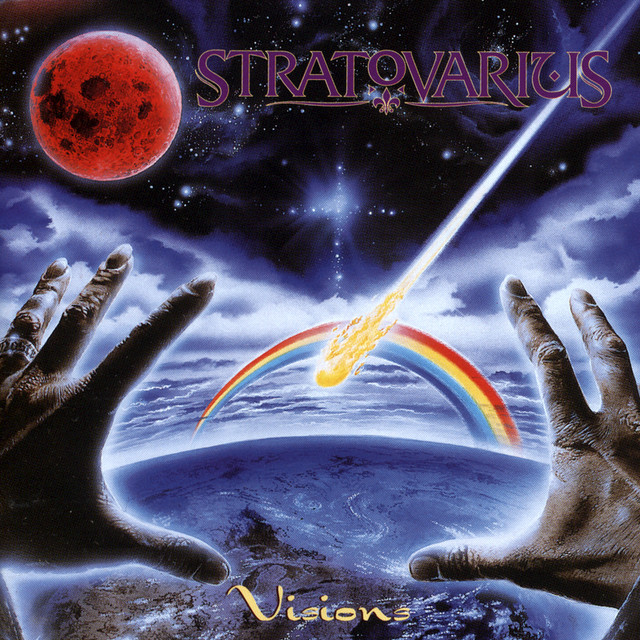
The Helsinki band that set Jens Johansson's harpsichord and keyboard runs against Timo Tolkki's guitar, and put Timo Kotipelto's high tenor over both, was Stratovarius, and Visions, released in 1997, opened on "The Kiss of Judas" and carried "Black Diamond", its harpsichord introduction the most recognisable minute the band ever recorded. On this record the keyboards were back in heavy metal, and this time they played the riff.
Further south, the São Paulo band that the singer Andre Matos had co-founded after leaving Viper called itself Angra, and Angels Cry, in 1993, carried a cover of Kate Bush's "Wuthering Heights" among its power metal songs. Brazil had its own sortie into the European style. It never looked back.
It cost them the money. It saved the music.
Heavy metal in grunge's home town
The Seattle band that the singer Warrel Dane and the bassist Jim Sheppard built out of the wreck of Sanctuary, a few miles from the clubs that had given the world Nirvana and Alice in Chains, turned out to be Nevermore, and its debut came out on Century Media in 1995. Heavy metal had a redoubt in the one city that had done most to bury it.
Dreaming Neon Black, released at the start of 1999, is the band at its heaviest and its bleakest, Jeff Loomis throwing riffs in combinations, short hooks to the body followed by a long right hand, while Dane sings over them with the range he had carried out of the eighties. "The Heart Collector" is the slow one, and still heavier than most of what the decade sold as metal.
| Band | Record | Year | What it kept |
|---|---|---|---|
| Blind Guardian | Somewhere Far Beyond | 1992 | The chorus a hall sings back |
| Megadeth | Countdown to Extinction | 1992 | A place in the American charts |
| Fight | War of Words | 1993 | Halford's voice, in a harder frame |
| Angra | Angels Cry | 1993 | The classical scale in the lead guitar |
| Iced Earth | The Dark Saga | 1996 | The ballad without the keyboards |
| Stratovarius | Visions | 1997 | Keyboards that play the riff |
| Nevermore | Dreaming Neon Black | 1999 | The high voice over a modern riff |
By 1997 a Swedish band called HammerFall was playing twin leads and anthems without a trace of irony, and the European labels that had kept the style going through the lean years were selling it back to a new generation. Where that revival went next, and who carried it, is the business of the heavy metal bands of the 2000s.
The nineties are remembered as the decade heavy metal lost, and on the charts it did. On the records it lost almost nothing. The catechism was the same one, twin guitars, a clean high voice and a riff that holds the song up, and the bands of the decade learned it by heart at the moment nobody was paying them to.
