
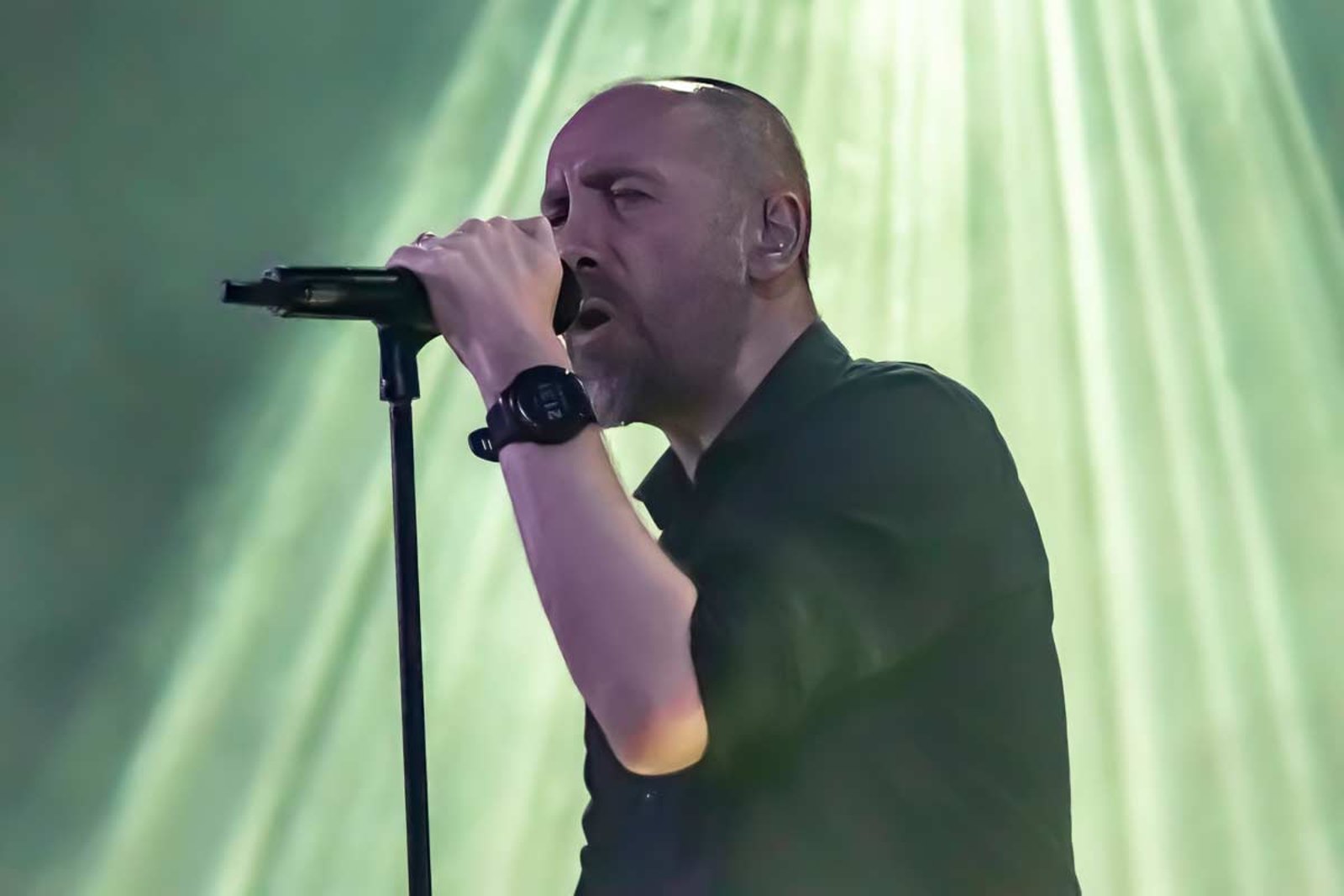
The baritone metal singers lost the argument for the centre of the music around 1970 and have been winning its borders ever since. Two Marshall stacks and a power chord rooted in the octave below middle C handed the middle of the stage to the tenors, and the low voices went out to the edges, into doom, gothic metal, industrial halls and slow blues after midnight, and built countries there that no high voice could have held.
A few dozen sand dunes on the planet can sing. When the slip face of one lets go on a dry afternoon, millions of grains avalanche down the lee side together, burying the scrub at its foot, and the whole slope gives off a low hum near a hundred cycles a second, loud enough to carry for miles and steady for minutes, the noise Marco Polo put down to spirits in the desert. A handful of sand thrown down the same slope makes no sound at all. The note is made by weight or not at all.
The singer who carried that kind of note into the biggest halls in Europe without once climbing above the guitars is Till Lindemann, and he is only the loudest of a lineage that the high tenors of the canon have always crowded out of the photographs. Each of them solved the same problem by a different road.
Why the centre went to the high voices, with the open vowel and the formant that cuts through distortion, belongs to the story of heavy metal vocalists as one family. The low voice has a different problem. It starts with the hall.
What baritone metal singers do instead of climbing
A baritone sings in the same register as the power chord, so it cannot win a room by pitch. A tenor wins the hall by pitch. A baritone has to win it by everything else, and there are three things left to win it with.
The first is colour, a darker timbre that the ear separates from distortion even where both sit on the same notes. The second is the consonant: a hard T, K or P is a short burst of noise spread high across the spectrum, above the crowded middle where the guitars live, so a low singer who strikes them cleanly is understood at the back of a hall where his vowels drowned long ago. The third is rhythm. A low voice that lands with the riff, on its accents, is heard as part of the weight instead of being buried under it. None of the three needs a note above the stave. All three need a singer who knows exactly where the riff puts its weight, and who is prepared to stand on it.
A tenor wins the hall by pitch. A baritone has to win it by everything else.
Doom, and the widest vibrato in the family

The singer who sang doom with the vibrato of a church cantor, wide and slow and entirely unembarrassed, was Messiah Marcolin, and on Ancient Dreams, released in 1988 and the one record by Candlemass to reach the Billboard 200, "Mirror Mirror" keeps his voice low and broad through the verses and opens it at the top of the chorus without ever letting it thin into a tenor. The riffs move at a funereal pace. The voice makes them sound written to be sung over. At that speed a low note has room to open fully before the next chord lands on it, which is the one advantage doom hands a baritone that no faster style can offer.
The blues after midnight
The voice that crooned a ballad on a heavy metal record in 1990 as if it had drifted in from a supper club at closing time belonged to Glenn Danzig, and "Blood and Tears", on Danzig II: Lucifuge, released by Def American that year with Rick Rubin producing, shows what the low register buys that no scream can: intimacy at full volume. The voice is left dry and close. A slow blues walks underneath it. Critics reached for Elvis Presley and Jim Morrison to describe the sound, and both names point at the same thing, a low voice that courts the listener before it threatens him.
A croon at that depth takes hold of a song the way the tar seeps at Rancho La Brea took hold of the Ice Age. A skin of rainwater and leaves hid the tar, and whatever waded in, a mammoth, then the dire wolves that came to pull it down, then the sabre-toothed cats that came for the wolves, was gripped by the legs, pulled under and kept, bone by bone, for tens of thousands of years. The low voice does not fly over a riff. It holds whatever steps in.
Gothic metal and the low croon

The Halifax singer who had growled on the early records of Paradise Lost, and who by Draconian Times, released by Music for Nations in June 1995, had found a rough, low baritone that sat inside the riffs instead of underneath them, was Nick Holmes, and "The Last Time" carried that voice further toward the mainstream than anything the band had made before. He never needed a high note. The tonnage of the riff was enough to stand on. Twenty years later, on The Plague Within in 2015, he set the growl back beside the baritone, which settles the point that the low clean voice had been a choice and never a limit.
The singer who set lines from Fernando Pessoa's poem "Opiário" to a gothic metal riff, half speaking and half singing them in a baritone that sounds like a man reading aloud to a room that has stopped listening, was Fernando Ribeiro of Moonspell, and "Opium", from Irreligious, released by Century Media in July 1996, is the record to start with. The lines are drawn from the poem "Opiário", published under Fernando Pessoa's heteronym Álvaro de Campos. Across the Atlantic, Peter Steele of Type O Negative had already set the floor of the style, and Ribeiro, its most literary exponent, built a whole catalogue a few steps above it.
The low voice inside the riff
Lindemann sits lower than any of them, a bass-baritone that never reaches for a high note. He rolls the R as a full trill, the tip of the tongue hammering the ridge behind the teeth in the manner of the old German stage rather than the everyday street. "Du hast", from Sehnsucht, released by Motor Music in August 1997, is the whole method in four minutes: every word dropped on the downbeat with the guitars, one syllable at a time, so the voice becomes part of the weight of the riff instead of a line above it. The tempo never moves. Neither does he.
The singer who joined Iced Earth in 1994 and carried its long songs in a grave, deep baritone, keeping a high scream back for the moment a chorus needed one, was Matt Barlow, and Something Wicked This Way Comes, released by Century Media in 1998, is the record where the balance between the two is set most plainly. The low voice tells the story. The scream only signs it. On "Watching Over Me", from the same record, a song Jon Schaffer wrote for a friend who died young, the baritone carries every verse and the chorus too, and the scream never arrives at all.
| Singer | Band | Start with | What the low voice does |
|---|---|---|---|
| Messiah Marcolin | Candlemass | Ancient Dreams (1988) | Wide vibrato at a doom tempo |
| Glenn Danzig | Danzig | Danzig II: Lucifuge (1990) | A croon over slow blues |
| Nick Holmes | Paradise Lost | Draconian Times (1995) | A rough baritone inside the riff |
| Fernando Ribeiro | Moonspell | Irreligious (1996) | Half spoken, half sung |
| Till Lindemann | Rammstein | Sehnsucht (1997) | Syllables dropped on the downbeat |
| Matt Barlow | Iced Earth | Something Wicked This Way Comes (1998) | A grave baritone, a scream kept back |
A tenor tells the hall where the song is going. A baritone tells it what the song weighs, and the hall remembers the second thing longer.
Declan Rourke, KaosMetal
The opposite pole, a tenor held at full power above the whole band, is the air raid siren style, built for the same halls by the opposite means. The centre of heavy metal still belongs to the high voices. Most of its borders were settled by the low ones.

