
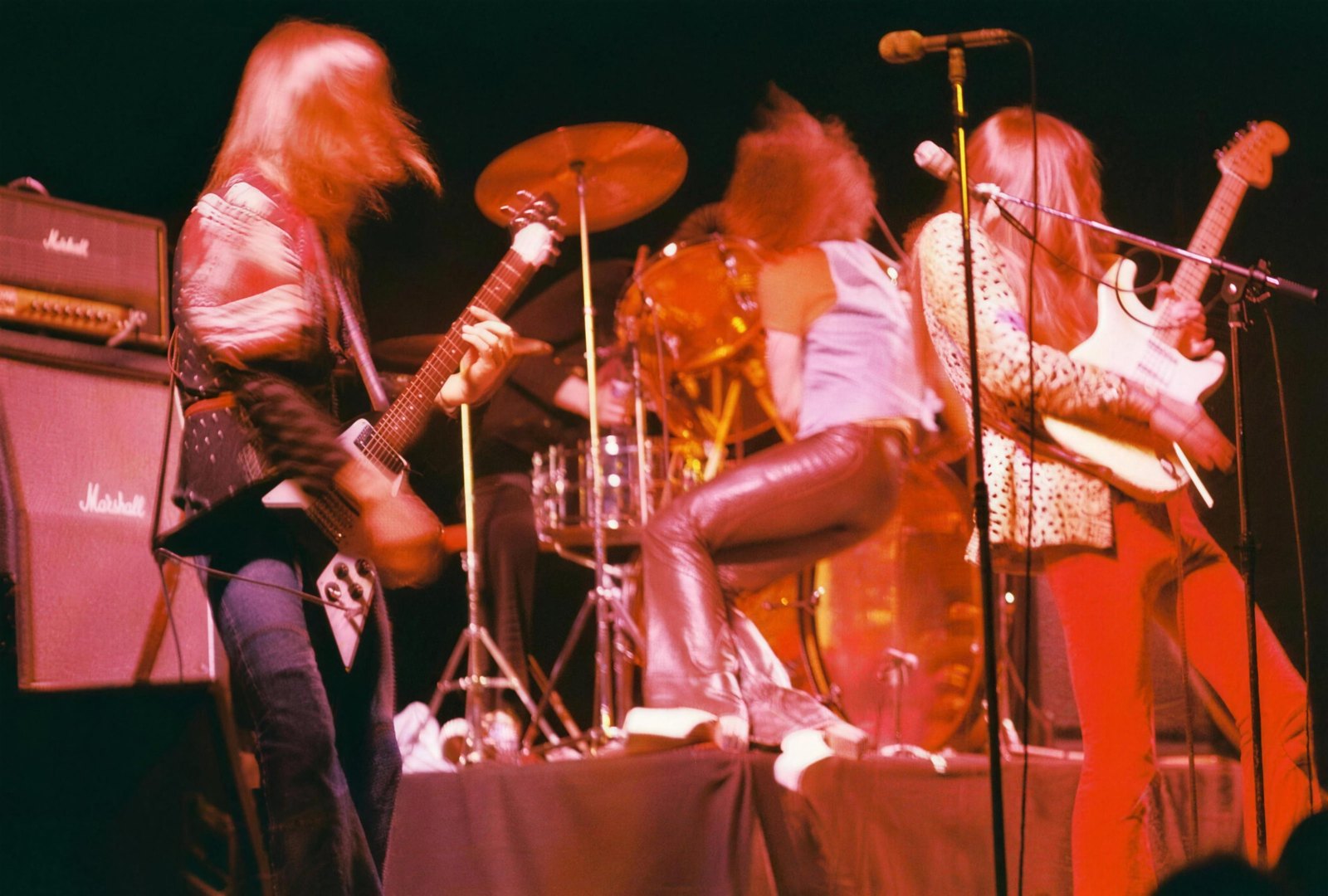
The best heavy metal song of the 70s that Black Sabbath did not write is the one that opens Stained Class. Released by CBS on 10 February 1978, the fourth album by Judas Priest starts on a drum pattern no rock song of the decade had dared, and the track riding it is "Exciter", which tramples flat the mid tempo stomp every heavy band had been hammering into stage boards since 1970. The drummer who set that pace, two bass drums pounding eighth notes under a riff built for speed, was Les Binks. Thrash was still five years away. It had just been given its tempo.
The decade dug the music out of the ground in lumps. Tin comes off the floor of a streaming works as black stone, heavy and dull and still carrying the grit of the gravel it was washed out of, and everything the smelting house does to it afterwards, roasting it, running it off white and molten, letting it set into bars a man can stack, takes the grit away and keeps the metal. The eighties smelted. The best heavy metal songs of the 70s are the black stone.
That rules some records in and some out. All eight songs were released between 1972 and 1978, after the first heavy albums had cut the swing out of the blues and before the young British bands of 1979 turned the lumps into a movement. How the blues was stripped out of the riff before any of these songs arrived is that part of the history, and it explains why none of them sounds like a shuffle.
Black Sabbath is left out on purpose. The Aston quartet's catalogue would take all eight places by itself, and its deep cuts have their own reckoning among the Black Sabbath songs that built heavy metal. What remains is eight songs by eight bands, most of them filed at the time as hard rock, each carrying a single tool the eighties would pick up and use.
1972: the first songs built for speed
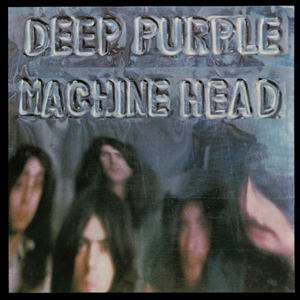
Cut in December 1971 with the Rolling Stones' mobile studio parked outside an empty hotel after the casino next door had burned to the ground, and released on 30 March 1972 on the band's own Purple Records, Machine Head went to number one in Britain, and its opening track was written on the tour bus to a Portsmouth Guildhall show on 13 September 1971, where the band debuted it that same night. The London quintet that turned a rehearsal joke into the fastest opener of its day was Deep Purple, and the song is "Highway Star". Ritchie Blackmore's solo climbs a chord sequence borrowed from Bach, and Jon Lord's organ answers it through a distorted amplifier. Neither of them waits for the other.
The live version taken on the band's Japanese dates in August 1972, released that December as Made in Japan, runs faster than the record and throws both solos further out over the edge, Ian Paice driving the kit as if the song were late for something. The studio take is the blueprint. The stage take is the proof that it could be played that fast by five men without a safety net.
Across the Atlantic the same year, Columbia put out a debut in January 1972 by a Long Island band whose irony the British lacked, and its heaviest track, "Cities on Flame with Rock and Roll", runs on a riff the band's own Albert Bouchard has said was inspired by Sabbath's "The Wizard". The five men from Long Island who sang about burning cities with tongue lodged firmly in cheek were Blue Öyster Cult, and the song is two minutes of menace delivered with a wink. The wink never softened the riff.
1974: the solo and the stopwatch
The German teenager who had crossed to a London space rock band in 1973 and turned it heavy inside a year was Michael Schenker, and on Phenomenon, released by Chrysalis in May 1974, UFO gave him "Rock Bottom", a stomping riff that opens halfway through into a solo long enough to stand as a song of its own. On stage it grew for five years until the version on Strangers in the Night, in 1979, ran past eleven minutes. Every guitarist who later stretched a solo past the patience of the audience was taking a lesson from it.
Credited to all four members and released on Sheer Heart Attack by EMI in November 1974, the heaviest two minutes the band ever put on record ride a riff that Brian May plays the way a shipwright swings an adze along an oak log, short hard strokes tearing the bark and the sapwood away in chips while the verse races to keep up. The band that cut it, a glam rock act to most of its buyers, was Queen, and the song is "Stone Cold Crazy". Metallica recorded it in 1990 and won the Grammy for Best Metal Performance at the 1991 ceremony. The forebear had to wait sixteen years to be recognised by its own progeny.
The best heavy metal songs of the 70s from 1975 to 1977
The Michigan guitarist who wanted his first solo record to sound like a stampede let the eight minute "Stranglehold" open it, and the man was Ted Nugent. Released by Epic in September 1975, it runs on a riff that barely changes and a lead played, by his own account, in a single take on a Gibson Byrdland, with Derek St. Holmes on lead vocal. Patience was the point. The riff wears the listener down before the solo takes him apart.
Two guitars a third apart had been done before, but nobody had yet made them charge. On Jailbreak, released by Vertigo in March 1976, the Dublin quartet built around Phil Lynott wrote "Emerald" about a Viking raid on an Irish village, and Brian Robertson and Scott Gorham trade solos on it before locking into harmony for the final salvo. The band was Thin Lizzy. The young British guitarists of 1979 learned their twin leads from this song more than from any other.
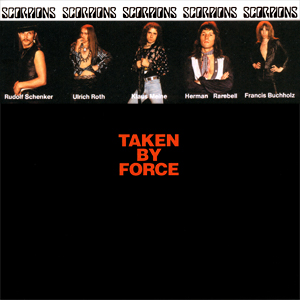
The Hanover band that had spent four albums learning how heavy it could be released Taken by Force through RCA on 4 December 1977, the last studio album with Uli Jon Roth on lead guitar, and its centrepiece is "The Sails of Charon". The quintet was Scorpions. The riff moves on an Eastern scale over a march, and Klaus Meine sings the ferryman of the Greek underworld as if he were already on the boat.
Roth's lead pushes through the song the way Charon's pole goes down into black water, striking the riverbed, shoving the whole boat forward a length at a time and tearing up the mud of the Styx with every stroke. It is the moment the classical hand and the heavy riff stopped being neighbours and moved into the same house.
1978: Exciter, and the verdict
Stained Class carries two songs that could top the decade, "Exciter" and the slow, climbing "Beyond the Realms of Death", and the first wins because nothing like it existed before 10 February 1978. The riff is a short, hard figure repeated at speed, Rob Halford sings it at the top of his range, and Les Binks's two bass drums churn under it like the paddle wheel of a river steamer at full ahead, the floats slamming into the water one after another and beating the brown river to foam behind the stern. Speed metal was assembled from that one track, five minutes and thirty four seconds long.
| Rank | Song | Band | Year | What it handed on |
|---|---|---|---|---|
| 1 | Exciter | Judas Priest | 1978 | The tempo of speed metal |
| 2 | Highway Star | Deep Purple | 1972 | The race between guitar and keyboard |
| 3 | Stone Cold Crazy | Queen | 1974 | The fast, down-picked riff |
| 4 | Emerald | Thin Lizzy | 1976 | Twin leads that charge |
| 5 | The Sails of Charon | Scorpions | 1977 | Classical scales over a march |
| 6 | Rock Bottom | UFO | 1974 | The solo as a song inside the song |
| 7 | Stranglehold | Ted Nugent | 1975 | The riff that wears the listener down |
| 8 | Cities on Flame with Rock and Roll | Blue Öyster Cult | 1972 | Menace with a wink |
Rank them by what each song handed on and, by common consent, the vanguard of the eighties took more from the top three than from the rest. "Highway Star" gave the next decade its idea of a race. "Stone Cold Crazy" gave thrash its right hand, a decade before thrash had a name. "Exciter" gave it the drums. The songs lower down gave colour, scale and nerve, which is no small thing, but they did not set the tempo anyone else had to play at.
Taken together, eight songs from six years hold most of what the eighties called heavy metal, from the twin guitars to the double kick to the solo that will not end. Nobody in 1978 called most of them metal. Everybody who played it afterwards learned from them anyway.
