
A chaffinch hatched out of earshot of every adult of its kind still sings. The song comes out at roughly the right length and inside the right band of pitch, broken into notes, with only a stub of a flourish on the end of it, and the bird sings that to its grave. Hatch the same egg in a bramble lane with three adults holding territory and within its first breeding season the young bird has the valley's dialect down to the last note of the flourish, learned inside a few weeks that shut behind it, after which the song sets and hardly anything it hears afterwards will move a syllable of it. Cut the lane back to the stumps and burn it off the bank, and the bird goes on singing that valley over bare ground with every stress in place, nothing left in earshot that could have taught it. The second bird sings better. It is also the one that could never have invented the song.
Power metal came out of the nineties with its dialect finished, and the ten years after that were the first written almost entirely by people who had taken it in that way, off records, early, before they could play. That is the single fact the best power metal albums 2000s listeners still argue over all have in common. The Hamburg quintet that assembled the grammar in the first place was Helloween, and it had a problem in front of it. The bands who made the decade's records had an inheritance instead, and an inheritance can be kept, spent or refused, but it cannot be discovered twice.
None of which is a complaint about craft. The decade's albums are better played and better recorded than the ones they were copied from, and several stand in any serious account of power metal albums without needing a defence. The question was a different one. Not what can be built out of a tenor, a double kick and a chorus in a major key, which was settled by 1988, but what is left when all three arrive assembled. Refuse a clause of it, and pay what the refusal costs.
An inheritance, not a discovery
The twenty three year old with a band of schoolmates behind him since 1992 who turned that inheritance into a cast list answers to Tobias Sammet. His The Metal Opera came out on AFM in 2001 with Michael Kiske, who had fixed the European register in 1987, and Kai Hansen, by then running Gamma Ray, hired in to sing parts written in their own manner by a man who had learned it off their records.
The same thing turns up in arithmetic. Italy, which started thirty four bands with power metal anywhere in their genre entry across the whole of the eighties, started two hundred and sixty between 1996 and 2005, against Germany's hundred and fifty six in the first stretch and two hundred and sixty six in the second. The country that invented almost none of it was starting bands at the rate of the one that invented nearly all of it. Nothing had been discovered. Something had been learned.
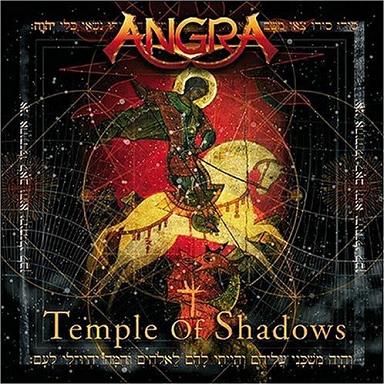
Recorded between January and July 2004 at Mosh Studios in São Paulo, produced by Dennis Ward and out on 6 September, Angra's Temple of Shadows is the album on which the inheritance becomes a guest list. One track hands the microphone to Hansen, another to Hansi Kürsch of Blind Guardian, a third to Sabine Edelsbacher of Edenbridge, and a fourth to Milton Nascimento, past sixty and the grand name of Brazilian folk and fusion.
"The Temple of Hate" makes the point without stating it. Hansen takes a verse against Edu Falaschi, and the two voices are a generation apart in provenance and interchangeable in function: the man who helped write the rule and the man who learned it off a record doing identical work in the same bars.
What the best power metal albums 2000s Europe produced refused

Released on 30 October 2000 and cut at Mi Sueño Studio on Tenerife with Roy Z and Charlie Bauerfeind producing, The Dark Ride is the album on which the band that wrote the covenant committed apostasy against it, hauling the guitars down below the pitch the style had held since 1987. The apostasy is rationed song by song. "Escalation 666" drags the tempo off the double kick and grinds the riff down into a trudge, the low strings chugging under pinch harmonics that squeal where a 1988 lead would have sung, and that is not a sound the band had put its name to before. Roland Grapow wrote it.
That limit is the whole measurement. The bright fast ones still do the classic job, the ballads sit where ballads have always sat, and what comes out is a record darker than the one before it rather than one with the light taken out of it. The major chorus was suspended, not cancelled, which is the size of the inheritance measured on the only band with the standing to refuse it outright.
"Mr. Torture", one of the two singles taken off it that same October, is where the retuning reaches a song written to be funny. A hook that would have gone up bright and open in 1988 sits on a chugging guitar figure instead.
What even that much refusal cost is printed on the sleeves after it. Roland Grapow and Uli Kusch were out of the band at the end of the tour and gone to form Masterplan, and the rest of the decade was spent walking the apostasy back, as far back as a 2005 album with Keeper of the Seven Keys in its title. Nobody else followed them down there. A grammar that has become common property does not take instruction from the people who wrote it.
A grammar that has become common property does not take instruction from the people who wrote it.
The Swedish studio trio with a working stage actor on its demo tape went out as Falconer. Released by Metal Blade in 2001, cut in three weeks at Los Angered and written almost end to end by Stefan Weinerhall, the debut refused the one clause the European school had never put up for discussion. The tenor. Mathias Blad arrives on the note with no grit on it at all, sits in the middle of a baritone range, well under where the style keeps its ceiling, and hurls "Upon the Grave of Guilt" at the back of a house with nobody holding a microphone.
Everything the altitude was holding up comes down with the tenor. There is little stacked refrain, because a baritone multiplied eight deep reads as weight rather than as a crowd, so the tunes have to carry where they sit, and Weinerhall's come out of Swedish folk song rather than the conservatory. Then the bill. The voice the album was built on could not tour, and when the band grew to five and took festival bookings in 2002 it lost him to a theatre with first call on his year.
Earnestness was the next clause to go. Issued by Nuclear Blast on 15 March 2004 with the Deutsches Filmorchester Babelsberg in behind the guitars, Hellfire Club sets a ten minute quest called "The Piper Never Dies" six tracks away from "Lavatory Love Machine" and plays the pair with one conviction, which is how Edguy stopped shielding the style from a joke without once admitting that one was being made.
The decade the records stopped being playable
Money arrived in the middle of the decade, and what it bought was not a better band. Out on SPV on 27 September 2004 and produced by Luca Turilli and Alex Staropoli, Rhapsody Of Fire's Symphony of Enchanted Lands II was made while the band were still billed as Rhapsody, and its credits run past the five players into an orchestra, two choirs, a baroque recorder, a harpsichord, a lute and Christopher Lee reading the story over all of it.
The clause broken there is the oldest one in the music, that a record is a document of a band playing. One track gives its music to Turilli, Staropoli and Vivaldi, a joke with an edge, because nothing on the album can be put on a stage as it stands and a keyboard has done in two hands what an orchestra and a choir did on the tape. The song exists twice from then on, and the full version only in front of a speaker. Blind Guardian had reached the same place two years earlier from the opposite direction, multiplying one throat until the stack would split any stage it stood on.
Why so many of them sound alike
Four hundred and nineteen power metal full lengths came out in 2004 against two hundred and seventy seven in 2000, and the charge that trails the decade is that they are hard to tell apart. The charge is accurate and it is not the criticism it looks like. There is an old device, the rosalia, in which a figure is taken up a step and then up a step again, and the name has carried a reproach for as long as theory has had the word, because anybody competent can produce the thing and so it says nothing for whoever did. It also works every time. Driven up the stave a third time it shoves the top of the tune past where the voice lives and tears the vowel open, and the faithful come up off the floor for it again.
A grammar is precisely the set of moves anybody in the room can make, and a decade in which by 2004, four hundred records a year made them correctly is the proof that the nineties finished the job. Which is why the best power metal albums 2000s audiences still hold on to are a small set inside a very large one, and why each of them carries a price on its face: a band that suspended its own major chorus and lost two of its five players, a band that could not tour, a band whose album cannot be played by the band.
The test is not difficulty and not polish, both of which the decade had in quantities nobody had seen before. It is whether a record named a clause and gave it up. Three did outright, a fourth in part, and no amount of competence anywhere else substitutes for them. The ten years after raised the stake again, and the argument runs on into the best power metal albums of the 2010s.
