
Some time after the summer of 1998 the tapes of a fourth album left a studio in Fulda and went north to a mixing desk in Helsinki. The five players from Hesse who had spent three records learning the German trade and had then quietly stopped learning it were Edguy, and Theater of Salvation came back to them in February 1999 carrying the same engineer's name that Visions had carried in April 1997 and that Ecliptica would carry seven months afterwards. Mikko Karmila mixed all three.
Lay a line of words under a tune one note to one syllable and the music can go nowhere the words will not go: the sentence arrives at the speed a man would say it, the tune turns where the sense turns, and not one bar of it is free. Run one vowel across forty notes instead and the word is split in half on the way, the back of it left on the floor of the bar, the consonant that was going to close it arriving three bars late like a cough, and everything the music wants to do happening inside a syllable that has stopped being a syllable. Those are the only two things a sung line can be. Tied to what is under it, or cut loose from it.
That is the quarrel this decade is about. Any run at the best power metal albums 90s Europe produced has to carry two incompatible kinds of record, cut inside five years by people reading the same magazines, and the line between them runs through the voice: fastened to the material underneath it on one side, riding clear above a gleaming surface laid down to carry it on the other. None of that shows from a distance, which is why the essential power metal albums of these ten years get filed together as one sound and are nothing of the kind.
Germany, 1992 to 1996, with the voice nailed to the riff
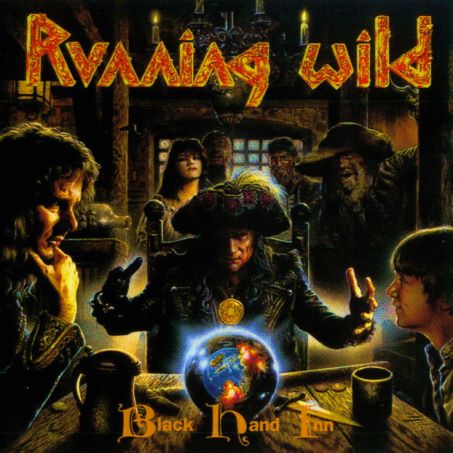
The Hamburg band that wrote its own records, produced them and never built a chorus around a voice it had to bring in was Running Wild, and Black Hand Inn, out in March 1994 with every song credited to Rolf Kasparek alone, is the plainest German specimen of the decade. Its choruses are its riffs with words put on them. Take the guitars out from under the title track and nothing is left to hum, because the melody was never sitting above the guitars at all. It was the guitars, shouted.
"The Privateer", out as a single a fortnight ahead of the album, makes the join audible: the vocal and the rhythm guitar move together through most of the verse, and the singer is not so much accompanied by the riff as bolted to it. That is cheap unity. It is also unbreakable. A song put together that way cannot be prised out of its own record and sold as another band's kind of song.
Take the guitars out from under it and nothing is left to hum, because the melody was never sitting above the guitars. It was the guitars, shouted.
The quartet from Krefeld whose singer was still playing the bass when the thing was finished answers to Blind Guardian, and Imaginations from the Other Side, cut at Sweet Silence in Copenhagen between August 1994 and March 1995 with Flemming Rasmussen at the desk, drives the same fastening home until it is sunk flush and the two cannot be separated without taking the song apart. Seven months in one room for nine songs. The writing crawled because the bar for what survived had been raised, and what fell short went into the bin.
The Hamburg band whose founder took the lead vocal back after eight years of hiring the job out signs itself Gamma Ray, and Land of the Free, out at the end of May 1995 with Kai Hansen singing it himself and Michael Kiske and Hansi Kürsch brought in as guests, makes the German creed's one real concession. Even that concession is structural. The guests walk into songs whose load had already been taken by guitar figures, and a chorus propped on a guitar figure does not care whose throat sits on top of it.
The best power metal albums 90s Europe made after 1996 cut the line loose
The schism runs straight through 1996. The five men whose guitarist wrote every note of the music and produced the record himself were Stratovarius, and Visions, out on 28 April 1997 after a winter at Finnvox in Helsinki, is where the other method arrives finished. Nothing underneath the voice on it carries a tune of its own. The rhythm guitar runs, the keyboard doubles or answers, the bass holds the root, and the whole floor is there so that Timo Kotipelto's line can climb, hold and come down without once having to agree with anything.
A wind part has its breathing places marked into it, which means the shape of the phrase is the shape of a pair of lungs and the music stops where a body stops. Hand the same line to something that does not breathe and every one of those stops goes: the phrase runs on past the point a chest can carry it, the singer is dragged along behind taking his air in the middle of words, and by the last chorus the line snaps in his throat and the top note comes out as a rasp. That is the trade the second method makes.
The Italian band that put a minute and a quarter of instrumental overture at the head of its second album before a syllable is sung called itself Rhapsody, and Symphony of Enchanted Lands, recorded at Gate Studio in Wolfsburg in 1998 with Sascha Paeth and Miro producing it for a German label, drives the cut line as far as it will go. "Wisdom of the Kings" has a tune a child could whistle and four or five things happening under it, not one of which the tune needs. Pull any of them out and the song stands. Pull the tune out and there is no song.
The Finnish band whose singer wrote most of the songs, sang them and played the keyboards on them goes by Sonata Arctica, and Ecliptica, out on Spinefarm on 4 September 1999 and mixed by the man who had mixed Visions, closes the decade on the method's purest statement. Tony Kakko has since called it out of control in a good way, made by people too young to know what they were doing. The hooks say otherwise. Every one is built to be understood the first time and to owe nothing to the bar it stands in.
Two records, one prophet, nothing in common
The cleanest test the decade offers is an accident of subject. Early in 1996 Helloween put out The Time of the Oath, built on the prophecies of Nostradamus, and some fourteen months later Stratovarius put out Visions, built on the prophecies of Nostradamus. Hold the words still and what is left moving is the method. The Helloween songs come to rest downward, onto guitar figures that were in the room before anybody wrote a vocal over them, and the Stratovarius songs come to rest upward, onto a line the band stands back out of the way of.
Which is the better record is a question of taste. Which could be taught to five strangers from the tapes alone is not, and in the judgement of everybody making records after 1999 the German standard-bearers are the harder albums to copy.
The record nothing can be taken out of
Blind Guardian finished the German case in April 1998, a year after Visions, with Nightfall in Middle-Earth: twenty two tracks, ten of which are not songs. "Mirror Mirror" is a single and works like one. The ten pieces wedged between the songs have both ends left raw where the record was cut away from them, and they were meant to. An album assembled so that half of it is worthless in fragments is making a claim about what an album is for, in a decade that had just learned to sell a seventy minute disc and a three minute video off the same tapes.
What 1999 settled

The fourth Edguy full-length, counting the one the band later rerecorded, was written almost entirely by Tobias Sammet, cut at Rhoen Studios in Fulda in the summer of 1998 and released on 1 February 1999 with guest singers and two of the band's own guitarists credited for its choirs, and every one of those is a German decision. The mix is not. Sending the tapes north states in a credit what a young songwriter had decided a power metal record ought to sound like, and he was neither alone nor early.
The decade settled it by what the next bands could use. A chorus fastened to a riff belongs to whoever wrote the riff, and the only way to get another is to write another riff that good. A chorus riding over a surface belongs to anybody who can find a tenor, and after 1999 it belonged to almost everybody. What the best power metal albums of the 2000s inherited is the second method, and the handful of records that refuse it stand out the moment they start.
