

Of all the songs Black Sabbath recorded with Ozzy Osbourne between 1969 and 1978, doom metal has sung from perhaps ten, and they are not the ones the radio chose. The Black Sabbath doom metal songs, the pages the genre actually opens, are "Into the Void" and "Lord of This World" first, then "Electric Funeral" and "Hand of Doom", then a quiet ballad called "Solitude" that gave an American band its first name, and, from the far end of the catalogue, "Heaven and Hell", sung by Ronnie James Dio. "Paranoid" and "Iron Man" belong to all of heavy music; the doom bands left their marks elsewhere. That is the verdict this page defends.
Picture a psalter that has lain for a century and a half along the pews of a parish church, passed hand to hand down the rows every Sunday, and look at what the congregation has done to it without ever meaning to: the spine cracked so that the book falls open by itself at the same dozen psalms, the lower corners of those leaves thumbed grey and soft as old cloth, the paper worn so thin at the fold that the print of the next page shows through, while the rest of the volume, the psalms nobody sings, stays stiff, square and nearly white. That is what the faithful of doom have done to the Sabbath catalogue since the late eighties. The wear is the evidence, in the covers the slow bands put on record and the names they took off the sleeves.
A song enters this list through a cover a doom, stoner or sludge band released, or a band that took its name from it, never through a resemblance a critic heard. How the quartet from Aston came to slow rock music down is told in chapter one of our doom history, and the case for the title song of the debut is argued on its own page. What follows is the book, and the wear on it.
Master of Reality: where the book falls open
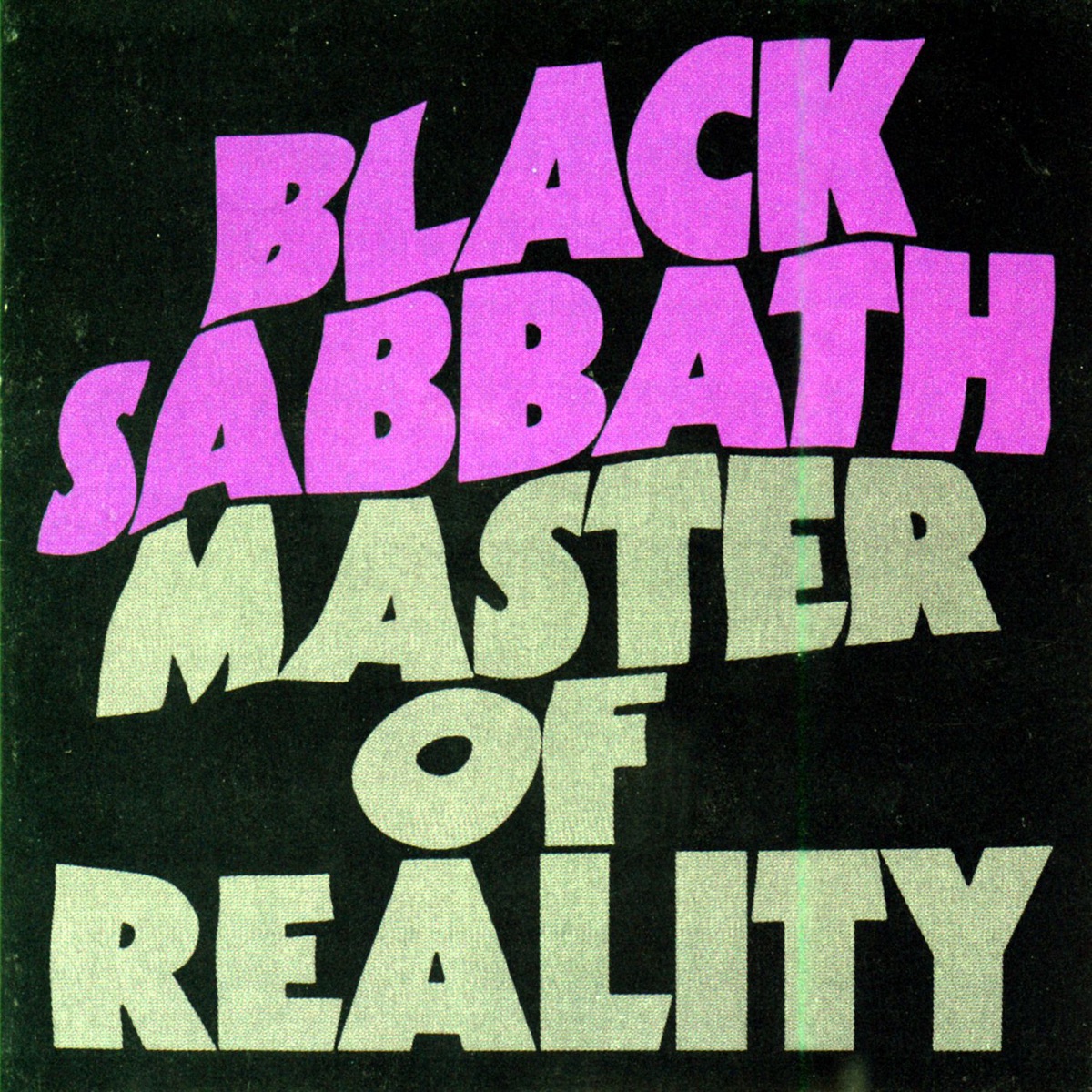
Recorded at Island Studios with Rodger Bain between February and April 1971 and released by Vertigo on 6 August, the third album is the one on which Tony Iommi, sparing the two fingertips he had lost years earlier in a sheet metal factory, tuned his guitar down a step and a half on "Children of the Grave", "Lord of This World" and "Into the Void", with Geezer Butler taking his bass down to match, and those slack strings dropped heavy music onto a lower floor it has never since climbed back from. "Into the Void" cost the band more than anything else on the record. Iommi told Guitar World in 1992 that they tried it in a couple of different studios because Bill Ward could not get it right, and called it "the most difficult one on Master of Reality".
That was a riff that I really liked, and that was Eddie Van Halen's favourite, to be honest, Into The Void.
Tony Iommi on Loudwire Nights, as reported by Guitar.com, 4 June 2024
The riff Iommi remembers, each chord let fall like a sledgehammer dropped from the shoulder under its own weight rather than swung, is the one the desert took. Recorded at Rancho De La Luna in Joshua Tree in March 1995 by the Palm Desert quartet Kyuss, which broke up that summer, and released by Man's Ruin Records as a ten-inch single in 1996, its "Into the Void" came out of the desert a year after the desert band itself was gone. In June 2000 the New Jersey stoner band Monster Magnet stretched the same song past eight minutes for the tribute album Nativity in Black II.
The slow bands' claim on "Lord of This World" is older. Recorded at Razor's Edge in San Francisco in September 1991 by the trio that Sleep had become after its second guitarist left, and pressed by the Swiss label Off the Disk Records as the A-side of the seven-inch Volume Two EP, the San Jose band's version is a twenty-year-old riff torn out of 1971 and set at the head of a record by a band with a single album behind it. The Raleigh band Corrosion of Conformity then recorded it at nearly six and a half minutes for Nativity in Black, released by Columbia on 4 October 1994, on the same disc as a Type O Negative reading of "Black Sabbath" that runs nearly eight.
Paranoid: the dirge and the hand
Recorded in June 1970 and released on 18 September, the second album carried the band's biggest single on its first side and, on its second, two songs radio never touched. "Electric Funeral" is a dirge about nuclear war, its riff dragged like a plough through the ash of a city the bomb has already flattened, and it reached doom first as a name: in 1993 the Dorset trio of Jus Oborn, Tim Bagshaw and Mark Greening called itself Electric Wizard, out of "Electric Funeral" and "The Wizard", the harmonica number on the debut.
"Hand of Doom" runs past seven minutes, and Butler wrote its words about American soldiers coming back from Vietnam with heroin habits. Recorded in June 1997 and released at the end of that year by Man's Ruin Records as a ten-inch record on orange vinyl, the Nuclear Guru EP by the London stoner doom band Orange Goblin put its own title track on one side and a seven-minute "Hand of Doom" on the other, and both tracks were later paired with Electric Wizard's Chrono.Naut on a split CD. Slayer covered "Hand of Doom" three years later, for Nativity in Black II.
Doom did not take Black Sabbath whole. It took a handful of pages, and it wore those pages thin.
Solitude: a ballad, a band name and a Dio song
The strangest worn page in the book is a quiet one. "Solitude", from the second side of Master of Reality and later the B-side of the "Children of the Grave" single, is a slow song about the end of a love affair, with Iommi on flute and piano, and it carries no heavy riff at all. Doom heard its lentitude anyway. When the guitarist John Perez founded a doom band in Arlington, Texas, early in 1987, he called it Solitude, in homage to this song and to the song of the same name on the Candlemass debut, and the band was later renamed Solitude Aeturnus. In England, Cathedral recorded a cover of "Solitude" that first appeared on Masters of Misery, the Earache Records tribute to Black Sabbath, in its Japanese edition, issued by Toy's Factory on 25 December 1992; the same recording came back in 1994 as a bonus track on the European edition of Nativity in Black, and again on Earache's 1995 and 1997 reissues of the tribute.
The Texan band then opened a page the older faithful had left almost clean. Recorded at Rhythm Studios in England in April 1998 with the co-producer Paul Johnston and released by Massacre Records on 3 August 1998, Adagio, the fifth Solitude Aeturnus album, closes on a six-minute cover of "Heaven and Hell", the title song of the 1980 album on which Dio replaced Osbourne. The singer, Robert Lowe, went on to front Candlemass itself from 2007 to 2012.
Candlemass and the whole book

Released on 23 November 1988 by Active Records, Ancient Dreams, the third album by the Swedish quintet whose debut had named epic doom, closes its CD edition with a six-minute bonus track called "Black Sabbath Medley", which runs through pieces of "Symptom of the Universe", "Sweet Leaf", "Sabbath Bloody Sabbath", "Into the Void", "Electric Funeral", "Supernaut" and "Black Sabbath". Read against the rest of this page, the medley is a map of the wear. "Into the Void" and "Electric Funeral" are pages the other bands opened too, while "Symptom of the Universe", from the 1975 album Sabotage, and "Supernaut" are pages no other band on this list took, a sign that the Swedish band's devotion ran to the whole book.
Master of Reality is the most worn part of the book, and "Snowblind", from Vol. 4, sits close behind, covered by Sleep for the same Earache tribute, Masters of Misery, in 1992. "Children of the Grave" shares the tuning of "Into the Void", but it gallops, and its cover on Nativity in Black in 1994 came from White Zombie, a band from well outside doom. Doom did not take Black Sabbath whole. It took a handful of pages, and it wore those pages thin.
Black Sabbath's original line-up played its farewell concert, Back to the Beginning, at Villa Park in Birmingham on 5 July 2025, where Tool played "Hand of Doom" and Lamb of God "Children of the Grave". Ozzy Osbourne died on 22 July 2025.
| Sabbath song | Sabbath album | Doom band | What it took, and where | Year |
|---|---|---|---|---|
| "Into the Void" | Master of Reality (1971) | Kyuss | A cover, Man's Ruin single | 1996 |
| "Into the Void" | Master of Reality (1971) | Monster Magnet | A cover, Nativity in Black II | 2000 |
| "Lord of This World" | Master of Reality (1971) | Sleep | A cover, Volume Two EP | Recorded 1991 |
| "Lord of This World" | Master of Reality (1971) | Corrosion of Conformity | A cover, Nativity in Black | 1994 |
| "Electric Funeral" | Paranoid (1970) | Electric Wizard | Half of its name | 1993 |
| "Hand of Doom" | Paranoid (1970) | Orange Goblin | A cover, Nuclear Guru EP | 1997 |
| "Solitude" | Master of Reality (1971) | Solitude Aeturnus | Its first name, Solitude | 1987 |
| "Solitude" | Master of Reality (1971) | Cathedral | A cover, Masters of Misery (Japanese edition), reused on Nativity in Black (European edition) | 1992 |
| "Snowblind" | Vol. 4 (1972) | Sleep | A cover, Masters of Misery | 1992 |
| "Heaven and Hell" | Heaven and Hell (1980) | Solitude Aeturnus | A cover, Adagio | 1998 |
| Seven songs in one medley | 1970 to 1975 | Candlemass | A bonus track, Ancient Dreams CD | 1988 |
What the table records is a reading habit, the same one that shows in a psalter at the end of a pew: band after slow band opening one book at the same few places, until those places are what the book means to them. What the word doom names once the covers are set aside is the question of what Doom Metal Actually Means. The pages it opens are not in dispute.
