
Love alters not with his brief hours and weeks,
But bears it out even to the edge of doom.William Shakespeare, Sonnets, 116, 1609
Before it named a genre, the word named a sentence. When the sonnets were printed in 1609, the edge of doom in the lines above was no mood and no tempo but the morning of the Last Judgement, and anyone who reaches doom metal through a record sleeve rather than through a church has to begin by putting that older weight back on the word.
The documented history is short and severe. Old English dōm meant a law, a statute, a decree, a judgement handed down, from a Proto-Germanic *dōmaz that also gave Old Norse dómr and Gothic dōms, and the verb beside it, dēman, survives as deem. In the law code attributed to King Alfred in the late ninth century, judges are told not to pass one doom on the wealthy and another on the poor. The word was neutral. A doom was simply what the court decided.
From judgement to fate: what the word doom meant
The darkening came slowly, and it came out of the church. The adverse sense of doom as fate, ruin and destruction appears in the early fourteenth century and becomes general only after about 1600, grown out of doomsday, dōmes dæg in Old English, the day of the one judgement nobody could appeal. By Langland's Piers Plowman in the late fourteenth century, the Last Judgement was the word's first meaning, and the crack of doom in Macbeth is the trumpet that announces it.
It was also the name of a picture. A doom, in the vocabulary of medieval churches, is a wall painting of the Last Judgement, often set over the chancel arch so that the congregation faced it through every service: Christ enthroned at the top, angels with trumpets calling the dead out of their graves, the saved led up towards a walled heaven and the damned driven down into the jaws of the Hellmouth. The one over the chancel arch of St Thomas's Church in Salisbury, painted around 1500, sets Christ and the twelve apostles above heaven and hell and was whitewashed over in 1593 and uncovered in 1881.
What doom metal means as music
Set against that history, the musical definition is simpler than the arguments around it. Descended from the title track of the first Black Sabbath album in 1970, which moves at roughly sixty-eight beats a minute, doom metal takes the heavy metal riff, tunes the guitars and bass down, thickens the distortion until the low strings smear into one weighted mass, and plays it slowly enough that each chord is endured rather than counted, usually in a minor key and often leaning on the tritone. We have gone through the Black Sabbath Songs That Became a Genre in a piece of their own; here it is enough to say that the tempo was only the carrier.
What it carried was the verdict. A doom riff hangs over a song the way that painting hangs over the arch at St Thomas's: fixed in place before anyone walks in, too large to take in at a glance, and set so that nothing in the building reaches the altar without passing beneath it, so that the verses go under it, the solos go under it, and the listener, who at that tempo has time to read every figure from the trumpets down to the Hellmouth, understands long before the last chord that the sentence was painted before the song began.
The voice and the words follow. Traditional doom sings clean and in open despair; epic doom sings as if from a pulpit; the branches that crossed with death metal growl. The lyrics keep to grief, dread and death, to the occult, and in the case of Trouble to scripture, so openly that Metal Blade, which released the Chicago band's debut in 1984, marketed them as white metal.
Slowness is only the tempo. The doom is in what the riff has already decided, and a band that plays slowly with nothing decided has written a long song, not a sentence.
Andrzej Sawicki, KaosMetal
What doom metal does not mean
The commonest error is to hear the tempo and stop listening. Slowness alone puts sludge, drone and much of post-metal on the same shelf as doom, yet the Louisiana sludge bands of the late 1980s took their weight through hardcore punk, screamed where doom sang and aimed at the listener's nerves rather than his mortality, while drone removes the tempo altogether until only the held chord remains. They share the lentitude. They do not share the sentence. The same distinction settles the old quarrel over is Black Sabbath Doom Metal, prototype or the thing itself.
The second error is to take the costume for the verdict. Gloom worn as fashion, the velvet, the candelabra at the lip of the stage, the singer who sighs rather than mourns, is a black cloak hung on a coat stand in a hallway: from across the room it has the outline of a mourner at a graveside, and there is nobody inside it. A band draped in funereal black can have nothing to say about fate, and a band in denim under festival daylight can play a dirge that sentences everyone in front of it.
They share the lentitude. They do not share the sentence.
Where the name came from: Candlemass and Epicus Doomicus Metallicus
Through the first half of the 1980s the slow bands had no common flag, and where the slowness itself came from is chapter one of our history. Witchfinder General released Death Penalty in 1982, Saint Vitus and Trouble their debuts in 1984 and Pentagram its first album in 1985, and still no word was nailed to what they played.

Formed in 1984 in Upplands Väsby, outside Stockholm, by the bassist and songwriter Leif Edling with the drummer Matz Ekström, the band that finally nailed the word down recorded its debut in February 1986 at Thunderload Studios with Ragne Wahlquist producing, on a one-record budget of 1,800 dollars from Black Dragon Records in Paris and with a session singer, Johan Längqvist, who had never heard the band play the songs. The band was Candlemass, and the title was dog Latin for epic doom metal. Released on 10 June 1986, the album sold poorly enough that Black Dragon dropped the band that year, and it named a genre anyway.
By setting doom between epic and metal on the front of a sleeve, Edling turned an old word for judgement and fate into a noun the scene could file records under, and the opener, "Solitude", a song about the wish to die sung over riffs of leaden patience, showed what belonged beneath it. Epic doom takes its name directly from the album, and Chris Chantler of Metal Hammer, writing in 2020, credited the title with defining the genre outright. The Swedish cognate of the word, dom, still means judgement.
How far the word stretched, and what Khemmis prove
Once it was a noun, the word could take prefixes. Paradise Lost, My Dying Bride and Anathema, the Peaceville bands of northern England, joined it to death metal at the start of the 1990s; Thergothon in Finland slowed it into funeral doom; the stoner bands soaked it in fuzz, the sludge bands dragged it through hardcore, and Sunn O))) reduced it to a single held chord, so that by the end of the century doom named less a sound than a family of sentences passed at different speeds, and the one thing every branch kept was the weight of something decided and not open to appeal.
The clearest present-day proof of how much the word now carries comes out of Colorado. Formed in Denver in 2012, the quartet that describes its music as doomed heavy metal, Khemmis, sets Phil Pendergast's clear, full clean voice and a harsher second voice over twin guitar harmonies of the kind traditional heavy metal made its own, and lays all of it on doom's weight. Its label sold the debut, Absolution, released by 20 Buck Spin on 7 July 2015, as music moving between Southern sludge heaviness and the sombre melody of traditional doom.
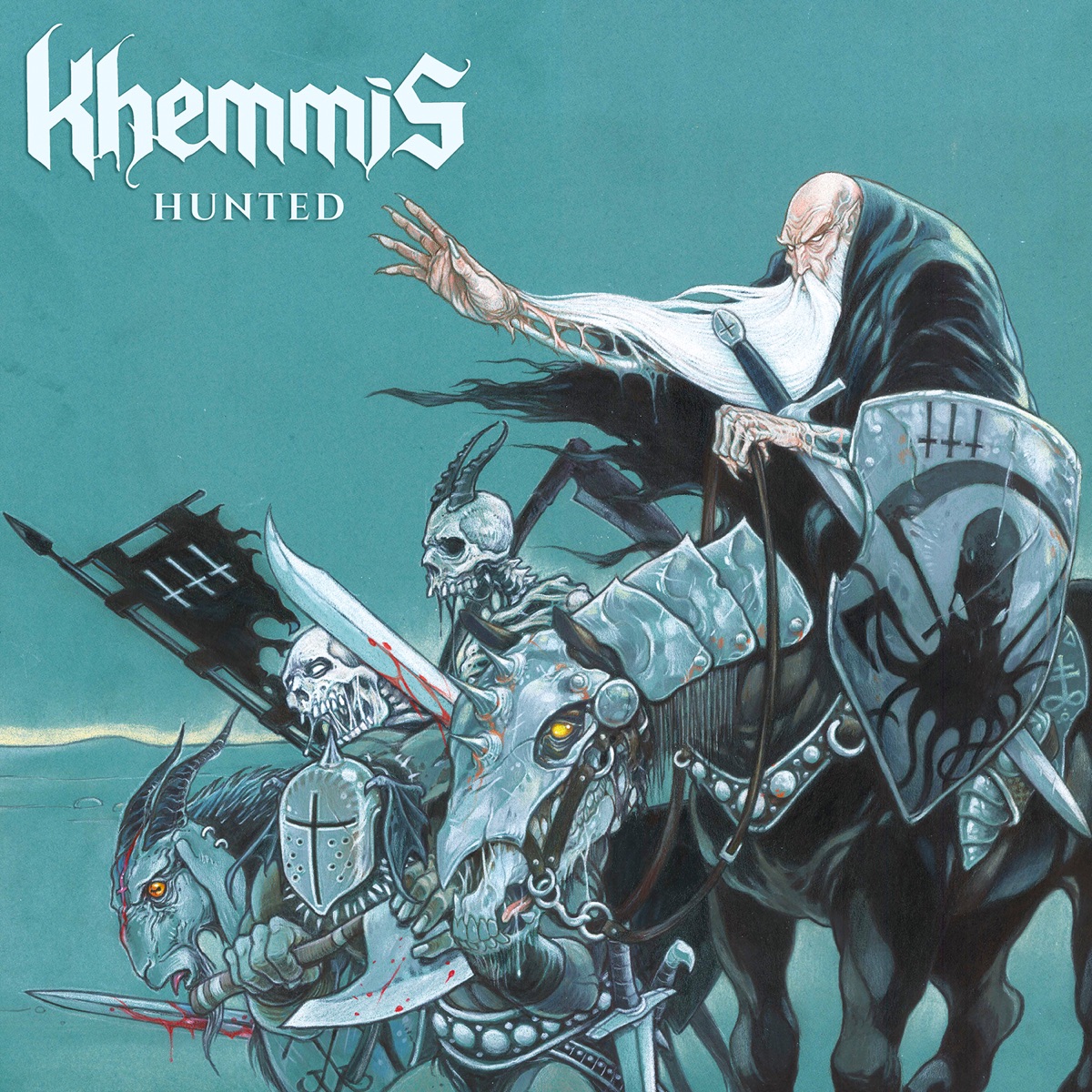
Produced like its predecessor by Dave Otero at Flatline Audio and released on 21 October 2016, Hunted runs five songs from "Above the Water" to a title track of thirteen and a half minutes, and it pushed every other record of 2016 beneath it at the top of Decibel's list of the year. In the reading of No Clean Singing, which premiered "Beyond the Door", that song opens slowly, breaks into a heavy rock drive with dual guitars and a solo, and turns back into a crusher at the close. Desolation followed on 22 June 2018, and Deceiver, the first worldwide Nuclear Blast release on 19 November 2021, took second place on the same magazine's list.
What makes the Denver quartet the proof rather than merely a success is the fifth album. Khemmis, released by Nuclear Blast on 12 June 2026, holds eight songs, the longest of them "Carrion King" at six minutes and twenty-one seconds, and in a statement Consequence published on 9 April the band described a tight, high-energy album that kept the essential Khemmis sound and celebrated the music that had sustained them, its songs not mined from suffering. Measured by tempo alone, that is barely a doom record. Measured by its titles, "Beneath the Scythe", "Tomb of Roses", "Grief's Reverie", and by the verdict still hanging over its riffs, it is nothing else.
That is the meaning under the paint. The word spent centuries under a coat of plain misfortune, the way the doom at St Thomas's spent 288 years under whitewash, and what the genre did, from Candlemass setting it on a sleeve in 1986 to Khemmis writing eight short songs beneath it forty years later, was scrape the lime from the wall and show the older picture: not sadness and not slowness but a judgement, set high over the arch and passed on everyone who walks under it. For every band that has stood beneath it, in order, start from the beginning.
