
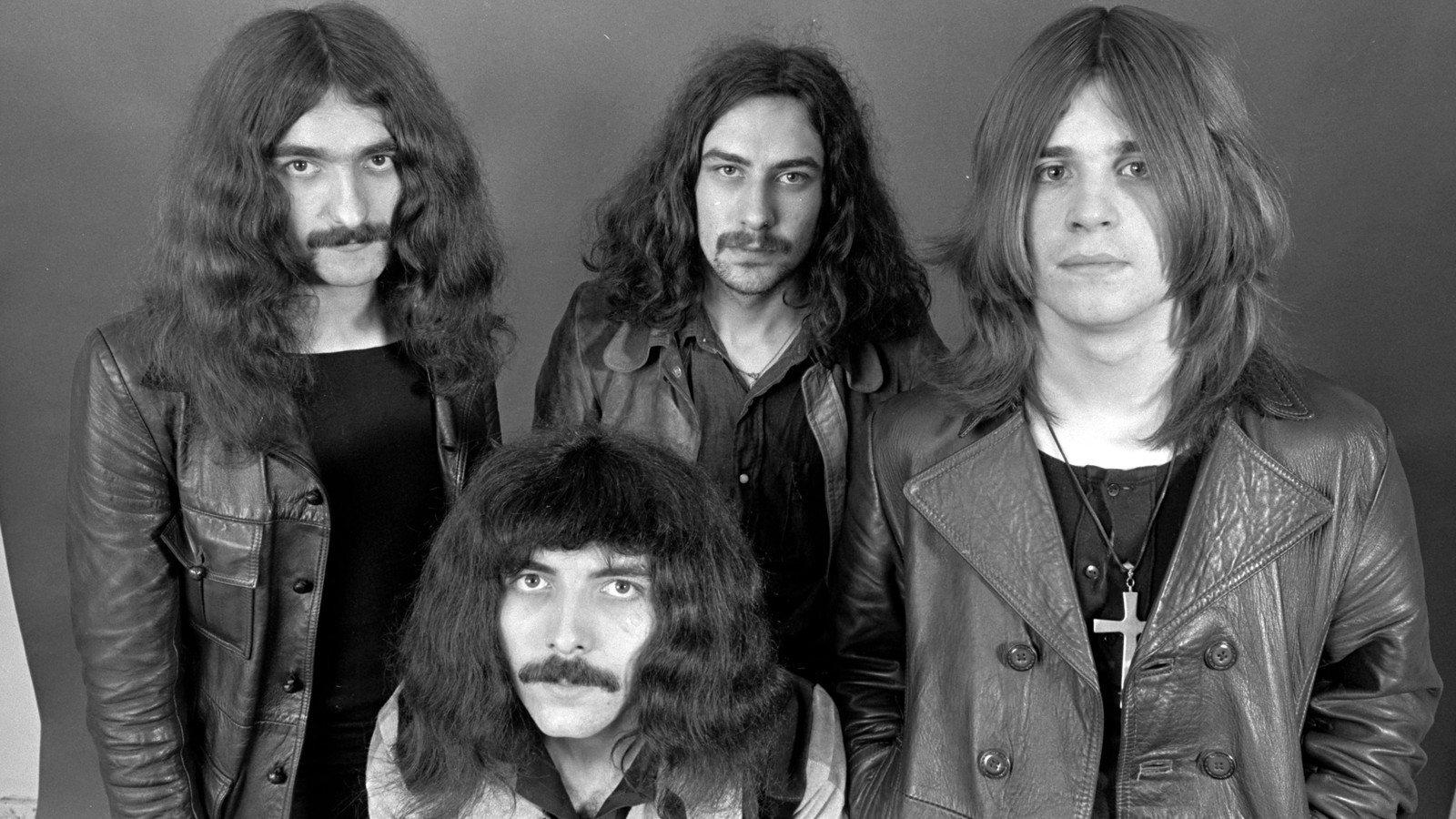
Is Black Sabbath doom metal? No, and the answer has to be given that bluntly before it can be qualified. The four musicians who named themselves after a 1963 Boris Karloff horror film were a doom metal band for no more than a few songs at a time. They are the band doom metal was built on, which is a different and a larger thing: a foundation stone cut in 1970, squared to the weight of a slow minor riff and set into the ground under a building nobody had yet drawn, so that when the architects of the eighties arrived with their plans they found the stone already bedded in, already carrying the load, and had no choice but to raise their walls along its edges.
A handful of songs on the first three albums, recorded between the autumn of 1969 and the spring of 1971, contain nearly the whole grammar of doom, from the tempo and the flattened fifth to the downtuned guitar. Around those songs, on the same records, stands a band that swung like the blues group it had been and wrote a hit single in under half an hour, and that a decade later took on a singer from Rainbow and made records of another kind. How the slowness was first chosen, and who else chose it in the seventies, is the subject of the origins chapter on black sabbath doom metal; here we stay on the question itself.
Black Sabbath wrote the grammar of doom inside eighteen months, and then declined to speak only that language for the rest of its career.
Four songs doom took whole
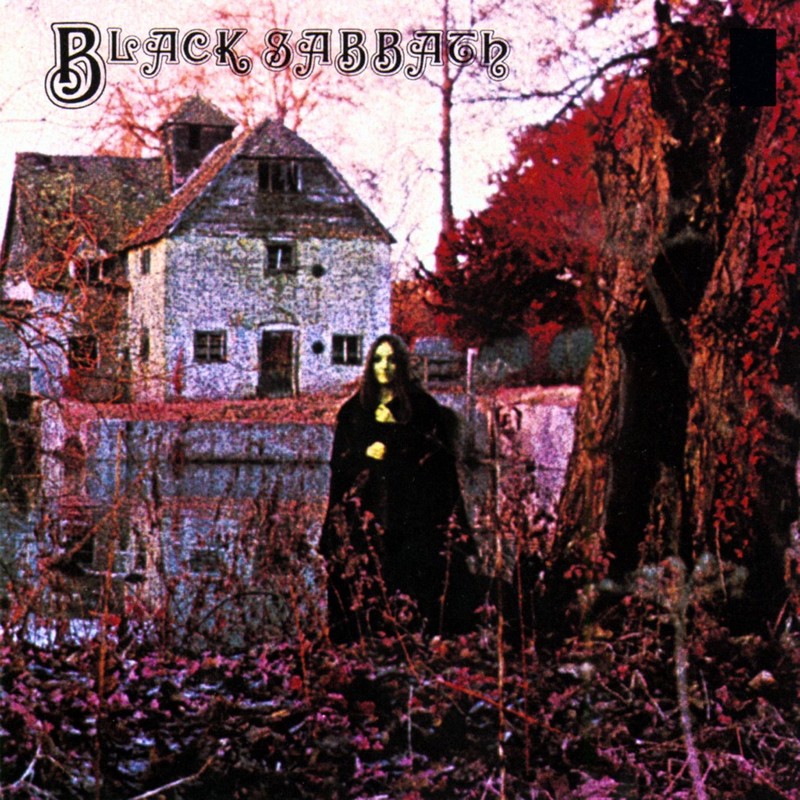
Recorded with the producer Rodger Bain, largely at Regent Sound in a session of roughly twelve hours, and released by Vertigo on Friday 13 February 1970, the debut album opens on rain, thunder and a distant bell before Tony Iommi sounds the three notes on which the title song rests, a root, its octave and the flattened fifth that theorists long called the devil in music, and then lets each chord stand in the room like a weight lowered onto a floor nobody is sure will hold it. The slowness is the song. Only in the closing minutes does the band break into a faster section.
Seven months later came Paranoid, taken to number one on the British album chart, with two more pieces of the plan. "Electric Funeral" sets a wah-wah guitar under Ozzy Osbourne singing of a world burned flat by the bomb. "Hand of Doom" takes the heroin habits of American soldiers back from Vietnam and sets them in a song more than seven minutes long, putting the word doom into a Sabbath title for the first time.
The fourth song closes Master of Reality, released in the summer of 1971, and on it the tuning and the tempo finally meet. "Into the Void" begins on a riff so weighted that it moves like a loaded barge pushed against a river's current, every stroke of the guitar shoving the song a yard forward before the water takes half of it back. Take those four songs away and doom has no first chapter.
A factory accident and three semitones
The tuning has a cause, and it was not an aesthetic one. On what was meant to be his last day at a sheet metal factory in 1965, the seventeen-year-old Iommi lost the tips of the middle and ring fingers of his right hand, the fretting hand of a left-handed player, in a machine. He made caps for the injured fingers from melted plastic, covered them with leather, and went looking for the lightest strings he could find, because the caps made bending a heavy string a struggle.
Slack strings are easier to fret and easier to bend, and so on three songs of Master of Reality, "Children of the Grave", "Lord of This World" and "Into the Void", Iommi tuned a step and a half below standard, with Butler taking his bass down to match. Critics have since traced stoner rock and sludge metal back to that album. Three semitones were given up to spare an injured hand, and nobody who came after has handed them back.
The same album shows why the tuning alone does not make Black Sabbath a doom band. "Children of the Grave", issued as a single in 1971 and tuned exactly as low as "Into the Void", runs on galloping verse riffs that, in MusicRadar's telling, spilled over into the new wave of British heavy metal a decade later. It is heavy, and it gallops where "Into the Void" drags. What doom took from Black Sabbath without condition was the register; the lentitude it had to select, song by song, from a band that did not always select it.
The other Black Sabbath: swing, singles and the Dio years
Built around a drummer whose first heroes were the big band players Gene Krupa, Buddy Rich and Louie Bellson, the band started out playing the blues and never entirely stopped swinging, and the debut already carries "The Wizard", pushed along by Osbourne's harmonica. That is not a dirge. Doom took its model from a narrow strip of these records, which is why any account of the roots, the scenes and the branches of the genre starts with four or five Sabbath songs.
The title song of Paranoid is the plainest evidence. Written in the studio because the album was a song short, in twenty or twenty-five minutes by Bill Ward's account, it lasts under three minutes, and as a single it reached number four in Britain in 1970. No other Black Sabbath song has entered the British top twenty; "Paranoid" itself did so twice more, reissued in 1980 and again in 2025. The most famous song Black Sabbath recorded is one of the least doom songs in its catalogue.

The Osbourne era ended in 1979, when the band dismissed its singer and brought in Ronnie James Dio from Rainbow. Recorded with Martin Birch and released on 18 April 1980, Heaven and Hell reached number nine in Britain and twenty-eight in the United States, and with "Neon Knights" as its opening track and first single the new line-up arrived in the same season as the new wave of British heavy metal, the young, largely self-financed groups then filling the country's clubs. Mob Rules followed in November 1981 with Vinny Appice in place of Bill Ward, and that line-up returned for Dehumanizer in 1992. They are strong heavy metal records. They are not doom records.
How the doom bands have named their forebear
The doom bands have answered the question with their own names. The American quartet that began in 1978 as Tyrant, one of the first bands anywhere to make slowness its entire method, renamed itself Saint Vitus in 1980 after "St. Vitus Dance", a two-and-a-half-minute song from Vol. 4, recorded at the Record Plant in Los Angeles in 1972, whose guitar introduction Mojo described in June 2013 as jaunty and Led Zeppelin-flavoured. The band that would spend four decades on dirges did not name itself after a dirge.
The English trio of Jus Oborn, Tim Bagshaw and Mark Greening called itself Electric Wizard in 1993, out of "Electric Funeral" and "The Wizard", a doom song and a harmonica number. A year earlier Earache Records had assembled a tribute from its own roster on which Sleep covered "Snowblind" and Cathedral recorded two songs, "Solitude" and "Shock Wave". The deepest devotion belongs to Leif Edling, bassist of Candlemass, who told Classic Rock in May 2024 that he owned seventy-one different vinyl editions of the Sabbath debut, and said of it: "Nothing sounded like it at the time. Nothing sounds like it now." They cite Black Sabbath as pedigree, not as a peer.
| Band | What it took | Sabbath song | Sabbath album | Year |
|---|---|---|---|---|
| Saint Vitus | Its name, in place of Tyrant | "St. Vitus Dance" | Vol. 4 (1972) | 1980 |
| Sleep | A cover for the Earache tribute | "Snowblind" | Vol. 4 (1972) | 1992 |
| Cathedral | Two covers for the same tribute | "Solitude" and "Shock Wave" | Master of Reality (1971) and Never Say Die! (1978) | 1992 |
| Electric Wizard | Its name, from two titles | "Electric Funeral" and "The Wizard" | Paranoid (1970) and Black Sabbath (1970) | 1993 |
A genre named after the fact
The chronology settles the rest. When Black Dragon Records released Epicus Doomicus Metallicus, the Candlemass debut that gave epic doom its name, on 10 June 1986, the most recent Black Sabbath album was Seventh Star, a hard rock record sung by Glenn Hughes and billed as Black Sabbath featuring Tony Iommi. The style was being named by bands that had found the stone, while the band that laid it was several line-ups and a whole sound away. Thirty-three years later the two stories touched again, when Iommi played a guest solo on "Astorolus - The Great Octopus" from The Door to Doom, released by Napalm Records on 22 February 2019.
So the precise answer runs like this. Black Sabbath is the band without which doom metal could not have been played, the author of its first riff, its tuning and the four or five songs every doom band still measures itself against. It is not a doom metal band, because for most of its career it was busy being something else, a blues band that swung and then, with Dio at the front, a heavy metal band of another kind, and to fold all of that into one of its own inventions is to shrink it. Whether anyone played doom as a whole band, rather than as a handful of songs on somebody else's albums, is the next and harder question, what Was the First Doom Metal Band, and it has more candidates than this one.
