
"Why Should the Devil Have All the Good Music?" is a question, not a slogan, and it was put on a record on 14 November 1972. The Jesus Movement singer who asked it, on the album Only Visiting This Planet, in a rock and roll song that rattled the organ out of the church hall and threw the hymnbook in after it, was Larry Norman, and every Christian heavy metal song since has been an attempt to answer him with something louder than he ever played.
Most attempts failed, and not for the reason their critics assumed. Nobody doubted the sincerity. The Christian heavy metal songs that lasted are the ones in which the belief rode on the music without once reaching for the controls, and the ones that dated fastest are the ones in which the lyric sheet took the wheel. The creed was never the problem. The steering was.
On 17 August 1859 the tightrope walker Charles Blondin crossed the Niagara gorge on a hemp cable with his manager, Harry Colcord, clinging to his back, the falls hammering the rocks below and guy ropes snapping along the span, and by the accounts of the day he gave his passenger one order before stepping out: sway when I sway, and never try to balance on your own. They made it across in about twenty minutes. The passenger was the only thing that could have killed them both.
Every song in this family carries a passenger that a secular song does not, and the rope is the riff. When the message sits still and sways with the guitars, the song crosses. When it starts balancing for itself, preaching over the chorus, correcting the bridge, stopping the solo to make a point, the whole thing goes into the gorge.
Christian heavy metal songs and the man on the rope
The prehistory is short. Black Sabbath's "After Forever", on Master of Reality in 1971, was a Christian lyric by a Catholic bassist, set to a Tony Iommi riff and never announced as anything else. It worked because nobody on the record asked the listener to agree. Heavy metal waited more than a decade for a band to make a career of it.

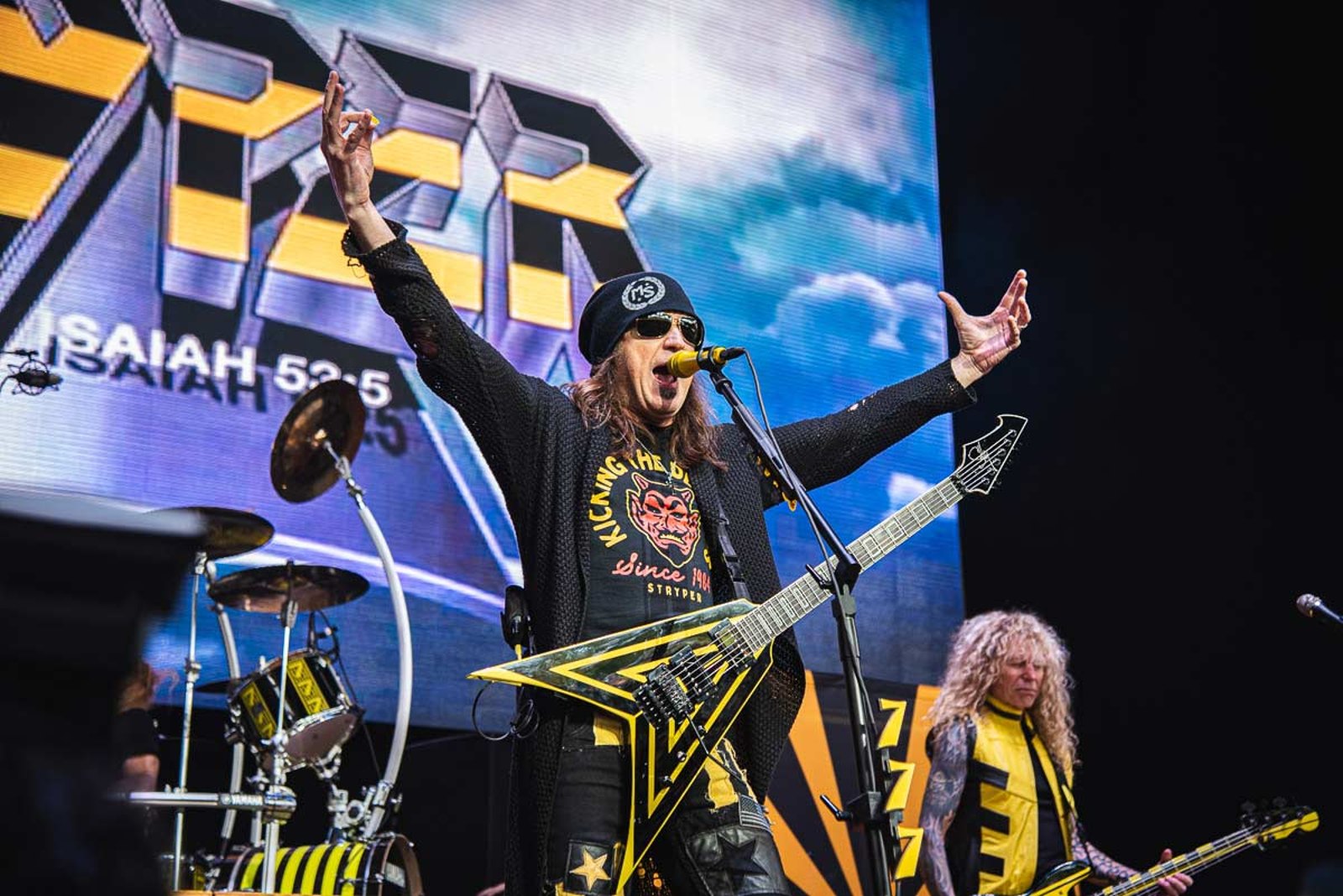
The band that finally carried the passenger across in front of the whole unbelieving world, on MTV and the Billboard charts at once, was Stryper. Released by Enigma on 24 October 1986, To Hell with the Devil became the first Christian metal album to sell a million copies and held that record until P.O.D.'s Satellite arrived in 2001, and its title track opens the record with a barrage of twin guitars trimmed, like most of the record, for the radio.
The songs that travelled furthest were the ones in which the passenger kept still. "Calling on You" reached number two on Dial MTV, the channel's nightly countdown of the most requested videos, and "Free" went to number one there in 1987, both of them pop metal choruses built on Michael Sweet's high tenor and the harmony guitars of Sweet and Oz Fox, with the faith in the words and nothing in the arrangement leaning on it.
The one that crossed into the Hot 100 was the quietest. "Honestly", the fifth single from the album, peaked at number 23 in 1987, the band's only top 40 hit, and it is a piano ballad that could be sung to a person as easily as to a God, which is exactly why it went where the heavier songs could not. The believers wrote it. The radio heard a love song.
A Christian band never had to hide the message. It had to stop the message from playing lead guitar.
Declan Rourke, KaosMetal
The Enigma and Pure Metal shelf
Behind Stryper stood a second rank on the small labels, and the songs sort cleanly on the rope. The Los Angeles four whose singer climbed into the register of Bruce Dickinson and whose video for "Imaginary Music" went into rotation on MTV's Headbangers Ball, the weekly metal programme, were Barren Cross. The song comes off Atomic Arena, released by Enigma in 1988, and it is a warning about the fantasy of rock stardom, the stage and the cheering crowd, a subject every metal band on the network could have claimed. That is why it crossed.
Pure Metal Records supplied the rest. From Salem, Oregon, Saint released Too Late for Living in 1988 with Josh Kramer singing, a record whose closeness to Judas Priest is the first thing its reviewers still point to, and its apocalyptic lyrics ride the gallop rather than interrupt it. From Illinois came Whitecross, whose self-titled debut arrived on 5 September 1987 and whose guitarist Rex Carroll took his solos at a sprint, fast and bright and loud enough to make the sermon wait its turn. Triumphant Return and In the Kingdom later took the Dove Award for Hard Music Album of the Year, in 1990 and 1992, the gospel industry's own prize, so the church's own jury ended up judging the guitars.
The Seattle band that went furthest in the opposite direction, putting the message on stage in costume, was Bloodgood. On the British tour of 1988 its singer, Les Carlsen, played Pontius Pilate during "Crucify", and the band staged the crucifixion itself in front of the audience, a Passion play performed with a drum riser for a hill.
It is the most sincere set piece in this music and the least portable. "Crucify", from Detonation in 1987, needs the staging to make sense; without it the song is a narrative in search of a stage, and a listener who was not raised on the story has nothing to hold. Here the passenger did not just balance. He took the pole.
The same fate met the single-issue songs of the late eighties, written to argue a position that was in the news that year, which played to the converted and to almost nobody else. A song that needs the listener to agree before the first chorus has already lost the crossing. The riff cannot carry a man who is trying to walk on his own.
The creed was never the problem. The steering was.
Tourniquet and the eight-second ride
The drummer who wrote most of the songs, filled the lyrics with medical vocabulary from his years in the pharmaceutical trade and pushed Christian metal into technical thrash was Ted Kirkpatrick, and the band he built in Los Angeles was Tourniquet. Their riffs change metre the way a rodeo bull changes direction, twisting out from under the rider on every third bar, throwing him forward over the horns and sideways into the rails, and the singer's whole job is to stay aboard for eight seconds at a time.
"Ark of Suffering", the third track on the 1990 debut Stop the Bleeding, is a song about cruelty to animals, and its video, cut with graphic footage of abuse, got a short run on MTV before the network pulled it. It is the one song on the Christian shelf whose argument a secular listener could hardly refuse, and it made the band's name for a stance rather than a doctrine. The rider stayed on. The message was simply the right weight.
| Song | Band | Year | On the rope |
|---|---|---|---|
| After Forever | Black Sabbath | 1971 | Belief inside a riff, never announced |
| Calling on You | Stryper | 1986 | Pop metal chorus, number two on Dial MTV |
| Honestly | Stryper | 1987 | The ballad that reached the Hot 100 |
| Imaginary Music | Barren Cross | 1988 | A song about music, on Headbangers Ball |
| Too Late for Living | Saint | 1988 | Apocalypse riding the gallop |
| Crucify | Bloodgood | 1987 | Needs the stage to make sense |
| Ark of Suffering | Tourniquet | 1990 | An argument nobody could refuse |
| Psalm 9 | Trouble | 1984 | Sold as white metal, built to outlast the tag |
White metal, and the band that refused it
The singer who spent years telling interviewers that his band had never been Christian metal, whatever the adverts said, was Eric Wagner of Trouble. Metal Blade sold the Chicago band's debut, released in March 1984 and known ever since as Psalm 9, as white metal, a marketing answer to the black metal of the day, and Wagner told Metal-Rules.com in January 2004 that he wished the label had never used it, worried it would be mistaken for a message he was not preaching.
The title track and "The Tempter" do carry a believer's vocabulary, sin and grace and judgement, but the slow riffs underneath would have outlasted any label printed on the sleeve, and they have. The records sold on the tag for a year. They have sold on the riffs for forty. Whether Psalm 9 deserves a place beside the records ranked in the chapter above is a question about the music alone, which is the only question that ever mattered.
Beyond dispute, the vanguard of Christian heavy metal won its argument with Larry Norman long ago: the believers got the good music, or at least a shelf of it, and the proof is that people with no faith at all still play "Calling on You", "Imaginary Music" and "Ark of Suffering" for the guitars. The decade after them turned the whole style upside down, and what survived it is gathered in the 90s heavy metal songs. The songs still stand. So does the question.
