
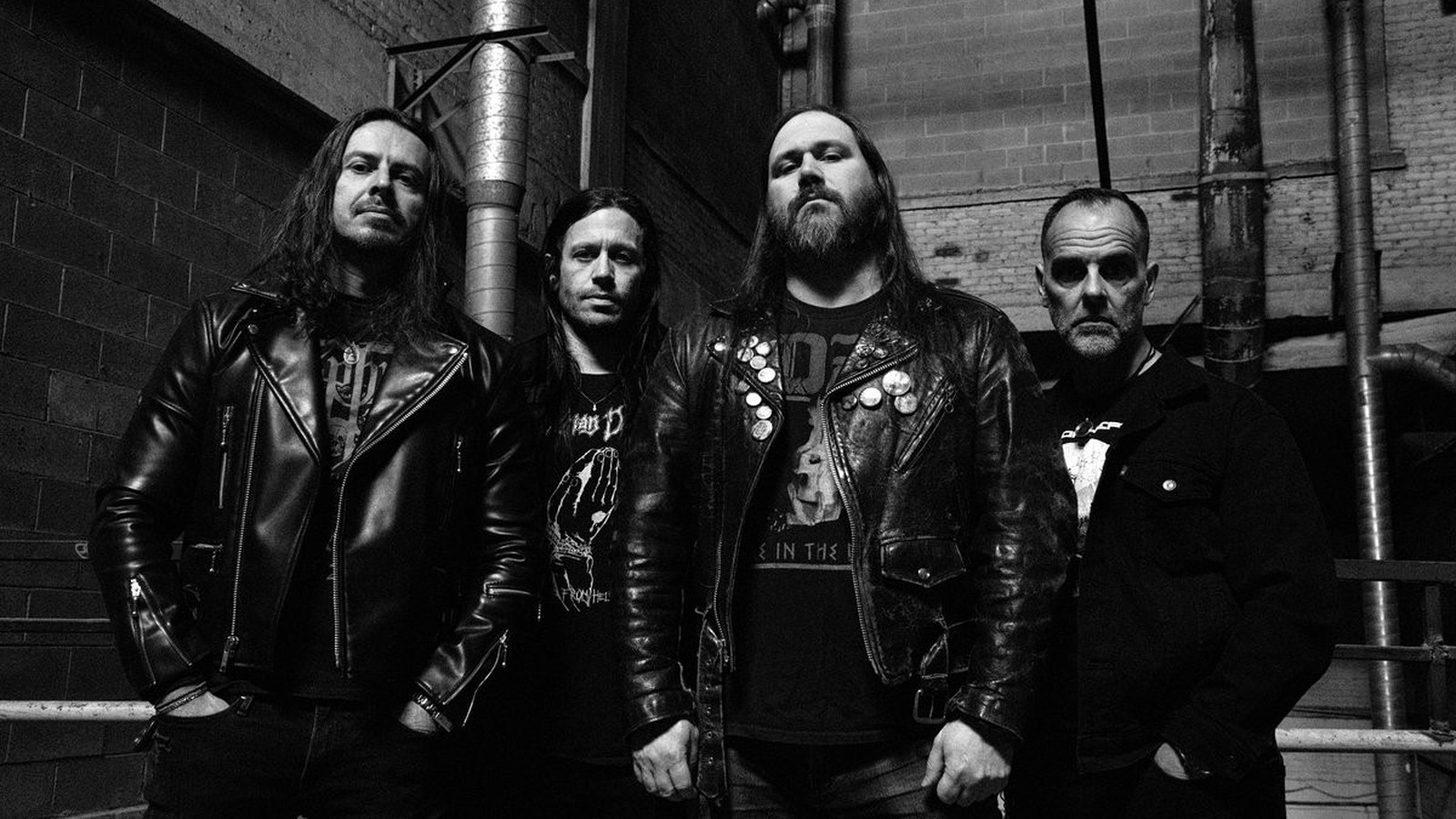
One hundred releases into its life, on 31 July 2012, Profound Lore Records put out Atra Mors, the fifth album by Evoken: sixty-seven minutes of death doom under a title that is Latin for the Black Death, by a band founded in Lyndhurst, New Jersey, in April 1992 under the name Funereus and renamed two years later after a song on a demo by the Finnish band Thergothon and by then twenty years into dragging its riffs across the floor of the American underground. A style that was supposed to have finished its work in the north of England by the middle of the nineties was filling a label's hundredth catalogue slot two decades later. The number is the argument.
The usual account of death doom is short and English. It runs from Winter and Autopsy to Paradise Lost, My Dying Bride and Anathema, it is told properly in Peaceville and what it pressed, and it ends when those three bands put the growl away. We do not retell it here. This is the roster the short account leaves out: bands from Chicago to Tokyo, Temple of Void among them, who went on making this music on small labels for thirty-five years, each on this page for a record, a year and a label.
Consider first what a peat bog does with a body. On 1 August 1984 a peat worker at Lindow Moss in Cheshire pulled what he took for wood off an elevator, and it belonged to a man who had died somewhere between 2 BC and AD 119. The acid water and the sphagnum moss had not let him rot. They had tanned him, skin, hair and fingernails still in place, the skull pressed out of shape by the peat, a human body cured into leather by two thousand years of cold and airless dark and lifted out still recognisable as a man.
Death doom outside Yorkshire has kept its bands the way that moss keeps its dead. Not in the light, but whole: Cianide went down into the Chicago underground in 1989 and came up thirty years later with an EP, Unhumanized, in December 2019, its features exactly where they had been, the riff tanned hard, the growl cured to leather, nothing softened and nothing lost. The peat does not improve what it holds. It refuses to let it decay, and in this music that refusal is the whole achievement.
Traitors and deserters they hang upon trees. Cowards, and sluggards ... they smother in mud and bogs under an heap of hurdles. Such diversity in their executions has this view, that in punishing of glaring iniquities, it behooves likewise to display them to sight; but effeminacy and pollution must be buried and concealed.
Tacitus, Germania, chapter 12, translated by Thomas Gordon
Chicago, New Jersey and Orange County: the first bodies in the moss

Formed in Chicago in 1989, the trio that names Hellhammer and Celtic Frost as its teachers, Cianide, with Mike Perun on bass and vocals, released The Dying Truth through Grind Core in June 1992, followed it with A Descent into Hell in 1994 and Death, Doom and Destruction in 1997, and has never left Chicago. Hell's Rebirth, from 2005, is the exception: the notes for its 2023 vinyl reissue on Hells Headbangers call it the band's most straightforwardly aggressive record, pitched at tempos very nearly blast beats, with almost no doom outside the closing "Wormfeast".
Across the same city, a death thrash band called Laceration, formed in 1989, had become Novembers Doom by 1992, with Paul Kuhr at the microphone, where he has stayed ever since. Released by the Italian label Avantgarde Music in early 1995, Amid Its Hallowed Mirth set Cathy Jo Hejna's voice beside Kuhr's growl. Thirty years later Major Arcana, the band's twelfth album, came out through Prophecy Productions on 19 September 2025 with Dan Swanö mixing and mastering it.
On the other coast, the Orange County band Morgion, founded in 1990 and named after the god of plague in the Dragonlance books, recorded almost an hour of music at Jim Barnes' Audio Productions in July 1994 and then waited while a licensing deal with Relapse Records was settled, two and a half years in the moss between the tape and the shop, until Among Majestic Ruin appeared on 28 January 1997. It holds five pieces, with "Relic of a Darkened Past" and "In Ashen Tears (Thus I Cry)" both running past eight minutes. After Solinari in 1999 and Cloaked by Ages, Crowned in Earth in 2004 the band ended, and a short set by former members at Murderfest in Hollywood on 19 April 2008 was its last show.
The New Jersey band that opened this page did not stop there. After Embrace the Emptiness in 1998 and Quietus in 2001, Evoken released Mendacium through Profound Lore on 17 October 2025: a dirge in eight parts, its concept worked out by the drummer Vince Verkay, its tracks named for the hours of the church's daily liturgy, among them "Terce", "Sext" and "Compline".
Copenhagen, Rotterdam and Leinster
Europe, which gave a history of doom metal its first chapter, kept its own bodies in its own moss. Formed in Copenhagen in 1991 as a death metal band called Asesino and renamed in 1993, Saturnus recorded Paradise Belongs to You in 1996 for the Danish label Euphonious Records, a record that sets a flute and whispered voices around Thomas A. G. Jensen's growl, passes through the eight funereal minutes of "Christ Goodbye" and borrows the whispered words of "The Underworld" from William Blake. The Storm Within, in 2023, ended an eleven-year silence.
In Rotterdam a band called Reïncremated became Officium Triste in the spring of 1994, took My Dying Bride and early Anathema as its models, called what it played "Rotterdoom", and released Ne Vivam in 1997 and, twenty-seven years after its debut, Hortus Venenum in 2024. In the Irish province of Leinster, Mourning Beloveth gave the Dublin label Sentinel Records its album Dust in 2002, and Sentinel pressed it again in 2024 as a double LP.
The peat does not improve what it holds. It refuses to let it decay, and in this music that refusal is the whole achievement.
Temple of Void: Detroit cuts into the peat
Formed in 2013 around Mike Erdody, a guitarist in Acid Witch since 2010 who took the microphone here, the Detroit band that put a Bruce Pennington painting on its first sleeve recorded Of Terror and the Supernatural between February and July 2014, with Clyde Wilson at Mount Doom in Warren and the drums at Audiolux in Fenton, released it on 30 September 2014 and later saw Shadow Kingdom Records put it back into circulation. Fifty-one minutes, ending on the ten minutes and forty-one seconds of "Bargain in Death". Chris Dick gave it eight out of ten in Decibel in January 2016, naming Asphyx and Bolt Thrower among its sources and picking out "Rot in Solitude" and "The Embalmer's Art"; the band describes itself in the same terms, early British doom set against old school American death metal.

Lords of Death, released by Shadow Kingdom in 2017 with Eric Blanchard beside Alex Awn on guitar, leaned toward the death metal half: reviewing it for No Clean Singing that October, Comrade Aleks heard the death metal component prevail in "Wretched Banquet" and "The Hidden Fiend", precise attacks delivered at mid-pace. Then the band turned. Recorded at Mount Doom in August 2019 with Clyde Wilson engineering and Don Durr now on second guitar, The World That Was arrived on 27 March 2020 with synthesisers threaded through "Self-Schism" and "Casket of Shame", and with Awn naming Alice in Chains, Failure, Pearl Jam and Ride as outside influences on what he still called very much a death doom record. Justin Norton of Decibel heard bedrock death doom "given depth with vocal harmonies, keyboards". The riffs are still leaden and still dragged along the ground, but for the first time something is breathing under the leather.
The move to Relapse Records, the label that had released Morgion's debut a quarter of a century earlier, brought Summoning the Slayer on 3 June 2022, produced, mixed and mastered by Arthur Rizk and written in the downtime that followed March 2020 by five men who, as Awn told Decibel that June, held day jobs as a firefighter, a charge nurse, a chef and soundman, a high school teacher of autistic children and a director of user experience for Bosch in North America. The sleeve continues the last one: the boat that approached the cave mouth now passes inside. The record sinks through the eight minutes of "Deathtouch", and ends on "Dissolution", a closer that Erdody wanted to fall somewhere between Black Sabbath's "Planet Caravan" and a Budgie ballad.
Tokyo, Boston and the bodies still coming up
Formed in Tokyo in 1996, Coffins worked through a long run of splits and small pressings before The Fleshland, its first record for Relapse, appeared in July 2013, and has gone on digging with Beyond the Circular Demise in 2019 and Sinister Oath in March 2024, each record disinterred from the same pit as the last.
In Boston, the singer and guitarist Justin DeTore, who had played nearly every instrument himself on the earlier recordings, assembled a full band out of the city's hardcore and power violence scene for the debut of Innumerable Forms, Punishment in Flesh, released by Profound Lore on 17 August 2018: ten songs including "Petrified" and "Re-Contaminated". Pain Effulgence followed on 22 August 2025, produced, like Temple of Void's Relapse album, by Arthur Rizk, and announced by its label as built on a blueprint of early nineties Finnish death metal fused with early nineties British death doom. That is how the style is handed on now: the same hands at the desk, the same peat, a new body.
Not every band that went into the moss came out growling. Saturnus kept a flute and whispered voices close to the growl on its debut, and the branch that let the growl go altogether, the one Paradise Lost and Anathema walked into in the late nineties, is gothic Doom Metal. The roster above belongs to the other branch, the one that stayed in the peat. In 2012, long after the Peaceville bands had moved on, Profound Lore's hundredth release was a death doom album from New Jersey. That is what preservation looks like in this music: not a revival, only a face still recognisable when the spade reaches it.
