
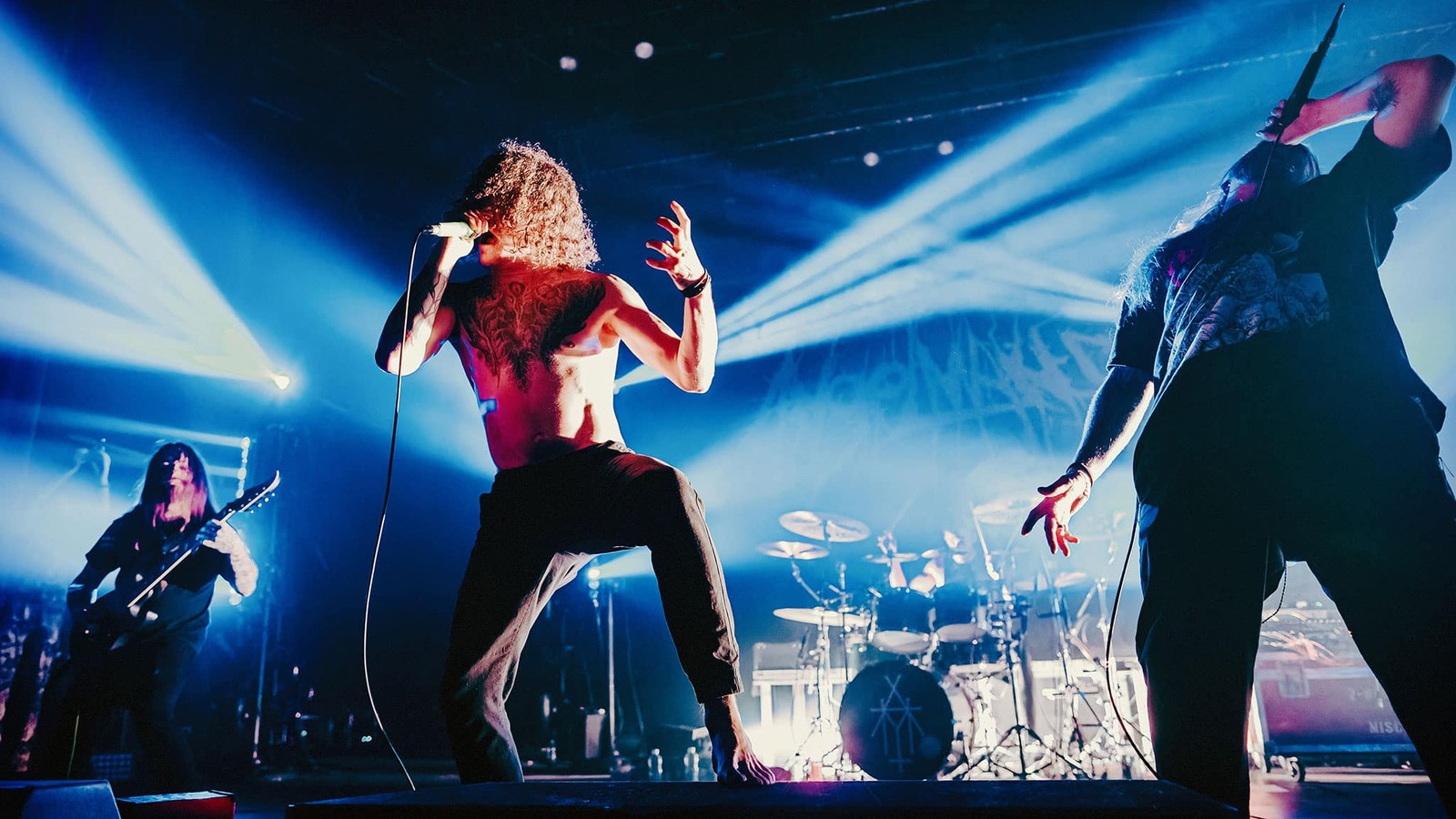
Booked as a farewell, hauled through Australian clubs in the last months of 2010 at the tail of six months on the road in twenty-four countries, the Montreal band that had split one microphone between two singers since 2004 and was going home to break up was Despised Icon, and the young band ripping through the support slot, months after its first full-length, The Adversary, came out on 16 July 2010, was Thy Art Is Murder, from Blacktown on the western edge of Sydney. The Red Shore filled the other slot.
One band was leaving. The other was arriving.
That handover is the shape of the whole decade. The 2010s deathcore bands that count were mostly formed between 2009 and 2014, after the MySpace gold rush had already paid out, and they had to earn a place by smashing something the founders had left standing: a border, a tempo, a tuning, the idea that a band needs a drummer, a label or the same singer for more than two years. None of them did it the same way.
Every all-ages hall that rents to heavy bills keeps a damage sheet on a nail behind the bar, one line per night, and ten years of bookings fill it with a different breakage on every line: a subwoofer split down its seam by a tuning lower than the cabinet was built to take, a horn driver blown out of its housing by a voice pushed past the top of the PA, a ceiling tile punched loose by a stage diver's boot on a breakdown slowed to half its old speed, the riser's carpet torn off the plywood in one strip by a drummer who was never in the room because his kick was programmed. The founders broke the same thing every night. The bands that followed each wrote a new line on the sheet, and each line names what that band broke.
The founders and the orchestral wave of the 2020s already have their places in the band roll call. The ten years between them were crowded with bands that never had a MySpace Top 8 to climb, and the chart entries, label moves and splits of 2010s deathcore only make sense once you know which band broke what.
Four bands the decade cannot be told without
Start with the support act. Thy Art Is Murder broke a ceiling that had held for death metal in its own country: Hate, released through Halfcut in October 2012, went into the ARIA chart at number 35, the highest debut an Australian death metal band had managed, and in October 2013 the record put the band up for the ARIA Award for Best Hard Rock or Heavy Metal Album, which went to Karnivool. A deathcore record was on the shortlist of the night the national music industry handed out its prizes. Nobody had booked that seat for it.
The war party around Thy Art Is Murder was small and tight. In August 2016 it put out The Depression Sessions, a split with Fit for an Autopsy and The Acacia Strain, three bands from two continents sharing one sleeve, and that list of names is a fair map of who the Australians counted as peers.
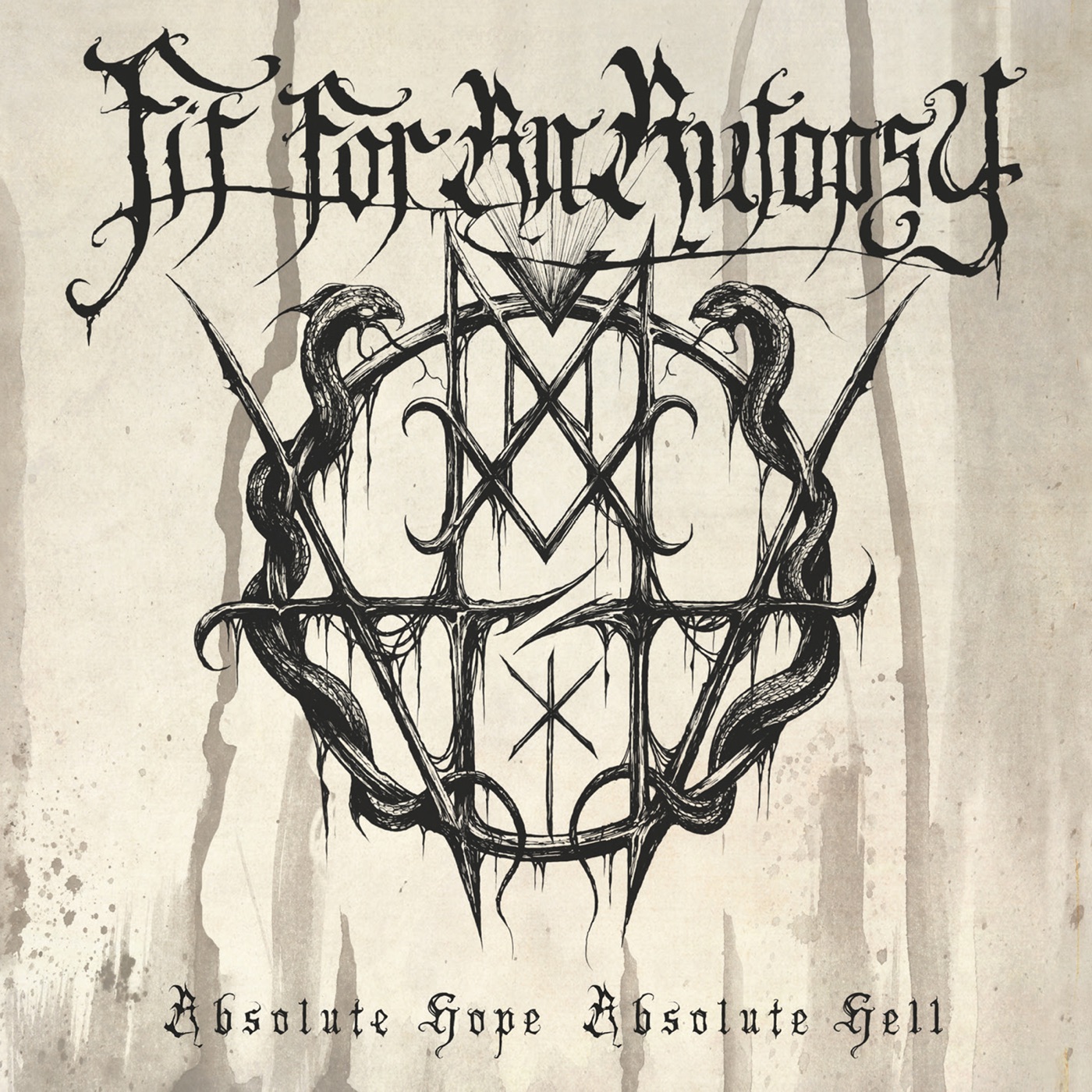
Formed in Jersey City in 2008 around a guitarist who also sat behind the producer's desk, put out Hellbound in September 2013 with Nate Johnson still at the microphone, and then made to go through three singers in under a year, with Johnson leaving in April 2014, Greg Wilburn of The Devastated standing in for most of what was left of it and Joe Badolato taking the job in February 2015, the band that proved a deathcore group could lose its voice and keep its sound was Fit for an Autopsy. Will Putney stayed on guitar through all of it. The riffs never changed hands, and Absolute Hope Absolute Hell, released on 2 October 2015, came out of the turnover sounding like a band that had simply reloaded.
"Saltwound", which the band put out with a lyric video on its own channel ahead of the album, is the one to hear for the handover: Badolato's first record, and the singer lands in the middle of Putney's riffs as if the seat had never been empty. That is Fit for an Autopsy's line on the sheet. Voices came and went. The guitars held the floor.

Formed in Connecticut in 2013 by two men who had met playing in separate bands at a local show, sharing its name with a Covenant ship in the Halo games and run for three years with no drummer at all, the studio project that put out the EP Inferi Sententia on 18 July 2014 and the album Primordial on 10 January 2016 with every kick and snare programmed was Shadow of Intent. Ben Duerr sang. Chris Wiseman wrote everything else. The programmed kick on those records hammers like a nail punch driven into a desk in a spare room, walking the lamp off the edge until the bulb bursts on the floorboards, with no drummer anywhere in the house.
Shadow of Intent broke the oldest rule of the genre, that a band starts in a rehearsal room. Matt Kohanowski was announced on drums on 19 September 2016, Reclaimer on 28 April 2017 was the first record with a real player on every part, and the first major tour came in April 2018, on a stretch of the Chaos and Carnage bill headlined by Carnifex. The band reached the stage last and arrived with a catalogue already written. The route ran through upload channels, Bandcamp and the bedroom, and Shadow of Intent was its clearest proof.
The last of the four broke in through the screen and then ran into a wall made of paper. Founded in Yekaterinburg in 2014 by a singer who had built a following posting vocal covers on YouTube and a British guitarist from the English band Acrania, signed to Sumerian in 2016 after the Chapters of Misery EP of 2015 had done its work underground, and put on the Summer Slaughter bill that same year, the band that brought a Russian voice to American stages was Slaughter to Prevail. Alex Terrible's low register drags like a backhoe bucket scraped across a frozen gravel lot behind a club, teeth throwing sparks off the stones.
The paper was a visa. In 2017 the band had to pull out of Summer Slaughter over visa problems and ran into visa problems again on the tenth anniversary tour of Suicide Silence's The Cleansing, and was back in North America in 2018 on Whitechapel's Ten Years of Exile tour. A band that could not cross the border kept getting invited anyway. That is its line on the sheet, and it was written in ink.
2010s deathcore bands that took one part past its rating
The second rank of 2010s deathcore bands did not break the rules of how a band is built. They broke the parts of the song, each one picking a single dial and turning it until the knob came off in the hand.
Formed in 2009 by high school students in the Bay Area as a project that only existed on a hard drive, self-releasing Embryonic Anomaly in May 2010 and signed by Unique Leader that November, the band that turned sweep-picking into the main event of a deathcore song was Rings of Saturn. The runs rattle up the neck like a shop vac swallowing a spilled box of drywall screws, every screw hammering the hose on its way up at once. When a pre-production copy of Dingir leaked in the autumn of 2012, the band answered by streaming the finished album in full on its own site, months ahead of the February 2013 release that legal trouble had pushed back from November.
Nuclear Blast signed the band on 17 May 2016. "Inadequate", released with an official video in June 2017, led into Ultu Ulla, which came out on 28 July and reached number 76 on the Billboard 200, the highest chart entry of the band's career, fifty places up from the 126 that Lugal Ki En had managed in 2014. Density was the line on the sheet. Nobody else in the decade wrote it in that hand.
The band that went the opposite way is Black Tongue. Formed in Hull in 2013 by members of Infant Annihilator, Aaron Kitcher and Eddie Pickard among them, signed to Century Media on 10 June 2014 and out with The Unconquerable Dark on 4 September 2015, it slowed the breakdown until each chord came down like the landing gear of a parked semi-trailer cranked one turn at a time, the whole load settling into the gravel with every turn of the handle. Tempo was its line. Its second album, Nadir, followed in October 2018.
Founded in Pittsburgh in 2014 and out with a mostly self-recorded debut, Senseless Order, on 29 April 2016, then signed to Unique Leader the same year, the band that wired the slam riff back into the deathcore song and put it out with The Disfigurement of Existence, released on 3 November 2017, was Signs of the Swarm. Its line on the sheet is weight carried in a groove. In 2018 it also lost its singer, and he went to Lorna Shore.
The singers who changed vans
A voice was the one part of a 2010s deathcore band that could be unbolted and carried across the lot to another van. A singer in those years was the ignition key on a ring passed from band to band: wrenched out of one dashboard in the middle of a tour, jammed into the next band's ignition and cranked until the starter screamed and an engine of three guitars and a drum kit caught on somebody else's chassis. The decade's lineage runs through those moves more than through any record.
The first went from a studio to a stage. Dan Watson, who had come to the Hull band from Indiana over the internet, sang Infant Annihilator's first album, The Palpable Leprosy of Pollution, released on 12 December 2012, left in late 2013 and said so publicly on 22 February 2014. In the late summer of 2014 he formed Enterprise Earth in Washington state with BJ Sampson on guitar. Infant Annihilator stayed a studio band and found its next singer, Dickie Allen, on another band's American tour; Watson's new band went straight out on the circuit, playing the Death Take Me Home tour in August 2015 and Summer Slaughter in 2016.
Enterprise Earth did the long haul that its singer's first band never attempted. Patient Ø, out on 11 December 2015, reached number 5 on Billboard's Heatseekers chart, Embodiment reached number 6 in April 2017, and "He Exists", released with a video on 13 December 2018, opened the run to Luciferous, released by Entertainment One and Good Fight Music on 5 April 2019. Three records in four years, each one toured.
The second move was a chain. Emptied in April 2018 when Tom Barber walked out to front Chelsea Grin, and refilled that same year by prying CJ McCreery loose from Signs of the Swarm, the New Jersey band at the head of the chain was Lorna Shore. Signs of the Swarm called the split mutual and toured on with fill-in singers until David Simonich of Improvidence took the job for good and sang Vital Deprivation, released on 11 October 2019. Three bands, one year, one empty microphone handed down the line.
Three bands, one year, one empty microphone handed down the line.
Lorna Shore spent exactly that decade searching. Formed in 2009, with Adam De Micco on guitar from 2010 and Austin Archey on drums from 2012, it put out Psalms in 2015 and Flesh Coffin in 2017, went through Barber and McCreery, and signed to Century Media in October 2019 still without the voice that would make it the biggest name in the genre. The scion of the decade spent the whole of it in the waiting room. The players who would carry it were already in place.
Late arrivals with the founders' habits
Two bands reached their audience last, and both kept something the founders had and the middle of the decade had dropped.
Formed in North Vancouver in 2011 with two lead vocalists from the first line-up, Casey Tyson-Pearce and Mike Greenwood, self-releasing the Decay EP in September 2012 and its first album, Dissentient, in 2015, the band that carried Despised Icon's two-throat format into a band that booked and sold itself was AngelMaker. Its first headline tour of the United States came in early 2017, and that summer it won the Summer Slaughter fan vote and a place on the tour. The self-titled second album followed in 2019. The fans voted it onto the bill.
The last arrival came out of the break-up of another band. Formed in Toronto in 2018 by five former members of The Afterimage, building its songs on Kentaro Miura's manga Berserk and out with The Interstice EP the same year and God Hand in 2019, the newcomer that closed the decade was Brand of Sacrifice. In 2019 it sat in the support block of the Summer Slaughter tour, beneath three co-headliners. That is the founders' habit it kept: an EP first, a full-length the year after, then a slot low on a package bill to be fought for night after night. Two late bands, two old habits, Despised Icon's pair of throats in Vancouver and the slow climb from the bottom of the poster in Toronto.
| Band | Formed | First full-length | What it broke |
|---|---|---|---|
| Thy Art Is Murder | Blacktown, 2006 | The Adversary (2010) | The ceiling for Australian death metal |
| Rings of Saturn | Bay Area, 2009 | Embryonic Anomaly (2010) | Note density |
| Fit for an Autopsy | Jersey City, 2008 | The Process of Human Extermination (2011) | Dependence on one singer |
| Lorna Shore | New Jersey, 2009 | Psalms (2015) | A decade of singer changes |
| AngelMaker | North Vancouver, 2011 | Dissentient (2015) | Two lead vocalists, self-released |
| Black Tongue | Hull, 2013 | The Unconquerable Dark (2015) | Tempo |
| Enterprise Earth | Washington state, 2014 | Patient Ø (2015) | A studio singer on the road |
| Shadow of Intent | Connecticut, 2013 | Primordial (2016) | The rehearsal room and the label |
| Signs of the Swarm | Pittsburgh, 2014 | Senseless Order (2016) | The slam riff inside the song |
| Slaughter to Prevail | Yekaterinburg, 2014 | Misery Sermon (2017) | The road from Russia |
| Brand of Sacrifice | Toronto, 2018 | God Hand (2019) | Nothing: it kept the EP-first climb |
What the decade's bands had in common
Lay the eleven side by side and the dates do the arguing. Eight of them released their first full-length in 2015 or later, five came from outside the United States, and at least three started as studio projects or self-released their first records before a label or a tour came near them. The founders had been found by labels. The 2010s bands mostly found their listeners first and let the labels catch up.
They also kept handing things to one another. Watson went from Hull's studio band to his own on the road, McCreery from Pittsburgh to New Jersey, Barber from New Jersey to Salt Lake City, and the musicians of Infant Annihilator stocked Black Tongue. Unarguably, the genre's next decade grew out of exactly these rooms: Lorna Shore with its line-up finally complete, Shadow of Intent with a drummer behind it, Slaughter to Prevail on bigger stages than any visa office had allowed it in 2017. The founders started the music. These eleven kept it running when the founders were going home.
