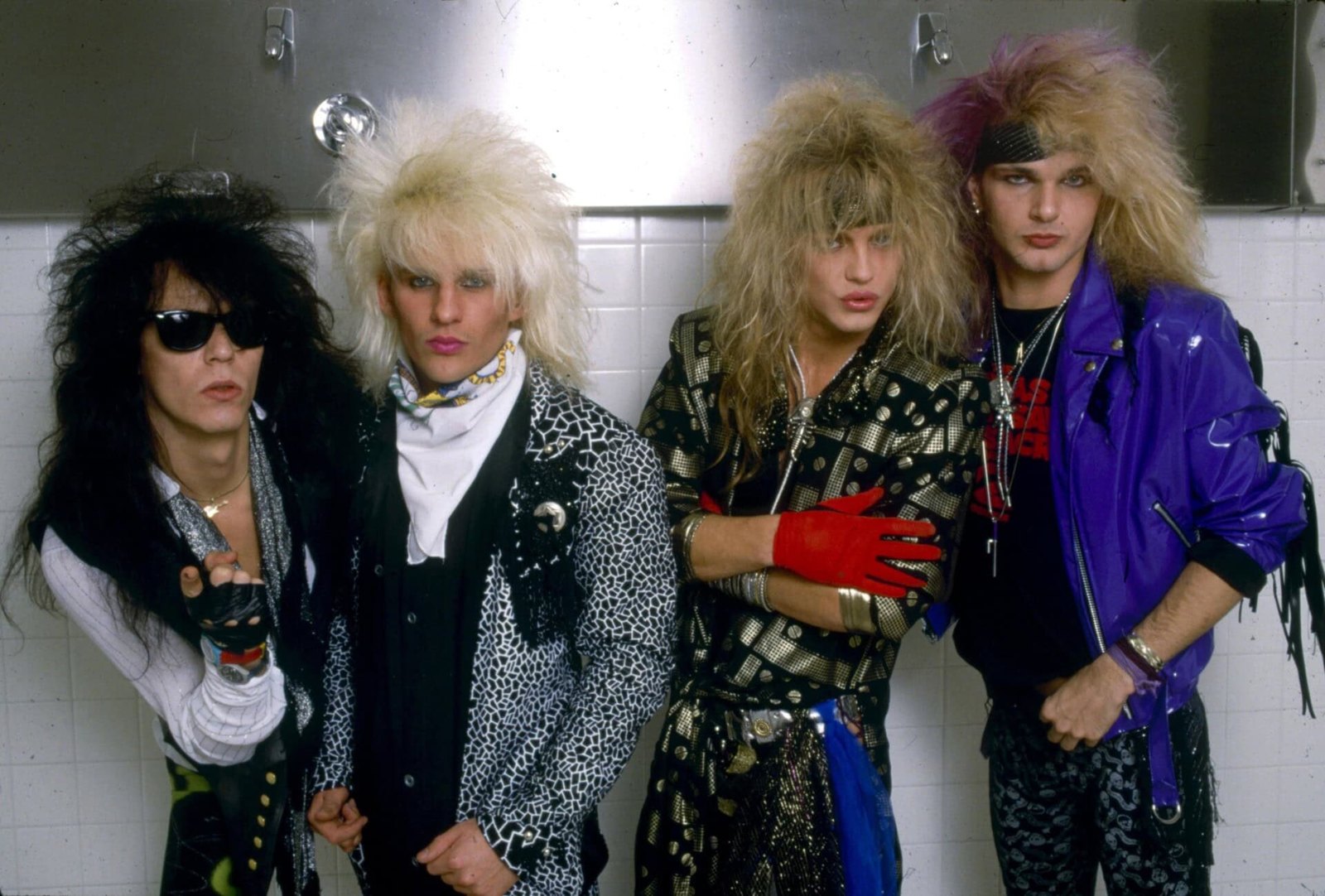
Number twelve. The Hollywood quintet whose video sat the comedian Milton Berle at the head of a dinner table in a dress and a wig was Ratt, and twelve is as high as "Round and Round" ever climbed on the Hot 100, the American singles chart, in 1984, Berle's own nephew, the band's manager, having called in the favour. It hardly matters. What the song proved was worth more than any chart place.
It proved that a Strip riff could sit on MTV all afternoon between the pop acts, and nearly every one of the 80's hair metal songs that still gets played was built on the same chassis. The labels learned to assemble them the way a back room mechanic guts a fruit machine, ripping the old reels out, rewiring the drum so the jackpot drops at the same second on every pull, and bolting the casing shut again: riff, verse, chorus inside the first minute, solo, chorus twice more. Most of what came off that bench was forgettable. A handful of songs beat the machine.
Those are the ones worth keeping, and they sort by the job each song did, not by the size of the hair in the video. The decade around them, the clubs, the camera and the sticker, belongs to 80's hair metal as a whole. What follows is only the songs.
The riff that carried the chorus
"Round and Round" opens on the riff, not the voice. Released as the lead single from Out of the Cellar on Atlantic in 1984, it sets Warren DeMartini and Robbin Crosby's two guitars on a mid tempo figure that grinds rather than gallops, lets Stephen Pearcy half sneer his way through the verse, and holds the chorus back just long enough that it lands like a door kicked in. The solo is short and vicious. Then it all comes round again.
The Hollywood four in leather and pentagrams who had written their own version of that blueprint a year earlier were Mötley Crüe, and "Looks That Kill", from Shout at the Devil in 1983, is the leather era in three and a half minutes, Mick Mars chopping the riff into short blunt blocks while Tommy Lee hits the snare as if he had a grudge against it. The video put the band in a post apocalyptic cage. The riff did not need the set.
The band that David Coverdale, once the singer of Deep Purple, rebuilt from the ground up for the American market went out as Whitesnake, and its 1987 album carried "Still of the Night", a slab of riff lifted straight from the Led Zeppelin school. John Sykes, credited alongside Coverdale as co-writer and playing the guitar on the record, runs a part along it like a blowtorch along a steel seam, until the chorus is welded to the riff. The re-recorded "Here I Go Again" went to number one on the Hot 100 on 10 October 1987. "Still of the Night" is the one that has aged.
80's hair metal songs built for the arena

Some songs were written for a stadium before the band had ever played one. "I Wanna Rock", the second single from Twisted Sister's Stay Hungry in 1984, is barely a song at all: a chant, a drum pattern that stamps like a terrace and a title shouted back over and over, with Dee Snider's call and the crowd's response doing the work that a melody would do anywhere else. It is almost impossible to play quietly. Nobody has ever tried.
The Swedish five whose singer wrote the most recognisable opening of the decade on a borrowed keyboard were Europe. "The Final Countdown", the title track of their 1986 album, starts on a synthesizer fanfare that goes off like a starting pistol fired into a stadium roof, before Joey Tempest's voice and John Norum's guitar pile in underneath it. The song held at number one in the UK for two weeks and climbed to No. 8 on the American Hot 100. Norum left the band that November, unhappy with how far the keyboards had pushed the guitar back and with the teen pop image growing around it. He had a point. The fanfare won anyway.
Great White took the other route to the arena, through someone else's song. Their 1989 cover of "Once Bitten, Twice Shy", written by Ian Hunter of Mott the Hoople, climbed to No. 5 on the Hot 100 on a loose bar room shuffle that sounds as if it were recorded with the doors open. Jack Russell sings it with a grin rather than a snarl. Great White's own songs never came close.
A synthesizer fanfare that goes off like a starting pistol fired into a stadium roof.
The fast ones
The Pennsylvania quartet that came to Los Angeles with more colour on its sleeves than riffs in its pocket was Poison. "Talk Dirty to Me", the song DeVille brought with him from his old band the Screamin' Mimis when he auditioned, is a garage punk song in spandex, three chords, a handclap and a solo bursting in at the midpoint like a man falling through a skylight. The whole track was cut fast and cheap and released as a single in February 1987, where it climbed to No. 9 on the Hot 100. It is dumb. It is also perfect.
Mötley Crüe came back at the end of the decade with the fastest thing they ever cut. "Kickstart My Heart", from Dr. Feelgood in 1989, opens on Mick Mars working his tremolo bridge to make the guitar itself sound like an engine turning over, then rides a riff bolted to a dragster's crankshaft and fired down a quarter mile of tarmac, a drag race with a chorus and a breakdown where the brakes should be. It has closed their shows ever since.
The New Jersey five with a Canadian singer out front were already writing like the decade was ending, and "Youth Gone Wild", the lead single from Skid Row's self-titled debut in January 1989, is the last great street anthem the scene produced, a football terrace chorus on top of a riff that leans closer to the British wave than to anything on the Strip. Sebastian Bach sings it at the top of his range for the whole run. The song never drops a gear.
The ballad at full price
Every label wanted the slow one, and the best of them earned it. Warrant's "Heaven", from the 1989 debut Dirty Rotten Filthy Stinking Rich, is the ballad formula at its cleanest, an acoustic verse, a chorus that swells with the full band and a solo that says what it has to in eight bars, and it climbed to number two on the Hot 100. Behind the desk sat Beau Hill, the producer who had shaped Ratt's early albums including Out of the Cellar, and the circle from the riff single to the ballad single closes in his hands. Nobody apologises for it. Nobody needs to.
Heavier and stranger was "The Ballad of Jayne", from L.A. Guns' Cocked and Loaded in 1989, a slow song with a woman's name in the title, sung in a cracked, road worn voice by Phil Lewis over Tracii Guns' guitar, which sounds less like a power ballad than a lament recorded after closing time, and it reached No. 33 on the Hot 100. It was the band's biggest hit. It is the one ballad of the year that still hurts.
The biggest ballads of all came from New Jersey, from the band whose "Wanted Dead or Alive" turned a twelve string acoustic into a cowboy film and whose place on this shelf is contested to this day, a quarrel set out under the question is Bon Jovi hair metal. The chart never asked. The chart just bought.
| Song | Band | Album year | The job |
|---|---|---|---|
| Round and Round | Ratt | 1984 | The riff that sold the chorus |
| Looks That Kill | Mötley Crüe | 1983 | The leather era in one single |
| Still of the Night | Whitesnake | 1987 | A Zeppelin riff with arena gloss |
| I Wanna Rock | Twisted Sister | 1984 | A chant, not a song |
| The Final Countdown | Europe | 1986 | The keyboard fanfare |
| Talk Dirty to Me | Poison | 1986 | Garage punk in spandex |
| Kickstart My Heart | Mötley Crüe | 1989 | Top speed |
| Youth Gone Wild | Skid Row | 1989 | The last street anthem |
| Heaven | Warrant | 1989 | The ballad formula, clean |
| The Ballad of Jayne | L.A. Guns | 1989 | The ballad that still hurts |
Ten songs out of thousands, and none of them depends on the video to stand up. The costume behind them had a longer history than the songs did, and that history, from the lipstick of 1973 to the lace of 1985, runs through the glam metal bands. Strip the pictures away and the riffs are still there, a verse, a chorus and a solo, loud enough to fill a room thirty five years on.