On 27 July 1973 Mercury Records released an album whose sleeve did all the arguing. The five men sprawled across a sofa in platform boots, teased hair and borrowed lipstick, with their name scrawled above their heads in the same lipstick, were the New York Dolls, and ten years later every glam metal band on Sunset Boulevard was still wearing some piece of what they had on.
Glam in heavy metal was never a sound first. It was a wardrobe, and it travelled the way a touring company's costume trunk travels, handed from one troupe to the next across a decade, until the Hollywood bands of 1981 took bolt cutters to the hasps, dragged out the satin, the leopard print and the eyeliner, and wore the lot in front of Marshall stacks twice the height of anything the Dolls had ever plugged into. The clothes came first. The songs caught up.
What MTV sold after 1983 as 80's hair metal was the same trunk with a can of hairspray thrown in on top, and the quarrel over which name fits which band has never been settled. The distinction worth keeping is older and plainer. Glam is the costume and the lineage behind it. Hairspray is only the scale.
Before any glam metal band: the seventies wardrobe
The band out of Phoenix and Detroit that gave its singer a girl's name and then executed him every night in front of paying crowds, by electric chair on the earlier Killer tour and by guillotine on the next, was Alice Cooper. Billion Dollar Babies, released in February 1973, went to number one on the Billboard 200 that spring carrying the idea that a hard rock concert could be staged as a horror spectacle with a body count. The music underneath was riff rock. The show was theatre.
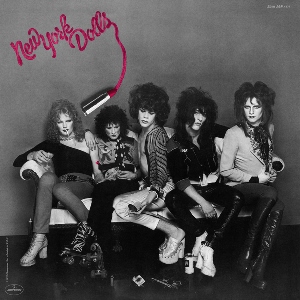
The Dolls went the other way, toward the street. Produced by Todd Rundgren, New York Dolls is a scrappy, overloaded record, Johnny Thunders' guitar tearing through "Personality Crisis" and "Trash" like a shopping trolley pushed down a fire escape, with David Johansen yelling over the top in a voice built for a bar with no stage. It stalled at No. 116 on the Billboard 200 and the original band had fallen apart by 1977. None of that mattered. The photograph outlived the pressing.
The New York quartet that pushed the costume past theatre and into the comic book, four painted characters in studded armour on platform heels, answered to the name Kiss, and from its Casablanca debut of 8 February 1974 the greasepaint worked as a trademark as much as a disguise. The faces stayed hidden until the band scrubbed the make-up off on MTV on 18 September 1983, which is to say at the very moment the Strip was reaching for its own brushes.
| Piece of the code | Who wore it first | Who inherited it in the eighties |
|---|---|---|
| Lipstick, eyeliner, teased hair | New York Dolls, 1973 | Mötley Crüe, Hanoi Rocks, Poison |
| Stage horror and props | Alice Cooper, early 1970s | W.A.S.P., Lizzy Borden, Twisted Sister |
| Greasepaint as a trademark | Kiss, 1974 | Twisted Sister |
| Platform boots and studded leather | Kiss, 1974 | Mötley Crüe, 1983 |
| Thrift-shop scarves and ragged layers | Hanoi Rocks, early 1980s | Guns N' Roses, Faster Pussycat |
Hanoi Rocks and the thrift-shop line
The missing link between the Dolls and Hollywood was not American at all. Formed in Helsinki at the end of the seventies around the singer Michael Monroe and the guitarist Andy McCoy, and relocated to London by 1982, the Finnish five that dressed like a jumble sale after a knife fight were Hanoi Rocks. Every song they wrote was a pop tune with a switchblade taped under the chorus, the Rolling Stones and the Dolls pushed through cheap amplifiers and played as if the club were about to be raided.
The major label came late. Two Steps from the Move, produced by Bob Ezrin and released by CBS in August 1984, opened on a cover of Creedence Clearwater Revival's "Up Around the Bend" and should have opened America. It did not. The drummer Razzle died in a car crash in Redondo Beach in December 1984, with Vince Neil of Mötley Crüe at the wheel, and Hanoi Rocks broke up the following year.
Their clothes crossed the ocean anyway. The layered scarves, the ripped tights under cut-off jeans and the hat pulled over the eyes turned up in Hollywood on Guns N' Roses and on Faster Pussycat, whose Elektra debut of July 1987 sounds like a Hanoi record played by men who had studied the photographs harder than the chords. Guns N' Roses later put the Finnish catalogue back in American shops, reissuing it on cassette through their own Geffen-backed Uzi Suicide label in 1989. Few debts in this music were paid so openly.
London had its own branch of the line. The young band that wore more make-up than anyone else in the British wave of 1980 called itself Girl, and its Jet Records album Sheer Greed, released in January 1980, set a pouting glam pop sound over hard rock guitars at the very moment the rest of the country was pulling on denim. Its two most visible members ended up in the eighties' biggest shop windows: the singer Phil Lewis in L.A. Guns, the guitarist Phil Collen in Def Leppard. The lipstick had been an apprenticeship.
Every song Hanoi Rocks wrote was a pop tune with a switchblade taped under the chorus.
Hollywood forces the lock
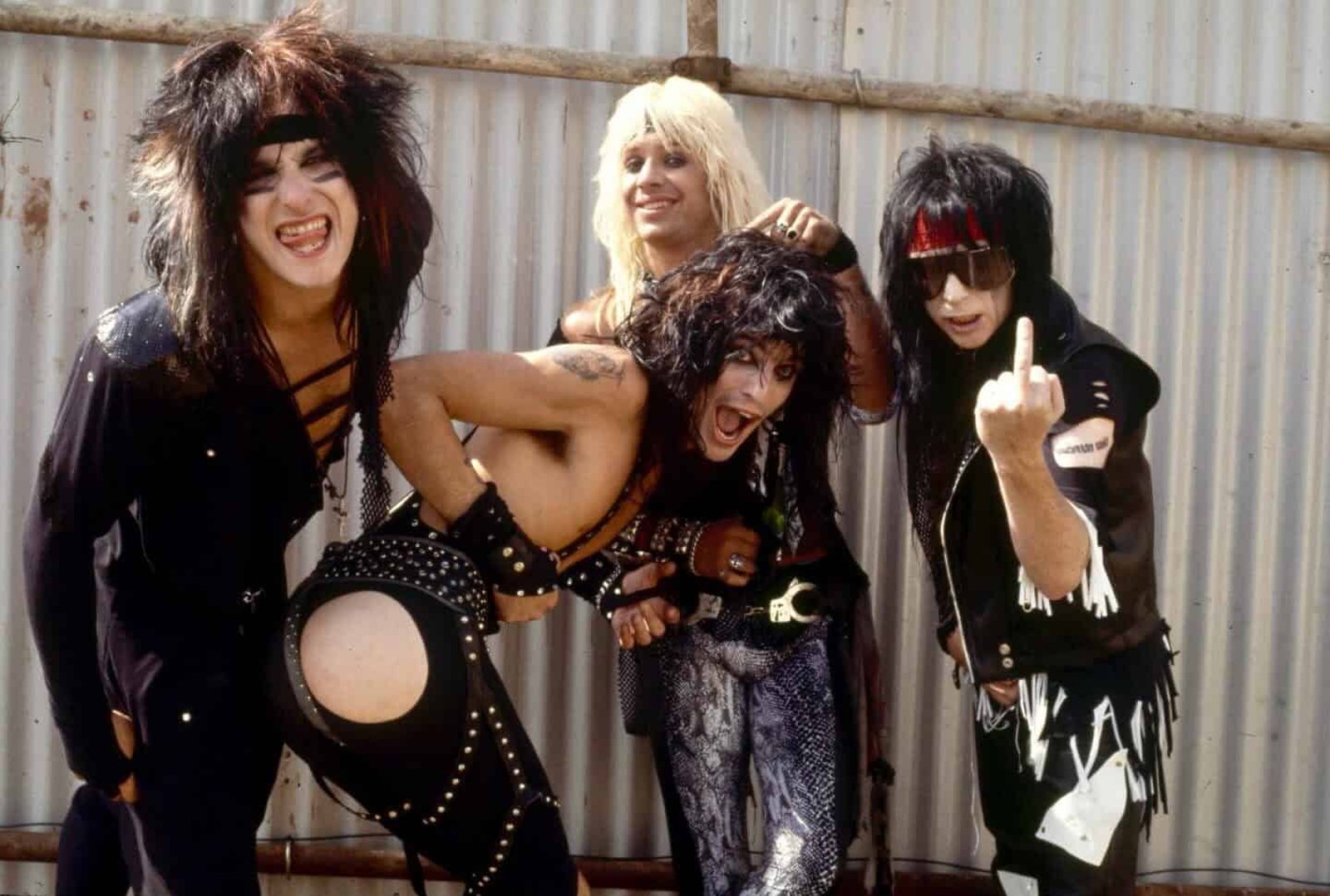
The quartet that rebuilt its own image twice in two years was Mötley Crüe. Shout at the Devil, released by Elektra on 23 September 1983, dressed the four of them in black leather, spikes and pentagrams, a wasteland look borrowed from the Mad Max films. Then the band changed costume completely.

Out of the leather and into lace, pink scarves and Dolls-style rouge, the vanguard of the Strip cut Theatre of Pain, released in June 1985, a record whose very title and sleeve, the two masks of the stage, declared where the whole idea had come from, and whose cover of Brownsville Station's "Smokin' in the Boys Room" climbed to No. 16 on the Hot 100, the band's first real hit single. The songs were thinner than on the album before. The look had never been sharper.
The Alice Cooper side of the lineage found its heir in Blackie Lawless. The Los Angeles four that turned the front of the stage into a butcher's cold room plugged into a Marshall stack, sawdust on the boards, white tile behind the drum riser and a steel rail running overhead for the riffs of their Capitol debut of August 1984, were W.A.S.P. Lizzy Borden ran the same horror show on a smaller budget for Metal Blade. Twisted Sister had been doing it in the bars of Long Island since the seventies, with make-up plastered on like warpaint rather than blusher. Not one of them looked pretty. That was the point.
By the time Poison put out its first album in 1986, the code no longer needed a theatre, a history or even a reason. It needed a hair dryer and a video budget, and it got both.
Where the glam metal band went after the hairspray
The look survived the fall of the Strip better than the songs did, and it survived furthest from home. In Japan a band built around the drummer and pianist Yoshiki pushed the make-up and the teased hair into something closer to kabuki than to Hollywood, and X Japan, whose debut Vanishing Vision came out on Yoshiki's own Extasy Records in April 1988, handed the code to a whole movement that took the name visual kei.
In Sweden the trunk was opened again in the 2000s. Crashdïet, whose debut Rest in Sleaze arrived in May 2005, and Hardcore Superstar wore the Hanoi layers and the Mötley eyeliner without a trace of irony, playing it faster and meaner than most of the originals ever managed. The costume had become a tradition, which is the last thing the Dolls ever meant it to be.
What the lineage proves is simple. A glam metal band is defined by the line of clothes it inherited, lipstick from the Dolls, horror from Alice Cooper, paint from Kiss, rags from Hanoi Rocks, and the good ones put a riff under the costume strong enough to carry it. The records that did that are gathered among the best 80s hair metal songs. The rest was fancy dress, and fancy dress does not age.