
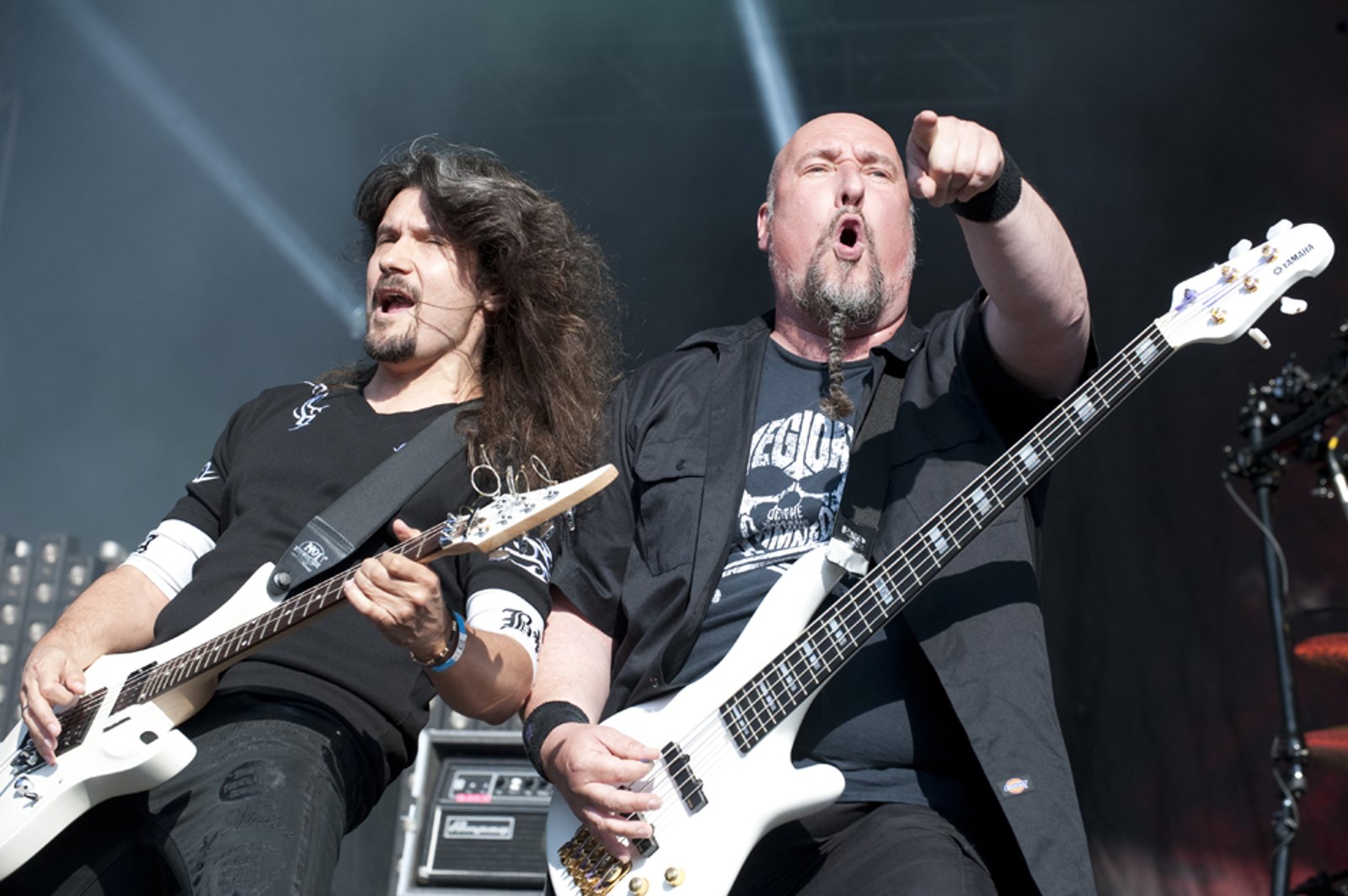
In 1996 Judas Priest went looking for a singer to stand where Rob Halford had stood, and one of the names on the shortlist, the voice behind Gamma Ray's first three albums, a tenor with the range to fill the job, was Ralf Scheepers. He sent tapes and was told to expect a rehearsal that never came. The job went to Tim Owens. Within a year Scheepers and the bassist Mat Sinner, who had been leading his own band, Sinner, since the early eighties, had turned a Judas Priest tribute act called Just Priest into Primal Fear, and its debut entered the German album chart at number 48 in February 1998. Nothing about the episode is unusual among German heavy metal bands. It is the way the whole trade works.
German carpenters still go on the Walz. For three years and a day the journeyman walks the roads in black corduroy and a wide black hat, forbidden to come within fifty kilometres of home, splitting oak in one master's yard and hacking tenons in the next, and moves on with his tools rolled in a bundle before anyone can get used to him. By the time he is done, a little of every yard he passed through is in his hands. A little of his hands is in every yard.
That is the German scene in one custom. Its players served in one band, took the method to the next, and opened yards of their own, so that a family tree of the country's heavy metal is really a map of who trained whom. The founders set the standard, and the order in which the famous names arrived is kept in the band list.
The masters: Hanover and Solingen
Two yards trained everyone. The Hanover band that had been cutting heavy records for Brain since Lonesome Crow in 1972 was Scorpions, and the Solingen band that put double kick drums under a German heavy metal record before the thrash bands had theirs was Accept. Both taught the country that a German band could sell in English and tour America. Their hits are well known. Their apprentices matter more.
The Hanover yard trained guitarists the way a regiment trains officers, and then lost them to other armies. Michael Schenker played lead on Lonesome Crow as a teenager and left for the English band UFO in 1973, Uli Jon Roth took his place and left in 1978 to follow his own music, and only with Matthias Jabs, in the band from 1978 onward, did the chair stop turning. The players rotated. The method stayed.

The rasping voice that walked out of Accept in 1987 and opened a yard under its own initials was Udo Dirkschneider's, and the band he named after himself, U.D.O., released Animal House on RCA on 3 November 1987, recorded that autumn at Dierks Studios near Cologne with Mark Dodson producing. Every song on it was written by his former Accept bandmates. The master's method went with him. So did the voice that sands the gloss off every chorus it touches.
The Stuttgart yard was smaller and busier. Leading his own band, Sinner, since the early eighties, writing, producing and passing players through its ranks on the way to bigger stages, the bassist whose lineage runs through half the country's credits was Mat Sinner, and records such as Danger Zone in 1984 served as the apprenticeship for the band he would found with Scheepers. The garrison was small. The training was thorough.
Warlock's singer took the same road two years later, releasing Force Majeure in 1989 under her own first name, Doro, and her career belongs with women in heavy metal bands.
Hamburg, where the yards kept splitting
No city trained more hands. The guitarist who co-founded Helloween, left it at the end of the eighties because the band had grown bigger than he wanted to handle, and started again from nothing in 1989 was Kai Hansen, and his new band, Gamma Ray, put Heading for Tomorrow out in 1990 with Scheepers singing. When Scheepers left, Hansen took the microphone himself for Land of the Free in 1995. A year later he joined the producer Piet Sielck in founding Iron Savior on the side, though it is Sielck who has directed it ever since.
A family tree of German heavy metal is really a map of who trained whom.
Across the same city, the band that had put a pirate flag over its records since the middle of the decade reached its peak on the last of them. Running Wild recorded Death or Glory at Studio M in Hanover in the summer of 1989, and Noise released it on 8 November, with "Battle of Waterloo" marching the band onto the field of 1815 and Rolf Kasparek's riffs going through the choruses like a cutlass through a rope ladder. Kasparek wrote or co-wrote every track on the record and produced it himself.
"Bad to the Bone", the single, went onto MTV's Headbangers Ball with a live video shot in Düsseldorf. It was the last record made with the guitarist Majk Moti and the drummer Ian Finlay. Rock Hard later put the album among its five hundred greatest rock and metal records.
The Ruhr, from Gladbeck to Herne
The mining towns kept a harder school. The Gladbeck band that Chris Boltendahl had been leading since 1980 was Grave Digger, and its debut, Heavy Metal Breakdown, released by Noise in 1984, beat the Accept template into a cruder shape and stamped a title on it that told the buyer exactly what was inside. The medieval concept records came a decade later. The debut is the foundation they stand on.

Formed in Herne in 1984 under the name Avenger and renamed Rage the following year, the band built around the bassist and singer Peter Wagner, Peavy to everyone, is Rage, and Perfect Man, released by Noise in 1988, became a hit inside the scene on the strength of its single.
"Don't Fear the Winter" runs on a riff that stamps down like a pit prop driven into a coal seam, and Wagner sings over it in a rough baritone that never reaches for the high notes of Hamburg. Rage kept going through every change of fashion and spent sixteen years with the Belarusian guitarist Victor Smolski, from 1999 to 2015.
German heavy metal bands of the second generation
The pupils became masters in the late nineties. Formed in October 1997 and signed to Nuclear Blast, the Swabian band that fused Scheepers' Priest-trained scream with Mat Sinner's sixteen years of songwriting was Primal Fear, and in 1998 it toured with Running Wild and HammerFall on the strength of a single album. It has made records steadily ever since.
Further north, in Fulda, the singer and songwriter Tobias Sammet formed Edguy as a fourteen year old in 1992, self-releasing the demos that became its unofficial first record, Savage Poetry, in 1995, and when the band was established on Nuclear Blast's sister label AFM he built Avantasia beside it, a rock opera project that recruited singers from Helloween, Gamma Ray and a dozen other yards for a single record. The whole trade in one studio. Nobody else in the country could have assembled it.
The newest yard is the loudest. Formed in Saarbrücken in 2004 by former members of a stoner rock band, the quintet that plays heavy metal as a mass, with an organ, church choirs and stage names, is Powerwolf, and Preachers of the Night went to number one on the German album chart in August 2013. Blessed & Possessed reached number three there two years later.
"Army of the Night", the first single from Blessed & Possessed in 2015, is the anthem in its plainest form, a march with an organ on top, the choir and the double kick drums arriving together like an organ pumped until the bellows split. Attila Dorn sings it in a trained, operatic baritone. By common consent it is the band's calling card.
| Player | Trained in | Opened or joined | Year |
|---|---|---|---|
| Udo Dirkschneider | Accept | U.D.O. | 1987 |
| Doro Pesch | Warlock | Doro | 1989 |
| Kai Hansen | Helloween | Gamma Ray | 1989 |
| Peavy Wagner | Avenger | Rage | 1986 |
| Ralf Scheepers | Tyran' Pace, Gamma Ray | Primal Fear | 1997 |
| Mat Sinner | Sinner | Primal Fear | 1997 |
Read down the table and the country's heavy metal turns out to be six or seven families intermarried, with the same names turning up on sleeves, credits and festival bills from 1980 to the present. The style never broke in Germany because nobody ever left it for long. They changed bands. They never changed the music.
