
Speed is the cheapest difficulty heavy metal has to sell. The hardest heavy metal songs are rarely the fastest ones on the shelf, and the only fair way to rank them asks a narrower question: which part of the player gives out first, the picking forearm, the fretting hand, the bass drum foot, the throat or the memory, and how many bars the song needs to find it.
Air forces put the same question to their pilots with a centrifuge. A trainee is strapped into a gondola at the end of a steel arm and whirled faster by the minute while instructors watch a camera on his face, the force wringing the blood down out of his skull and rubbing the colour off the edges of his sight until only a grey tunnel is left, and what the machine writes down is not the top speed but the moment one particular body stops obeying. No two trainees grey out at the same number.
The guitarist who set the modern exam for the picking hand, teaching at a Hollywood guitar school before he was out of his teens, is Paul Gilbert, and the piece guitar teachers still hand out as a final paper is one he built with his fellow guitarist Bruce Bouillet.
Which records the genre was built on is argued in the chapter that covers it. Difficulty keeps a separate ledger, and the ledger opens in the right hand.
The hardest heavy metal songs for the picking hand
Released by Shrapnel in 1987 on Second Heat, the second album by Racer X, "Scarified" runs its theme in strict alternate picking, one stroke down and one up for every note, at a tempo that leaves the forearm no bar to recover in, then breaks into arpeggios played by skipping strings, the plectrum vaulting a string it must not touch and landing on the next one without a sound in between. One brush of the skipped string and the passage rings like a fork dropped on a tiled kitchen floor.
Most players fail it below the elbow, not in the fingers. Kept up for four minutes, alternate picking at that velocity turns the muscles of the forearm to setting cement, and the tone thins out several bars before a single note goes wrong. The ear hears the arm tire first. Teachers set the piece with the metronome at half speed and raise it a notch a week, and most students stall at the same notch, somewhere short of the record.
The song most people name when the subject comes up, the power metal single that Guitar Hero III turned into a public examination in 2007, belongs to DragonForce, and "Through the Fire and Flames" is hard above all in tempo and length, the two things a metronome and a patient year can buy. Stamina in the forearm cannot be bought that way.
Sweep picking asks the opposite of the other hand. The Californian who at eighteen pushed it further than any teenager on record was Jason Becker, and "Altitudes", on Perpetual Burn, released by Shrapnel in 1988, drags the plectrum across five and six strings in single raking strokes while the fretting hand rolls whole arpeggio shapes up the neck beneath it, several of them stretched wider than an ordinary hand spans without pain.
A juggler keeping five clubs in the air never holds two at once: each hand has to be empty the instant the next club drops into it, and a catch made a hair early knocks the whole pattern out of the air and scatters it across the boards. Sweeps demand the same emptiness. Each fretting finger must leave its note the moment the pick has passed, or two notes ring together and the arpeggio collapses into a smear.
Becker was diagnosed with amyotrophic lateral sclerosis in 1989 and lost the use of his hands in the years that followed. He has kept composing since, through a system of eye movements.
Speed is the cheapest difficulty heavy metal has to sell.
The hardest parts sit behind the singer
The bassist who wrote most of Iron Maiden's first album and played every note of it with two fingers of the right hand, never a plectrum, was Steve Harris, and "Phantom of the Opera", more than seven minutes long on the EMI debut of April 1980, keeps him running the gallop in unison with both guitars through changes of tempo and an instrumental middle that never once lets the plucking hand rest.
Two fingers doing the work of a plectrum at that speed is attrition, bar by bar. The notes have to land evenly while the tendons on the back of the hand stiffen like wet rope, and the calluses on those two fingertips are all that keeps the skin on them through the second half.
Racer X supplied the drum exam as well. Hired by Judas Priest in 1989, Scott Travis opens Painkiller, released by Columbia in September 1990, alone at the kit and then keeps two bass drum pedals running under nearly the whole title track, at a tempo that flattens anything a drummer of 1980 would have called fast, so that the song tests the thighs and the lower back as hard as it tests the ankles. The feet cannot cheat, and there is no slower way to play it that still sounds like the song.
Iron Maiden's own drummer went the other way. The player who launched Piece of Mind in May 1983 with the triplet figure that opens "Where Eagles Dare", snare and toms and kick in one rolling phrase, and who played it with a single bass drum pedal where most of his peers had already reached for two, was Nicko McBrain. The triplet runs through the whole song. So does the right foot.
Songs that fail the memory before the muscle

Some songs leave the body alone and go after the head. The New York quintet that put a piece titled "Metropolis, Part I: The Miracle and the Sleeper" on its second album, Images and Words, released by ATCO on 7 July 1992, and then had to play it night after night, was Dream Theater, and its instrumental middle sends John Petrucci's guitar, John Myung's bass and Kevin Moore's keyboards through long unison runs while the metre shifts beneath them bar by bar.
No single bar of it is beyond a good player. The trouble is that nobody can drop out and catch up, because a unison line has nowhere to hide a missing note, and one musician a sixteenth late splits three instruments into a stammer. The arithmetic of odd metres is simple enough, and what the guitars are doing inside them fits on a single page. Holding several minutes of it in the head, in order and at speed, is another matter. A drummer who counts it aloud has already lost, because by the time the count lands the bar has changed shape.
The voice has no spare string
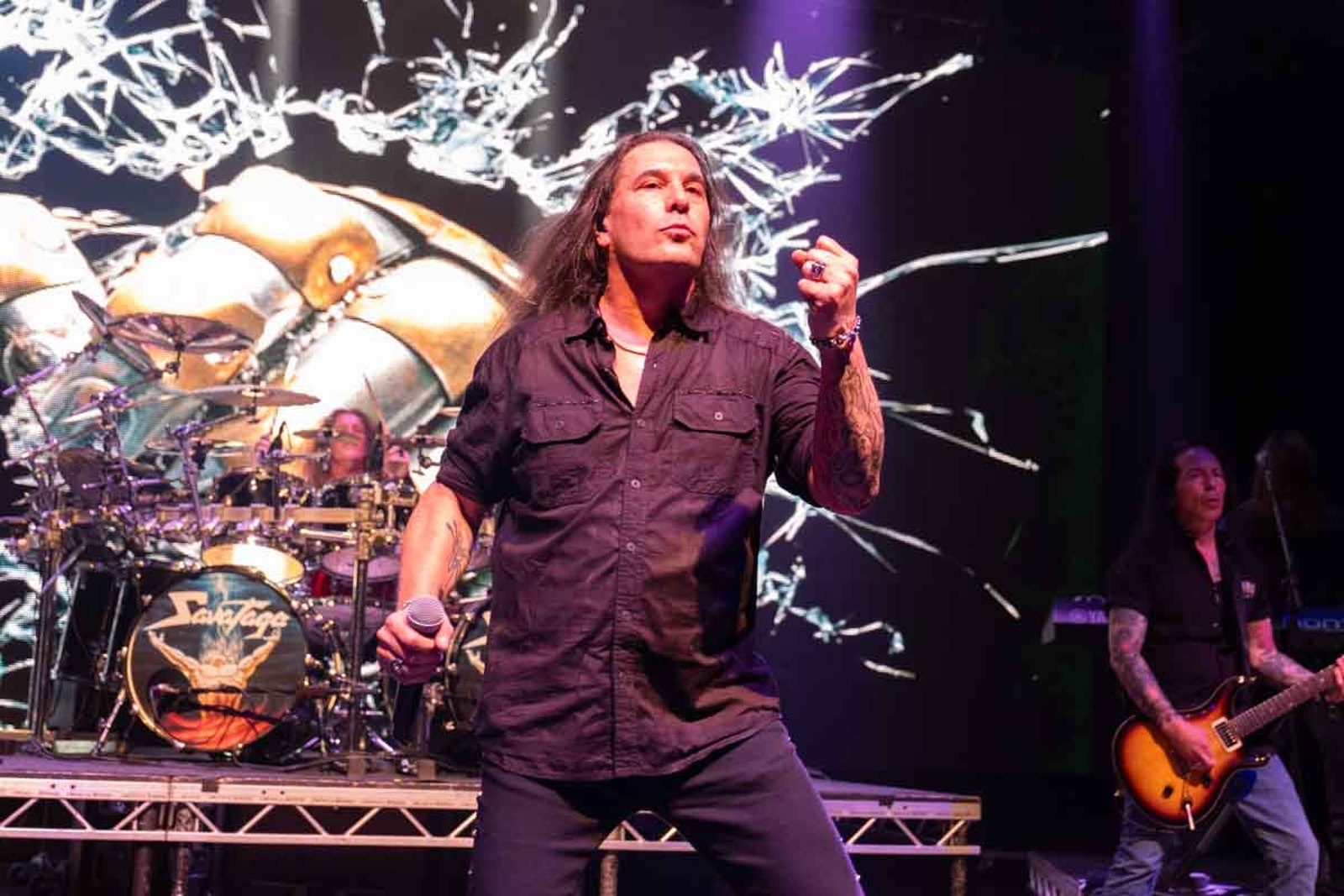
A guitarist who snaps a string picks up another guitar. A singer has one instrument for the whole night, and the song that punishes it hardest is the one that gives it no ramp. The singer asked to carry the title track of Hall of the Mountain King, released by Atlantic in 1987, gravel through the verses and screams near the ceiling of his range in the chorus, with no bridge between the two, was Jon Oliva of Savatage.
The gear change is the hard part, not the top note. A clean high scream can be trained, and so can a rasp, but jumping from one to the other inside a bar asks the throat to rebuild itself mid phrase, and a singer who gets it wrong on the first night of a tour hears the damage for the next five. The riff can be learned in a week. The voice takes years, and some voices never arrive.
| Song | Band | Year | What gives out first | Why |
|---|---|---|---|---|
| "Scarified" | Racer X | 1987 | The picking forearm | Alternate picking at speed, then string skipping |
| "Altitudes" | Jason Becker | 1988 | The fretting hand | Sweeps across five and six strings, wide stretches |
| "Phantom of the Opera" | Iron Maiden | 1980 | Two plucking fingers | Seven minutes of fingerstyle bass in unison |
| "Painkiller" | Judas Priest | 1990 | Both legs | Double bass drum under nearly the whole song |
| "Where Eagles Dare" | Iron Maiden | 1983 | One right foot | Triplets on a single pedal |
| "Metropolis, Part I" | Dream Theater | 1992 | The memory | Unison runs over shifting metres |
| "Hall of the Mountain King" | Savatage | 1987 | The throat | Rasp to scream with no ramp between |
None of the seven is hard in the same place, which is the whole case against ranking by tempo. A drummer who gets through "Painkiller" end to end can still lose his way inside "Metropolis", and a guitarist who clears "Scarified" at full speed can be undone by two fingers and a bass line on a record from 1980. Each song finds one weak joint and leans its full weight on it until something gives, and by common consent the players who admit which joint gave are the ones worth learning from.
Difficulty of another kind lives a long way from the fretboard. The heavy metal songs about death ask nothing of the hands and a great deal of whoever is listening, and a few of them are harder to sit through than any solo is to play.
