

The heaviest heavy metal bands are not the loudest bands and not the slowest ones. Heaviness inside this music can be measured, and it runs out at a line: past a certain pitch, a certain tempo and a certain density of riff, the song stops being heavy metal and becomes doom or death metal, which are other genres with other rules. The band that set the zero on the scale, slackening its strings on Master of Reality in 1971 and leaving everybody else to be weighed against it, was Black Sabbath. Every band below is measured from there.
A white dwarf is the burnt-out core of a star, a mass close to the sun's crushed into a ball about the size of the earth, and it holds itself up against its own gravity only because the electrons packed inside it refuse to be squeezed any closer together. The Indian student who worked out, on a voyage to England in 1930, exactly how much such a star can carry before that refusal breaks was Subrahmanyan Chandrasekhar. The answer, reached on the deck of the ship that carried him from India to England in 1930, is about 1.4 times the mass of the sun. One increment past it and the electrons are driven into the nuclei, the core caves in on itself inside a single second, and what is left is no longer a white dwarf at all.
That is the only fair way to rank heaviness here. Most heavy metal artists never went near the line. The few worth naming loaded their records right up to it and stayed on this side.
Four ways to weigh a band
The first unit is pitch: how far the lowest string has been let down below the open E. The second is tempo, and heaviness in heavy metal lives in the middle of the range, slow enough for each chord to land with its full mass and fast enough that the song still moves. The third is mass, meaning how much of the band sits on the riff at once, guitars, bass and kick drum hitting the same note in the same instant or scattering across it.
A Catalan human tower makes the point better than any meter. Before anyone climbs, a crowd of several hundred packs in around the base, shoulders jammed into backs and palms braced on the ribs of the man in front, and at the signal every body in that crush leans inward in the same split second, so that eight or nine storeys of people come down on the bottom row as one load and the tower stands instead of splitting apart. A riff works the same way. Four instruments on one note outweigh six instruments on six.
The fourth unit is volume, and it is the weakest. The decibel records that Deep Purple and Manowar collected in 1972 and 1984 measured a public address system and a room on one night, not a record anybody can play at home. A quiet heavy record is still heavy. A loud light one is only loud.
The heaviest heavy metal bands, by the pitch of the bottom string

The band that put out the heaviest record of its career and was punished for it was Judas Priest. With Rob Halford gone and Tim Owens singing, Jugulator, released by SPV and CMC International that October, dropped Glenn Tipton's and K.K. Downing's guitars as low as C sharp and C, slowed most of the songs to a driving mid pace and cut the structures down to the bone, and "Blood Stained" and the title track grind the old speed of Painkiller into the floor under their heels. By pitch it outweighs anything the band made before or since.
By reputation it sits near the bottom of the catalogue. Many of the faithful heard a band imitating the groove records of the day instead of leading them, and the lesson is a hard one for any ranking of weight. Heavier is a measurement. Better is a verdict.
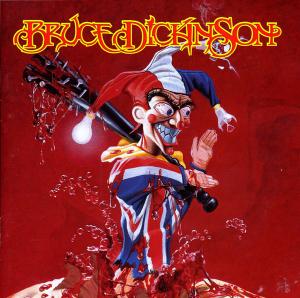
The singer who went lower than his old band ever had, and still came back with a record Iron Maiden's audience recognised as its own, was Bruce Dickinson. On Accident of Birth, released by Raw Power in 1997 with Roy Z producing and playing guitar beside Adrian Smith, several songs sit in drop tunings, "Freak" among them in drop C, while the melodies stay pure British heavy metal on top.
"Road to Hell", co-written with Smith, is the record at full stride, a riff that swings its weight rather than dropping it and a chorus built to carry over the top of the lowered guitars. Roy Z has said the plan had once been to tune down to B and A, and the decision to pull back at the last minute is the whole argument of the record. At B and A the record would have been heavier, and it would have been something else.
Heavier is a measurement. Better is a verdict.
Weight at walking pace
Mass is the unit the old bands understood first. The reunited line-up that brought Ronnie James Dio back to the microphone of Black Sabbath for Dehumanizer, released in June 1992, set Geezer Butler's bass hard against Tony Iommi's guitar through most of the record, so that the opener, "Computer God", lands the full tonnage of the band on every downbeat. By common consent it was the heaviest record Dio ever sang on. It stayed heavy metal, because he was still singing.
Tempo is the unit where heavy metal comes closest to the line. The Ventura band that played slower than almost anyone in the American underground of the eighties and still refused to be anything but heavy metal was Cirith Ungol, and One Foot in Hell, released in August 1986, drags its leaden riffs at the pace of a column marching uphill with its wounded on its back while Tim Baker shrieks over the top. The drums keep moving. That alone keeps it on this side.
The Swedish band that crossed the line in the same year, and was honest enough to put the word on the sleeve, was Candlemass. Epicus Doomicus Metallicus, released by Black Dragon that June, took the heavy metal riff down to a crawl, made the slow tempo the point of every song rather than a passage inside one, and in doing so founded a genre of its own. Its riffs are heavy metal riffs. Its clock is not.
Where heavy metal stops being heavy metal
The line runs in two directions. Below walking pace, with the riff held so long it stops being a figure and turns into a weight, the music belongs to doom. Below C, with the voice no longer carrying a melody and the drums running at speeds heavy metal never used, it belongs to death metal, and a band such as Obituary is weighed on an altogether different scale. Neither genre is heavier heavy metal. Each is what heavy metal turns into once it gives up the melody or the walking drums.
So the heaviest heavy metal bands share one discipline. They take the pitch down and keep the melody, slow the clock and keep the drums walking, pile every instrument on the riff and still leave the singer room to be heard over it, and on any honest reading that restraint weighs more than anything on the far side.
| Band | Record | Year | The unit | What keeps it heavy metal |
|---|---|---|---|---|
| Black Sabbath | Master of Reality | 1971 | Pitch | Songs that still move |
| Judas Priest | Jugulator | 1997 | Pitch, down to C | The twin guitars and a clean top voice |
| Bruce Dickinson | Accident of Birth | 1997 | Pitch, drop C | British melodies over the low strings |
| Cirith Ungol | One Foot in Hell | 1986 | Tempo | Drums that never stop walking |
| Black Sabbath with Dio | Dehumanizer | 1992 | Mass | A singer on top of the unison |
| Manowar | On stage | 1984 | Volume | Anthems, whatever the meter says |
| Candlemass | Epicus Doomicus Metallicus | 1986 | Tempo, past the line | Nothing: this is where doom begins |
Weight is one way to make an audience flinch. A face nobody is allowed to see is another, and the heavy metal bands that wear masks have been trading on it since the first greasepaint went on in the seventies.
