
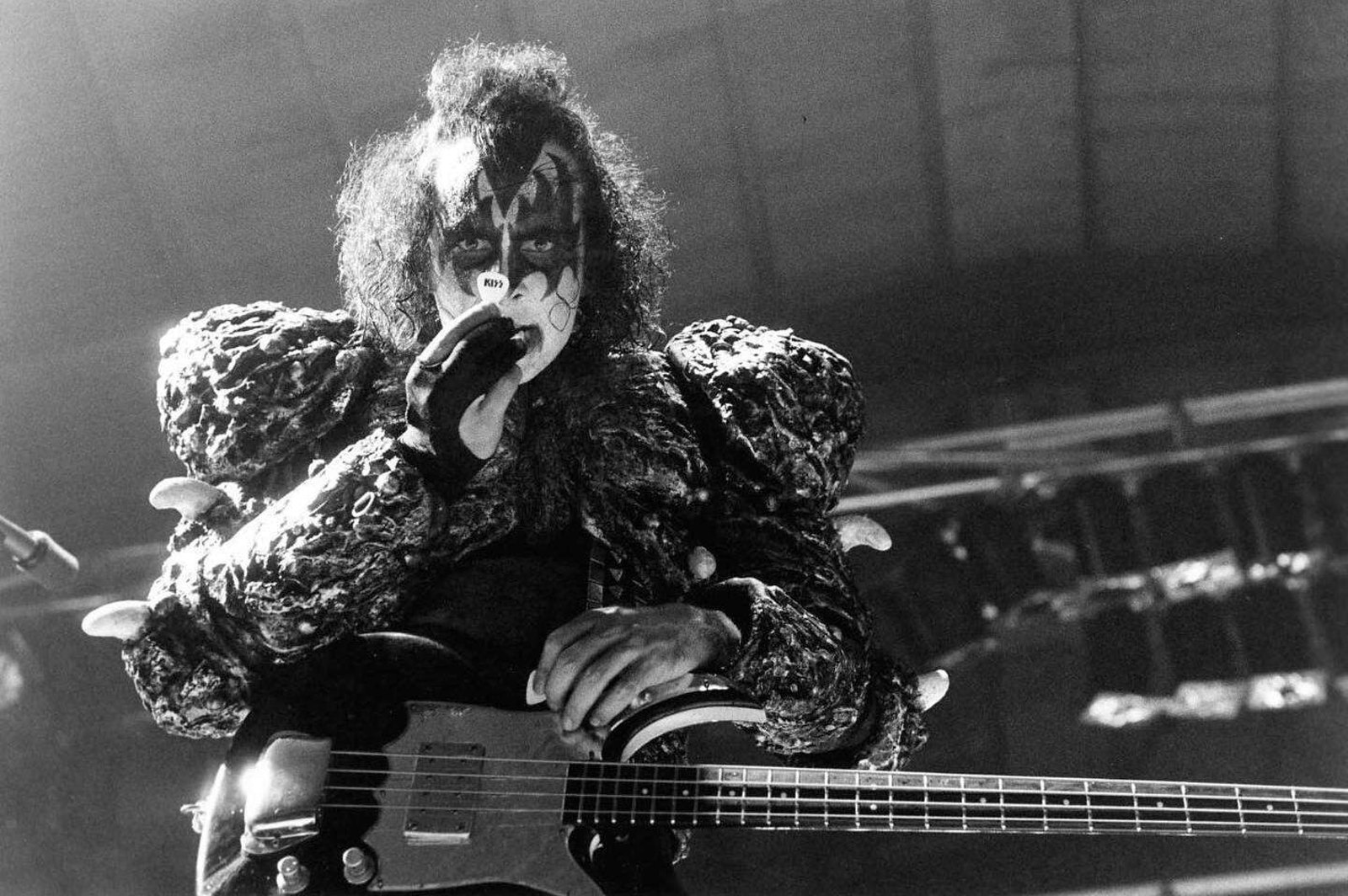
A mask in heavy metal is never a disguise. It is a contract, and it binds the man underneath harder than anybody in the crowd, because a face the audience has never seen cannot grow old, cannot be photographed outside a hotel bar and cannot walk out of the band with the character. The bands that read the terms kept the mask for life. The bands that broke them paid for it.
Behind the curtain of a Noh stage there is a small room with a tall mirror. The lead actor sits before the glass holding a carved cypress face that may have passed through a dozen pairs of hands before his grandfather was born, and his trade does not say he puts it on: it says he hangs it, so that by the time the curtain lifts the man has been swallowed whole and only the character walks out along the bridge. Nobody in the audience asks who was inside. The question would be an insult.
The band that drafted the contract for everyone after it, four New Yorkers in greasepaint who were hard rock by every test of riff and swing and heavy metal only by the tonnage of their fireworks, was Kiss, and the heavy metal bands that wear masks have read its small print ever since, some closely enough to rip the masks off their own heads the moment they misread it. Which bands built the music is argued in the earlier chapter. Which of them hid while doing it is a separate ledger.
The greasepaint precedent, and the night it came off
Painted on for a Casablanca debut in February 1974 and scrubbed off on MTV on 18 September 1983, the day the band showed its faces to sell Lick It Up, the four characters had carried Kiss through a decade in which the men beneath them were almost beside the point. The unmasking went over like a window dresser stripping the mannequins after closing time: bare plaster, a bolt at every joint, a price tag on a string, and the passers-by who had stopped at the glass for years simply walking on.
The record went gold, the band's first gold album in three years. The mystery never came back at that price. For thirteen years the demon, the starchild, the spaceman and the cat were four more hard rock musicians in spandex, and in 1996 the original line-up put the paint back on and toured the old faces to the largest houses of their career.
The guitarist who wore Ace Frehley's silver star through the band's last two decades on the road was Tommy Thayer, while Eric Singer painted on Peter Criss's cat, and the Swedish company that bought the catalogue, the name and the likenesses four months after the final show at Madison Square Garden on 2 December 2023 was Pophouse. The reported price ran past three hundred million dollars. The characters were sold. The men went home.
Corpse paint, and a letter from New York
Heavy metal took the idea and turned it towards the grave. The Copenhagen singer who painted his face black and white before his band had a record out, and who carried the paint through Mercyful Fate's debut Melissa in 1983 and every solo album after it, is King Diamond. The letter never touched the paint. Gene Simmons has said in interviews that his lawyers sent King Diamond a cease and desist letter over the resemblance, and King Diamond kept the paint exactly as it was, answering that Kiss were not the first to wear make-up and naming Alice Cooper and Peter Gabriel as the painted performers he had actually watched.
Lifted from Conspiracy, released by Roadrunner in 1989 as the second half of the story begun on Them, "Sleepless Nights" shows what the paint is for: the face holds perfectly still while the voice swings between the falsetto and the lower register that carries the plot, so the character stays fixed and the singing does all the moving. The Norwegian bands of the early nineties stripped the paint off that face and made it the uniform of another music. They left the falsetto behind.
Heavy metal bands that wear masks, and two that took them off
The British wave had one masked man, and he was locked in. The drummer who played behind the bars of a cage at the back of Samson's stage from 1979, in a black cotton mask one night and a rhinestone mirrorball mask the next, modelled on Hammer films and the Dr. Phibes pictures, was Barry Graham Purkis, billed as Thunderstick. He had passed briefly through an early Iron Maiden in 1977, one more face he tried on and shed before this one stuck. By 1981 he had left to lead a band under his own mask name, which is the contract working exactly as designed: the character walked out with the man who built it.
Across the Atlantic the masks were moulded in silver. Full-faced and blank, they hid every member of Crimson Glory from the 1986 debut onward except the singer Midnight, whose mask stopped short of the mouth so that the voice could get out. On the tour for Transcendence, released in 1988, the heat under the stage lights forced the band to cut the masks down to half faces in the style of the Phantom of the Opera. By Strange and Beautiful, issued by Atlantic in June 1991, the masks were gone, two years earlier had gone the guitarist Ben Jackson and the drummer Dana Burnell, and the progressive metal had been swapped for bluesy hard rock. The face came off and the sound went with it.
The face came off and the sound went with it.
Lordi, and a country that refused to look
The Finnish singer who sculpted his own latex head in the early nineties and has refused to be photographed without it ever since is Tomi Putaansuu, Mr Lordi, and the band is Lordi. The Eurovision win of 20 May 2006 put those heads in front of a continent. Four days later the Finnish weekly 7 Päivää put an old photograph of the singer's bare face on its front cover.
The readers did the rest. A petition calling for a boycott gathered more than 221,000 names, the brewery Olvi pulled its advertising, and both that weekly and a second one that had printed the rest of the band unmasked apologised and promised not to do it again. No band in heavy metal has ever had its audience enforce the contract on its behalf with that kind of force. The faithful did not want to see.
The practice inside the band runs the other way from Kiss. When a member leaves, his monster leaves with him, and the newcomer is built a new creature with a new name. Nobody inherits a face. The costume belongs to the man, and it retires when he does.
Ghost, the ghouls and the edge of the genre

The Linköping band that stood a skull-painted anti-pope at the front and a row of identical masked players behind him, all billed as Nameless Ghouls, was Ghost, and the heavy metal case rests on its first record, Opus Eponymous in 2010, whose riffs came straight out of the Mercyful Fate songbook. On Infestissumam in 2013 the singer returned as Papa Emeritus II, and every later Papa has been the same songwriter, Tobias Forge, under fresh paint.
The masks behind him did what band masks are built to do, which is make the players interchangeable. In April 2017 four former ghouls sued Forge in Sweden, claiming they had been partners rather than hired musicians, and the Linköping District Court dismissed the claim in October 2018. The case named the men. It changed nothing on stage.
The genre moved while the masks stayed put. "Mary on a Cross", first issued on the 2019 EP Seven Inches of Satanic Panic as a pastiche of late sixties pop, became the band's biggest song years after release, and when Skeletá entered the Billboard 200 at number one in May 2025, Billboard filed it as hard rock. That spring the band sealed every phone in the hall inside a Yondr pouch, the faces it had hidden for fifteen years now guarded against the audience's cameras. The spectacle is heavy metal. The songs, since the second record, have mostly not been.
| Band | Face | From | Genre | Did it come off? |
|---|---|---|---|---|
| Kiss | Greasepaint characters | 1973 | Hard rock | 1983, back on in 1996 |
| Samson (Thunderstick) | Hood, mirrorball mask, cage | 1979 | Heavy metal | Left with the drummer |
| King Diamond | Black and white paint | Early 1980s | Heavy metal | Never |
| Crimson Glory | Silver full-face masks | 1986 | Heavy and progressive metal | By 1991 |
| Lordi | Latex monster heads | 1990s | Heavy metal and hard rock | Never, by public demand |
| Ghost | Papa paint, ghoul masks | 2010 | Heavy metal to hard rock | Never |
The rest of the masked bands belong on other shelves. The Des Moines nine in numbered boiler suits who broke through in 1999 were Slipknot, nu metal by every test of rhythm, and Sleep Token, whose Even in Arcadia topped the Billboard 200 a fortnight after Skeletá, wears heavy metal's costume rather than its creed. A costume that preached rather than hid, the yellow and black stripes that Stryper wore through the eighties, belongs with the Christian heavy metal bands.
Every one of these bands signed the same paper, and the record of who kept to it is short. King Diamond never washed his face in public, Lordi's audience would not let its singer, and Kiss, which wiped its paint off to sell a record, spent the next thirteen years earning back what the unmasking cost. A heavy metal band can change its singer, its label and its sound. It can change its face exactly once.
