
Who would true valour see, let him come hither; one here will constant be, come wind, come weather.John Bunyan, The Pilgrim's Progress, Part II
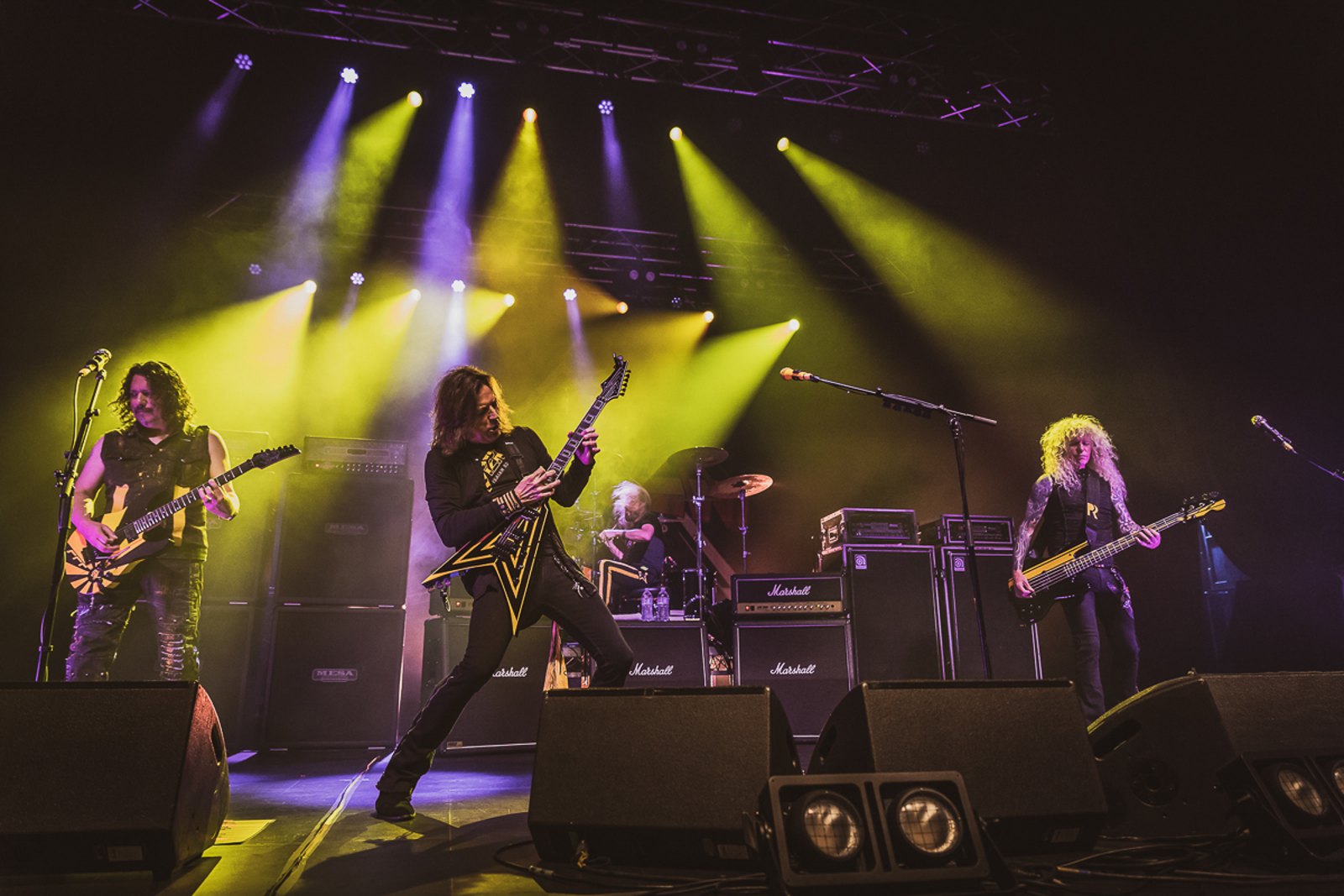
Christian heavy metal bands were handed the easiest brief in the whole family and the hardest room to play it in. Heavy metal had been singing about archangels, the beast, the last battle and a voice raised over the multitude since 1970, so a believer who picked up a guitar in 1983 needed no disguise and no translation, only riffs strong enough to carry the doctrine without buckling under it. Most never found them. The first band that did, an Orange County quartet with two brothers at its core, was Stryper.
On campaign, with no chapel inside a day's march, an army chaplain said the service on the drums. The drummers stacked their instruments into an altar in the middle of the square, a cloth went over the skins, the chalice stood on a batter head that had beaten the long roll at dawn, and when the blessing was done the cloth was ripped away and the same drums hammered the regiment forward into the guns. That is the drumhead service. Everything depends on what sits under the cloth.
Judge the altar and every record on the shelf passes, because nobody ever doubted the sincerity. Judge the drums underneath, the riff, the second guitar and the reach of the singer, and the shelf empties fast, which is the test the best heavy metal bands of every creed and of none have always had to pass. Four decades of Christian records sort cleanly on it. The sermon earns no marks.
Christian heavy metal bands that kept the drums beating

Built around Michael Sweet on voice and guitar and his brother Robert behind the kit, the band settled its case on a single album, Soldiers Under Command, released by Enigma on 23 August 1985 with Michael Wagener producing. Sweet and Oz Fox divided the solos between them like two stonecutters splitting the same granite face from opposite ends until the block drops out between them, and the album reached number 84 on the Billboard 200, the American album chart, before going gold, the first Christian metal record to get there.
The title track is a marching order set at a gallop. Michael Sweet's voice goes up over the twin guitars into a register most of his Hollywood neighbours never attempted, the chorus is built for a hall to shout back, and nothing in the arrangement leans on the lyric to hold it up. The platinum album that followed a year later belongs to the story of the Sunset Strip. This one belongs to heavy metal.
The last record of the first life is the one most often skipped and the one that argues hardest. Stripped of the uniform, recorded with the guitars pushed up and the harmonies pulled back, Against the Law, released by Enigma on 21 August 1990, sounded like a band that had grown tired of being asked about its clothes. The old audience walked away from it. The riffs were the best the band had written since 1985. The band broke up in 1992 and returned in 2003.
Enigma, Pure Metal and the Maiden school
Formed by two high school friends in Los Angeles in 1983, fronted by a singer whose timbre and phrasing reviewers have been setting beside Bruce Dickinson's ever since, and signed to the same independent label as Stryper, the four men who put a gallop under songs about suicide, abortion and terrorism went out as Barren Cross. The Iron Maiden debt is plain to hear. It is also the best thing about them.
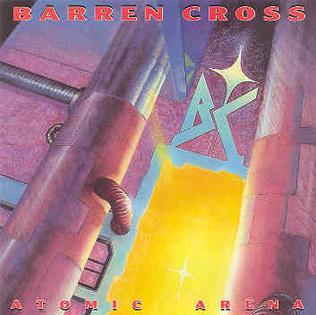
Released by Enigma in 1988, Atomic Arena is where the band sounds most sure of itself, Mike Lee's voice going over the riffs like a gale tearing the tin off a barn roof and the rhythm section running flat out underneath. State of Control followed on the same label in 1989, and Enigma let them go soon after. Then the label door closed.
The Louisville brothers Dale and Troy Thompson, one singing and one on guitar, started out as Matrix in 1983 and took the name Bride when they signed to Pure Metal Records. Their first three albums, Show No Mercy in 1986, Live to Die in 1988 and Silence Is Madness in 1989, are the heavy metal ones, Dale Thompson's shriek driven through the guitars like a nail through a church door. By 1990 they had turned to hard rock. The early records are the ones to own.
Up in Salem, Oregon, the band that put out Warriors of the Son in 1984 and filled its songs with hell, judgement and the end of days called itself Saint, and the Christian press has kept its records close ever since. In 2010 the magazine HM, the scene's own paper of record, ranked Hell Blade 46th and Time's End 67th among the hundred best Christian metal albums. The band went quiet after the eighties. It reunited in 1999.
Judge the altar and every record on the shelf passes. Judge the drums underneath and the shelf empties fast.
Where the border runs
Two famous names stand just outside. Tourniquet, from Los Angeles, played technical thrash with surgical song titles, and Trouble, from Chicago, was sold under a Christian banner its singer spent years refusing, and both belong to the faster and the slower genres that took them. Stryper, Barren Cross, Bride and Saint stay here because their records keep the clean high voice and the twin guitars of 1980, the grammar laid out in the overview. The beliefs never decided the shelf. The riffs did.
| Band | From | Start with | Year |
|---|---|---|---|
| Stryper | Orange County | Soldiers Under Command | 1985 |
| Bride | Louisville | Live to Die | 1988 |
| Barren Cross | Los Angeles | Atomic Arena | 1988 |
| Saint | Salem, Oregon | Time's End | 1986 |
| Theocracy | Athens, Georgia | Mirror of Souls | 2008 |
The long songs of the second generation
The revival came from the South, and it came from one man first. The Athens, Georgia band that began in 2003 as Matt Smith alone, singing and playing every instrument over a drum machine, is Theocracy, and by 2008 it had become a full band that wrote the way the European power metal groups wrote, long, melodic and built for a choir.
Released by the Swedish label Ulterium on 21 November 2008, Mirror of Souls closes on a twenty-two minute title track built in three movements. It is laid down section by section like the keel and ribs of a ship in a dry dock, each frame bolted to the last until the hull stands and the whole thing is ready to take water. As the World Bleeds followed in 2011, Ghost Ship in 2016 and Mosaic, on Atomic Fire, in 2023. The pace is slow. The records hold.
Sweden supplied the other half of the revival. The band that the singer Christian Liljegren and the guitarist Carl Johan Grimmark built in the second half of the nineties, with neoclassical runs laid over double kick drums in the manner Yngwie Malmsteen had taught a whole country, was Narnia, founded in 1996, and it proved the faith could travel the same roads as European power metal without changing a note of the grammar. Its debut, Awakening, arrived in 1998. The front had moved to Europe. The songs had moved nowhere.
Beyond dispute, the faithful have been making this music for forty years, and the verdict has never once depended on the lyric sheet: Soldiers Under Command for the gallop, Atomic Arena for the Maiden voice, the early Bride records for the shriek, and Theocracy for the length. The decade in which most of them began, and the bands from every country who shared its charts and its stages, is gathered among the heavy metal bands from the 80s. Faith was never the barrier. A weak riff always was.
