
In 2010 twelve male students pedalled stationary bikes for about twenty-five minutes to six popular tracks, three times over, and nobody told them that on one visit the music had been sped up by ten per cent and on another slowed by ten per cent. Played fast, the same songs pulled 3.5 per cent more power out of their legs; played slow, they drained almost ten per cent away. The riders had not changed. The drummer had.
The engineer who gave the machine its first and harshest form, for the gaols at Bury St Edmunds and Brixton in 1818, was William Cubitt. His treadwheel was a long drum of wooden steps that a row of convicts climbed for hours at a stretch, going nowhere, grinding corn or grinding nothing, with no count to keep but the next tread and no sound but the creak of the axle, until the endless staircase had ground the men down to the bone of their patience. Nothing on it marked time. That was the punishment.
Heavy metal music for workout puts the count back on the wheel, and it does so by the plainest mechanism the music owns: a drummer who does not slow down. The sports psychologist who has spent three decades measuring what music does to a body under load, at Brunel University London, is Costas Karageorghis, and his findings are less romantic than a gym wall and more useful. Music makes hard work feel lighter and go a little further. It does not make anyone stronger.
Which records the style was built on, and in what order, is told in the longer account. The question in a gym is narrower: what the research can actually show, and which songs do which job in a session.
What the studies show, and where they stop
The Australian psychologist who led the largest pooled review so far was Peter Terry, and the analysis he published with Karageorghis and three colleagues in Psychological Bulletin in 2020, gathering 139 studies and more than 3,500 participants, found music linked with better mood during exercise, lower perceived exertion, better performance and slightly more efficient use of oxygen. The effect on exertion was real and small. Nobody should sell it as larger.
It also has a ceiling. At light and moderate effort the song competes with the body for attention and wins some of it back, but near the top of a person's capacity the signals from labouring lungs and burning thighs flood every channel and wash the music out of the head, so that most studies find it changing how a hard session feels far more than how hard it registers. The body outvotes the band.
Music makes hard work feel lighter and go a little further. It does not make anyone stronger.
Taste matters, though how much is unsettled. A team led by Christopher Ballmann reported in 2021 that twelve trained men pressed more repetitions to music they had chosen than to music they disliked, and a later, larger repeat of the same test with 28 trained men found no difference at all. On any honest reading, a listener who hates heavy metal gains nothing from being made to lift to it.
Heavy metal music for workout: tempo does the counting
Tempo is where the genre earns its reputation. In treadmill and cycling studies, people exercising at moderate to hard effort preferred music at roughly 125 to 140 beats a minute, and the preference climbed with heart rate before levelling off instead of rising for ever, which explains why nobody sprints better to a ballad and nobody feels faster at 220.
Much classic heavy metal sits above that band, and it gets away with it because drummers so often play in half time over a fast guitar. A riff running at 170 can be felt as 85, one beat for every other stride, and a runner whose feet fall somewhere between 160 and 180 times a minute can lock onto either number. Locking on is a different effect again. When movement is timed to the beat, studies report the same work done at a slightly lower oxygen cost.
Why heavy metal suits the work
What the genre brings to a session is mostly structural. The drummer rarely drops out, the kick and the snare sit high in the mix, and a riff repeats long enough for a body to lock onto it without waiting for a chorus, so the beat stays as plain as the white line a groundsman rolls down a running track, the one mark a tired eye can still hold when the rest of the stadium has blurred into noise. Pop hides its beat under the singer. Heavy metal rarely bothers.
Almost none of the studies used heavy metal. They used pop, dance and rock tracks chosen for their tempo, and what they found carries across to any genre only as far as its tempo and the listener's taste carry it. The claim for the genre is therefore a modest one, and it rests on the drumming, not on anything mystical in the distortion.
Loudness is the one thing the genre adds that no study recommends. It raises arousal, and over an hour it also raises the dose of sound the ears absorb, and the research on the first does not cancel the research on the second. Turning the song up is a choice with a cost attached.
The songs, by what they do in a session
Before the first set the job is arousal, the charge a song puts into a body that has not yet moved. A song used that way works like a pair of jump leads clamped to a flat battery on a winter morning, the clips biting into the terminals and dumping a live engine's current into a dead one until the starter motor coughs, catches and turns over on its own, after which the leads come off and the car has to run on what it has.
The singer who built an entire song out of two words for a crowd to shout back was Ronnie James Dio, and "We Rock", which opens The Last in Line, released in 1984 under the name Dio, charges in on a fast, driving riff and a chorus that asks the listener to answer rather than admire. Four minutes of it and the pulse is already moving. The work has not started yet.
Steady work is where the gallop pays. The drummer who set the pace under "Run to the Hills", on Iron Maiden's The Number of the Beast in 1982, was Clive Burr, and the song rolls on at a tempo a runner or a rower can hold for its whole length without once having to think about the count. That is the entire trick of synchronous music, and it asks for nothing clever from the song. A beat a runner can find without listening for it is worth more than a solo he has to wait for.
Heavy lifting asks for weight rather than speed. Slow, relentless riffs such as the title track of Accept's Balls to the Wall or Judas Priest's "Metal Gods" leave long gaps between the blows, and a lifter who works between sets rather than to the beat uses them for arousal and nothing else. No study has singled either song out. The use is the same one the research describes for any music a lifter likes.
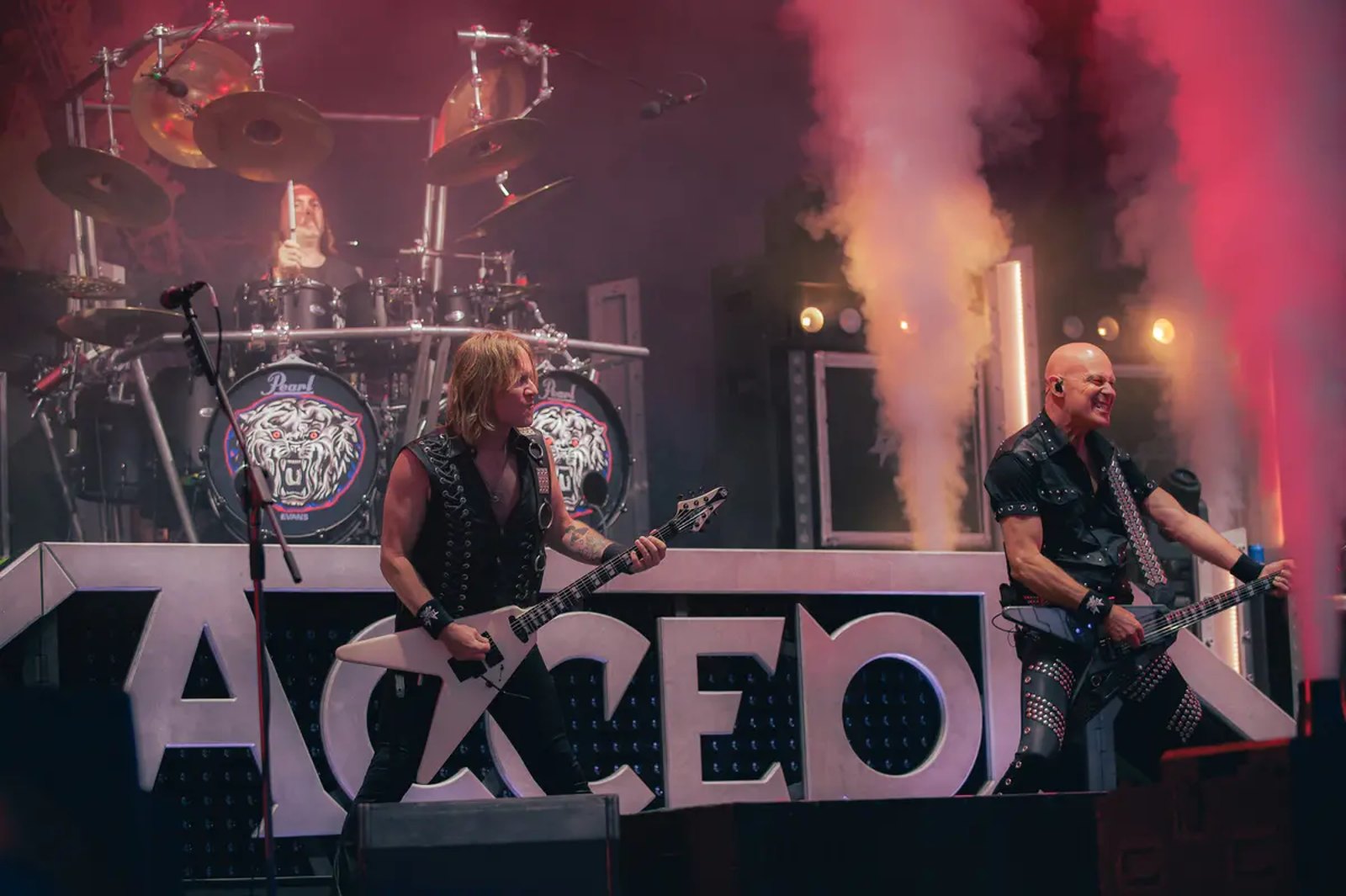
Intervals want the opposite: short, flat-out bursts and a hard stop. The German veterans who were still firing off their 1982 speed songs at full velocity thirty-five years later are Accept, and the title track of Restless and Wild, captured on the tour for Restless and Live in 2017, is a sprint of a riff that lasts about as long as a hard interval does. Then it stops. So does the runner.
Cooling down asks the music to get out of the way. "Planet Caravan", from Black Sabbath's Paranoid in 1970, drops the distortion, slows almost to a drift and lets the heart come down without a riff pulling against it. Few heavy bands wrote many of those. The ones that did are worth knowing.
| Phase | What the research says music does | Rough tempo | Examples |
|---|---|---|---|
| Before the first set | Raises arousal | Fast to mid tempo | "We Rock" |
| Steady effort | Timing movement to the beat can lower oxygen cost | About 125 to 140 bpm, or a fast song felt in half time | "Run to the Hills" |
| Heavy lifting | Arousal between sets; no proven gain in strength | Slow | "Balls to the Wall", "Metal Gods" |
| Intervals | Distraction from effort, weaker near maximum | Fast | "Restless and Wild" |
| Cool-down | Lets the pulse settle | Slow | "Planet Caravan" |
None of it is magic, and the theory is far less gruelling than the session. A beat gives a tired body something to answer, a favourite song gives it a reason to keep answering, and past a certain effort the lungs take over the conversation whatever is playing.
The traffic runs the other way for the people on the records. For a player rather than a listener, the hardest heavy metal songs to play leave the forearms and the ankles more spent than most sessions on a bench, and not one of them lets the player choose the tempo.
