
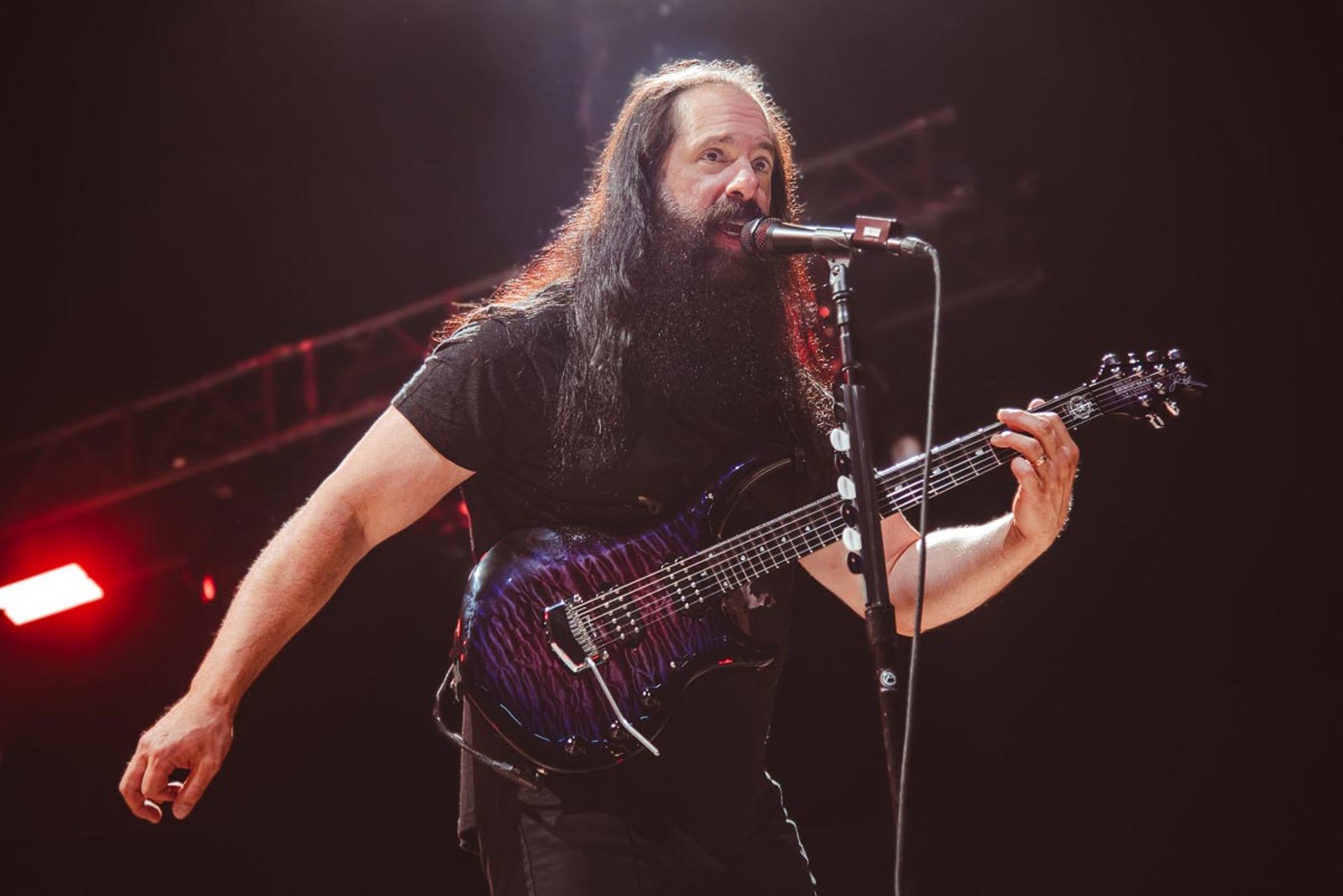
Forty-two minutes and four seconds. The American quintet that gave the entire second disc of a double album to one composition in January 2002, a piece in eight movements indexed as separate tracks and played without a break, was Dream Theater, and the title track of Six Degrees of Inner Turbulence still sits near the top of any honest list of the longest heavy metal songs. Longer ones exist. Few of them are heavy metal.
A long song works on its listener the way saturation diving works on a commercial diver, who lives for weeks in a steel chamber on the deck of a support ship at the pressure of the seabed. He is lowered in a bell to the job and brought back in stages so slow that the ascent takes days, because pressure released too fast boils the dissolved gas out of the blood and wrecks the joints from the inside. The length is not decoration. It is the price of the depth.
Most metal songs are a free dive: one breath, down, a grab at the bottom, and back up inside four minutes. The longest ones keep the listener down there long enough to adjust, and they pay back the time only if something is waiting at the bottom. Three things usually are: a suite of linked movements, a story told at the pace of a story, or a single riff repeated until it stops being a riff and becomes the room you are sitting in.
Suites: the longest heavy metal songs built like symphonies

Written as a set of portraits of people living with mental illness, one condition to each movement, and framed by an orchestral overture that states the themes before any of them is sung, the title track of Six Degrees of Inner Turbulence behaves like a symphony that happens to own a double kick drum. John Petrucci and Jordan Rudess trade the melody back and forth, and every return of the opening theme lands like a hatch slammed shut on the one before. It is exhausting. It is meant to be.
The model is older than the band. Rush gave the whole first side of 2112 to a seven-part suite of a little over twenty minutes in 1976, and Dream Theater's own A Change of Seasons, a single track of twenty-three minutes, had been meant for Images and Words in 1992 and finally appeared as an EP title track in 1995, is the direct heir. Both are campaigns rather than songs. Both repay the time.
Italian power metal took the suite and dressed it for the opera house. The Trieste band built around the guitarist Luca Turilli and the keyboard player Alex Staropoli, still called Rhapsody before a 2006 trademark dispute forced the Rhapsody of Fire rename, closed its five-album Emerald Sword Saga in 2002 with "Gargoyles, Angels of Darkness" on Power of the Dragonflame, nineteen minutes for choir, orchestra and a guitar that keeps arriving late to its own battles. Subtle it is not. Long it certainly is.
Some bands cheat the count. Iced Earth wrote a piece about the battle of Gettysburg that runs past half an hour and split it into three tracks on The Glorious Burden in 2004, so that it appears on almost no list of long songs and deserves a place on most of them. The stopwatch has no ear.
Stories told at the pace of a story
Twenty-eight minutes and thirty-eight seconds is the benchmark every long heavy metal song is measured against, and the quartet from upstate New York that set it, in 1992, was Manowar. "Achilles, Agony and Ecstasy in Eight Parts" runs its story through a spread of eight sections fired in sequence like torpedoes from the bow tubes, each on its own heading and all converging on the same target, with whole passages handed to solo bass and solo drums along the way. The solos are the weak water. The riffs either side of them are not.
The band that had set the length standard for a generation with thirteen minutes of Coleridge in 1984 beat its own mark thirty-one years later, and the man who did it, sitting at a piano he had taught himself to play, was Bruce Dickinson. "Empire of the Clouds", which closes Iron Maiden's The Book of Souls of September 2015, runs to eighteen minutes and tells the story of the R101, the British airship lost on its first overseas voyage.
The R101 crashed near Beauvais in northern France in the early hours of 5 October 1930, bound for India. Forty-eight of the fifty-four people aboard died.
Dickinson builds the song as a newsreel, with a slow piano opening, a long middle section of guitars running like engines at full throttle into a head wind, and a crash rendered by the whole band before the piano returns alone. Six years later the band put three songs over ten minutes onto Senjutsu, the longest of them "The Parchment" at more than twelve and a half. The disease is now chronic. Nobody wants a cure.
The Hamburg five who closed both halves of Keeper of the Seven Keys with a song of more than thirteen minutes, Kai Hansen's "Halloween" in 1987 and Michael Weikath's title track in 1988, were Helloween, and both pieces run as a chain of verse, chorus, solo and chorus again, a speed metal single welded end to end to copies of itself until the seam became the form. It works because the choruses can stand being heard four times. Most choruses cannot.
The Krefeld band that released a fourteen-minute account of the fall of Troy as a single in 2001, ahead of its album A Night at the Opera, was Blind Guardian, and "And Then There Was Silence" layers Hansi Kürsch's voice into a choir of itself, a hundred tracks deep by the band's own account, until the chorus sounds like a city shouting from the walls. Radio did not play it. Radio was never the point.
The length is not decoration. It is the price of the depth.
The riff that refuses to end
Beyond the stories lies the outer limit, and heavy metal in the narrow sense only borrows it. The San Jose trio that recorded a single song of more than an hour in the mid-nineties and saw its label refuse to release it was Sleep, and "Dopesmoker", issued in full by Tee Pee Records in 2003, moves at one slow crushing weight a step, with no interest at all in the clock. It is doom, and doom keeps its own measures.
The other extreme courts have their own long pieces. Edge of Sanity in Sweden released Crimson in 1996, one death metal composition of forty minutes, and Fates Warning's A Pleasant Shade of Gray in 1997 ran a single progressive piece of about fifty-three minutes in twelve parts. Both are albums in the form of songs. The distinction matters less than the listening.
Where the long song sits in the canon
| Song | Band | Length | Year |
|---|---|---|---|
| Six Degrees of Inner Turbulence | Dream Theater | 42:04 | 2002 |
| Achilles, Agony and Ecstasy in Eight Parts | Manowar | 28:38 | 1992 |
| A Change of Seasons | Dream Theater | 23:09 | 1995 |
| 2112 | Rush | 20:33 | 1976 |
| Gargoyles, Angels of Darkness | Rhapsody | 19:03 | 2002 |
| Empire of the Clouds | Iron Maiden | 18:01 | 2015 |
| And Then There Was Silence | Blind Guardian | 14:06 | 2001 |
| Rime of the Ancient Mariner | Iron Maiden | 13:45 | 1984 |
The pantheon of the genre's great records is mostly made of songs of four to eight minutes, and the long pieces sit at its edges rather than its centre, which is exactly where the albums that frame them are weighed in the chapter it belongs to. A long song rarely makes a great album on its own. It often makes a great album's closing side.
Metallica, a thrash band with other habits, reached its longest studio song only in 2023, when "Inamorata" closed 72 Seasons at a little over eleven minutes. Judas Priest waited until 2005 to try it, with "Lochness", thirteen minutes about the monster, and few lists put it anywhere near the others. The tonnage of the style was always in the riff, not the clock. Length is a second language, spoken fluently by a few bands and badly by many more.
The long form also suits grief, and some of the slowest heavy metal ever pressed belongs less to the roll than to the saddest heavy metal songs, where length is measured in how long a record takes to let you go. Beyond dispute, forty minutes of heavy metal is still harder to write than four. These bands simply had the lungs for it.
