
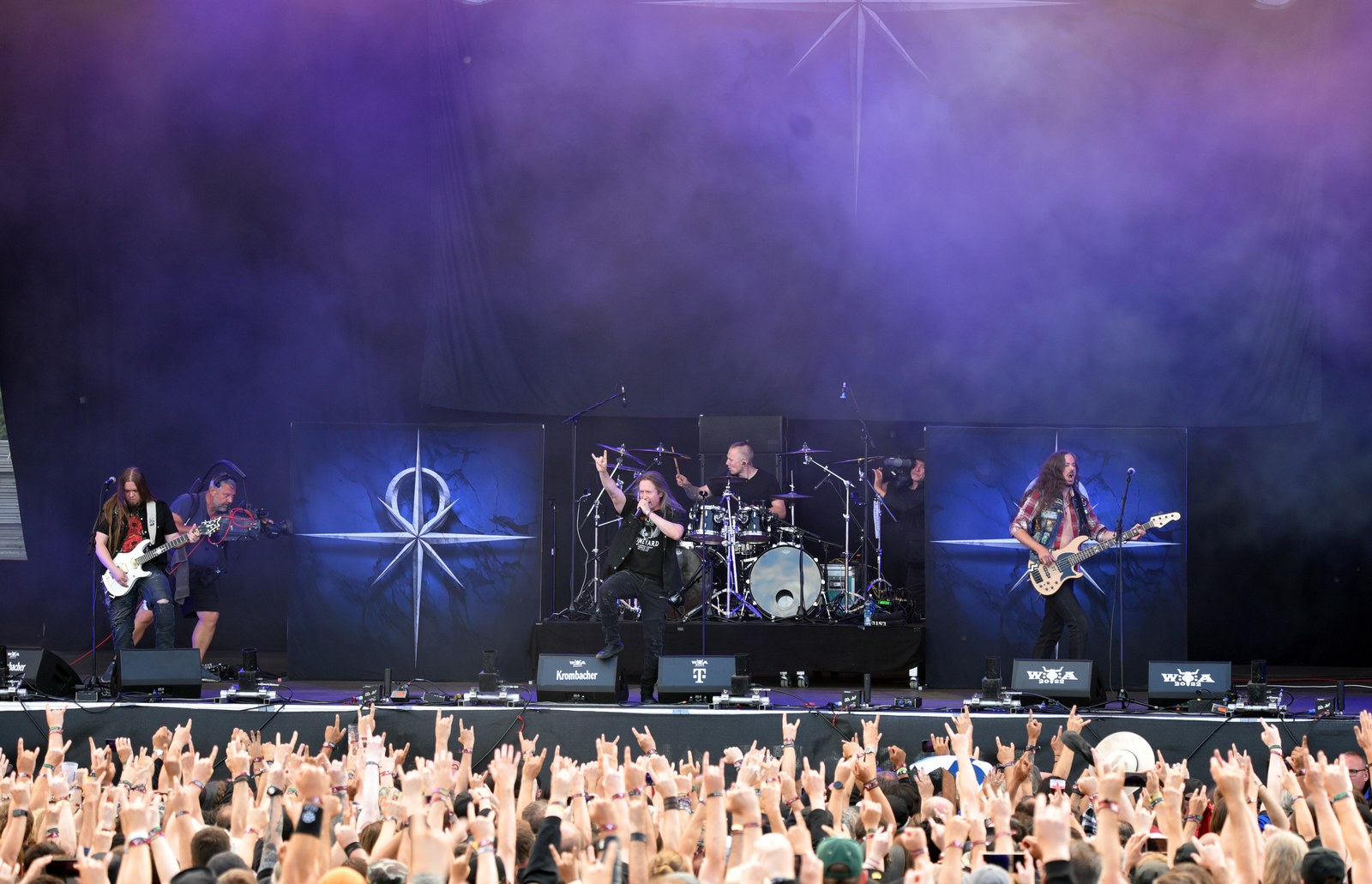
Side one of a 1987 album on Noise ends on the slowest thing on it, and anybody who wanted something fast again had to get up and turn the record over. The five-piece that spent the rest of that disc hanging a tenor over a continuous double kick calls itself Helloween, and "A Tale That Wasn't Right", written by Michael Weikath and fifth of eight on Keeper of the Seven Keys Part I, sits at the one point in the running order where a listener has to put a hand on the machine. Side two opens on "Future World" and then gives thirteen minutes to "Halloween". A power metal ballad is a position before it is a song.
Ninety players and forty minutes of score can carry one stroke of a triangle. It goes in once, and the bar it lands in is chosen with more care than the chord underneath it, because a single piece of bent steel ringing out over a full platform is the only address the work has: not the big theme, not the return, the triangle. Hit it hard enough to part the gut loop it hangs by and send the frame skidding off across the boards, and the hall still knows precisely where in the piece that was. Write it in twice and neither stroke is an address. Write it into every loud bar and what the score has is a triangle part, a line of quavers, a player with nothing left to wait for, and forty minutes with no way into them.
Records work like that too. Forty minutes at one tempo, in one register, with one shape of chorus, is forty minutes with no interior, and the slow track is where an album acquires a middle and therefore a before and an after. It is a girder, not an ornament. Which is why nearly every record with its place in the story carries one, and why the interesting question about it is never whether the thing is any good. The question is where it sits, what it does to the two songs touching it, and whether it was written for the album or for somebody's radio.
Where the power metal ballad goes on a record
Three positions are available and they do different work. One is the end of a side or of the first half, where the device buys a boundary that was not there. Another is straight after the longest song, where it stops a listener being asked for two kinds of concentration back to back. The third is last, where it takes the record's final word off the fastest thing on it. The Finnish band whose line-up for the next decade was completed by the keyboard player and the drummer who arrived for this one bills itself Stratovarius, and Episode, out on T&T Records on 22 April 1996, closes its sixty two minutes and fifty six seconds on "Forever", three minutes six, twelfth of twelve, words and music by Timo Tolkki.
Nothing comes after it. The two singles the label took off Episode were "Father Time" backed with "Uncertainty" and "Will the Sun Rise?", so the track that has outlasted the record in the band's own sets, played more than five hundred times on the fan-kept setlists and more often than either single, was never pushed at anybody at all. It was placed. A closing ballad absolves a record of none of its speed and changes entirely what is remembered of it, because the last thing an ear is handed is the thing it carries out of the door.
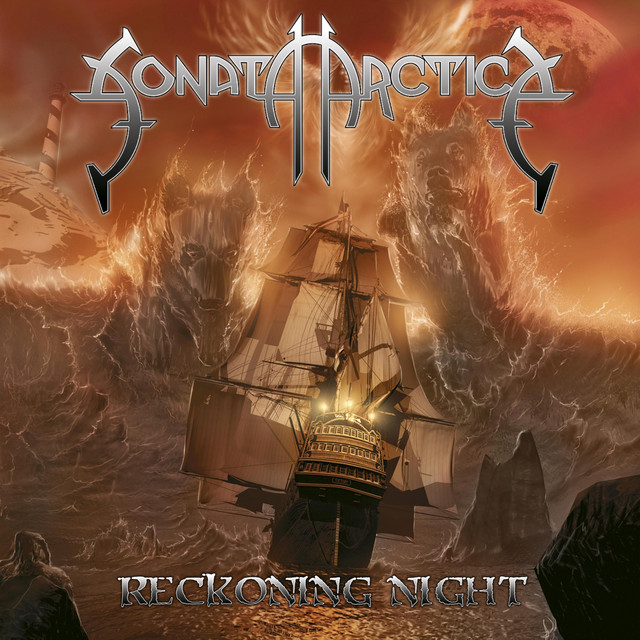
The same slot taken eight years later, with a long piece standing directly in front of it, does something else again. The band that put its longest track ninth and then refused to end on it plays under the name Sonata Arctica, and "Shamandalie", four minutes four, is tenth and last on Reckoning Night, sitting immediately behind the eight minutes forty seven of "White Pearl, Black Oceans...". The long song is allowed to be a climax because something follows it and asks for nothing. Reverse the two and the long one is an appendix.
The track before it and the track after it

A ballad rewrites its neighbours whether or not anybody planned it. The band that cut a ballad and a dragon under one title in the spring of 1992 at Karo Studios and sequenced them back to back goes by Blind Guardian, and "The Bard's Song - In the Forest", three minutes ten and seventh of the ten tracks on Somewhere Far Beyond, runs straight into "The Bard's Song - The Hobbit", three minutes fifty four, with Hansi Kürsch and André Olbrich credited for both. So the acoustic one is not a break at all. It is an overture, the loud song that shares its title is the first act, and once the fifty nine seconds of "The Piper's Calling" have gone past, the seven and a half minute title track arrives at somebody who has spent eight minutes among hobbits and dwarves.
Sonata Arctica had done the reverse three years earlier. On Silence, out on Spinefarm in 2001 and written throughout by Tony Kakko, a ninety three second instrumental called "Revontulet" sits tenth and "Tallulah", five minutes twenty, eleventh, so the record goes quiet twice in a row, and the track that breaks the run is "Wolf and Raven" at twelve. Without the pair in front of it that would have been one more fast song stacked behind the others. Not a bar of it was altered. Its position was.
What an interlude cannot do
An interlude buys a door and nothing else. Inside a loud arrangement the ring of the room goes over the top of everything beneath it and covers every seam in the playing, so a part that sits half a beat behind where it belongs is taken by the chord still sounding above the gap, and nobody past the third row ever finds out the gap was there. Take the same music down to a voice and one guitar and that half beat goes through the bar like a chair going over in a quiet house. That is what a power metal ballad publishes: the tune with no apparatus on it, the voice unmediated, the band's actual timekeeping, and the writing, which on a fast song in this style is carried by a double kick that never lets up and a stacked refrain whatever it is worth. A record with nothing like that on it has an audit it never files.
Interludes are how a record breathes without conceding anything. The four-piece whose own singer shared the front of its slow track with a guest out of another band carried the name Gamma Ray, and "Farewell", five minutes eleven and seventh of thirteen on Land of the Free, has Kürsch at the front of it beside Kai Hansen, with the words and the music credited to Dirk Schlächter alone. Three sub-minute tracks are already scattered through the same record. They keep the surface from going flat and they cannot do the other thing, because fifty seconds is not long enough for anybody to be caught out in.
Written for the album, or sold off it
The two uses want opposite things, and the dates tell you which one was served. "Forever and One (Neverland)", fifth of twelve on The Time of the Oath, reached Japan on 29 February 1996 inside a Nostradamus concept record cut at Chateau du Pape in Hamburg, and then went out on its own as that album's third single in the late summer, about six months later. The album wanted it fifth. The label wanted it alone. On the record its neighbours are "Power" and "Before the War" and the sequence is doing half the work; on a radio its neighbours are an advertisement and a weather bulletin, and the thing has to carry the whole job unaided, which makes it a different song with an identical tape.
The album wanted it fifth. The label wanted it alone.
Two of them, and the record loses its middle
The device is spent by its second instance. Kamelot put "Don't You Cry" fifth on Karma in July 2001 and "Temples of Gold" eighth, both a little over four minutes, on a twelve track album whose last three tracks are one piece in three parts, and a listener coming off the second of them has no way of telling which one the record was built around. The songs between the two stop reading as the album's weather and start reading as the gap between the slow ones. Three of them and the record is not restful but interminable, a dirge with interruptions in it.
The fault scales up, and Helloween proved it on Chameleon in 1993, where the soft and the slow stopped being one position on a record and became four of its twelve, at three, six, eight and twelve. With a third of the running order spoken for, no one slow track occupies a place any more, because there is too little fast left for a place to be cut out of. What a quiet track costs and buys at the other end of the same argument, where the lever is length rather than tempo, is the business of the longest power metal epics.
None of this asks anybody to like the songs, and the sentiment in them is beside the point. Take any record in the style, move its slow track one place in either direction, leave every bar of it exactly as it was, and listen to the two songs it used to touch. One of them has lost an entrance and the other has lost an ending. Then put it back. The song was never the decision.
