
Seven hundred and nineteen bands carried the words symphonic and power in their Metal Archives genre field in October 2026, eighty five of them Japanese and seventy two Italian against twenty six in the Germany that grew the trunk, and any roll of symphonic power metal bands that tries to hold the whole crowd buckles under it before the second page.
The Italian band that hired five string players for a debut cut in Wolfsburg in the spring of 1997, and let the keyboards lay a film score nobody had yet paid for over the gallop, was Rhapsody Of Fire, then still called Rhapsody. Every band after it struck a variation on that bargain.
The names on the shelf change with the observer. In 1845 Christophorus Buys Ballot, a young lecturer at Utrecht, put a party of horn players on a train behind a locomotive on the line to Amsterdam, ordered them to hold one note and stood musicians with trained ears beside the rails.
The engine dragged the brass past at full steam. The note arrived sharp, was wrenched flat in the instant the horns went by, and one breath out of one bell went into the notebooks as two pitches, set down by honest ears that disagreed about nothing except which way the train had been travelling when it reached them.
Two archives listening to one record do exactly that. One archive writes down the orchestra, the other writes down the double kick, and neither is lying. A careful roll checks every band against both, and where the two part company, the parting is a fact in its own right.
The road from Hamburg to the Adriatic is the story so far. A band earns its place among the symphonic power metal bands on one record, the one that would convince a sceptic, with the strings or the choir written into a song the double kick still drives; a later album that wanders off does not undo it.
Where the orchestra stops dressing the song and starts writing it, the music has crossed into symphonic metal, a different genre with its own shelf, and that crossing is how the branches divide at this end of the tree. The test is the same in every country. Only the accents change.
Symphonic power metal bands from Italy, where the label begins
Rhapsody Of Fire: Legendary Tales (1997)
Released by Limb Music in October 1997 after two months at Gate Studio with Sascha Paeth and Miro at the desk, Legendary Tales credits a lead violin, a second violin, a viola, a cello and a contrabass, and that is the whole hired orchestra behind the record every later Italian band would be measured against.
Five players were set against an arrangement written as if for sixty, bows sawing at parts that wanted a full section apiece, the contrabass grinding away until its endpin gouged a furrow in the studio floor, while the keyboards of Alex Staropoli hammered the other fifty five chairs into place around them. The size was arranged before it was ever hired.
That is why the pedigree could be copied so widely. Any band with a keyboard player and a tenor who could hold a top note could claim the same descent, and by the end of the decade dozens did.
Luca Turilli's Rhapsody: Prometheus, Symphonia Ignis Divinus (2015)
The guitarist who left the founding band on friendly terms in August 2011 with half of its name torn off and packed in his luggage was Luca Turilli, leaving Staropoli and Fabio Lione on vocals to carry on as Rhapsody of Fire, and the second and last album he made under the name Luca Turilli's Rhapsody is the one that proves the case.
Released by Nuclear Blast in June 2015 with Alessandro Conti singing, Prometheus, Symphonia Ignis Divinus went out on what the band billed as a cinematic world tour and came back the following year remixed for Dolby Atmos. A power metal record mixed for the speakers in a cinema ceiling is the label taken as far as it can go and still keep a drummer. Nobody has pushed it further.
Thy Majestie: Hastings 1066 (2002)
Signed to Scarlet Records before Limb Music came calling in September 2001, the Sicilian band that set the Battle of Hastings to a film score was Thy Majestie, and Hastings 1066, released by Scarlet in 2002, is the concept record that put it on the symphonic shelf.
Wikipedia describes the band as darker than typical power metal and more cinematic, and Metal Archives files it plainly as symphonic power metal. In January 2002 Kamelot's Thomas Youngblood offered the band a European support slot, and it could not afford the travel. The record got made instead.
Ancient Bards: The Alliance of the Kings (2010)
Formed in January 2006 around the keyboards of Daniele Mazza and fronted from 2007 by Sara Squadrani, the Italian band that answered Rhapsody most directly, on the same Limb Music label and with the same appetite for a saga spread across several albums, is Ancient Bards, and The Alliance of the Kings in 2010 is where the answer starts.
The difference is the voice. A soprano stands where the tenor stood, and neither archive moved the band an inch for it: Metal Archives files it as symphonic power metal and Wikipedia's own opening sentence does the same.
Finland, where the soprano meets the border
Nightwish: Oceanborn (1998)
The Finnish band whose early records sit on this shelf and whose later ones do not is Nightwish. Oceanborn, released by Spinefarm on 7 December 1998, is fast and double kicked, with harmonised guitar and keyboard leads and Tarja Turunen's soprano where a tenor would stand.
By 2004 the orchestra had taken over the writing, and the archive that files the early records as symphonic power metal files the later ones as symphonic metal. Oceanborn stays.
Amberian Dawn: River of Tuoni (2008)
Built on the songs of Tuomas Seppälä, who played guitar and keyboards, and released by KHY Suomen Musiikki on 30 January 2008, River of Tuoni is the proof, and the Finnish band that set Heidi Parviainen's classical soprano to cut straight across guitar-driven tempos was Amberian Dawn, filed as symphonic power metal by both archives.
The orchestra on it is small and real where it counts: a six-voice choir on three tracks and kettle drums from Jarmo Lahtiranta, across thirty six minutes. In the judgement of its own singer the band played fast, guitar-driven metal with purely classical female vocals, which is the definition in a single sentence.
Fourteen years later the same band released an album of ABBA songs. The debut does not move.
German and Austrian records the archives file apart

Blind Guardian: At the Edge of Time (2010)
Filed by Metal Archives as speed metal in its early years and power metal afterwards, and never once as symphonic, the Krefeld quartet that opened its ninth album inside an orchestra is Blind Guardian, and Wikipedia files At the Edge of Time, released by Nuclear Blast on 29 July 2010 with Charlie Bauerfeind producing, as power metal and symphonic metal both.
"Sacred Worlds", nine minutes and nineteen seconds at the head of the record, began life as "Sacred", written for the 2008 video game Sacred 2: Fallen Angel, and for the album the band bolted a new orchestral introduction and ending onto it. "Wheel of Time" closes the record at almost nine minutes.
The strings kick the door in on the first bar, and behind it walk "Tanelorn (Into the Void)" and "A Voice in the Dark", the band itself. One archive heard the door, the other heard the house.
One archive heard the door, the other heard the house.
Serenity: Death & Legacy (2011)
Released by Napalm on 25 February 2011, with orchestrations written by Oliver Philipps, its co-producer, and guest voices borrowed from Sirenia, Delain and Epica, Death & Legacy is the record that fixes Serenity, from Austria, on the shelf: fourteen tracks of historical portraits, Francis Drake, Casanova, Galileo and Joan of Arc among them, with two interludes and two instrumentals stitched between the songs.
Wikipedia's opening calls Serenity symphonic power metal. Metal Archives adds a third word and files the band under symphonic and progressive power metal, which is the same record heard with a progressive ear.

Visions of Atlantis: Wanderers (2019)
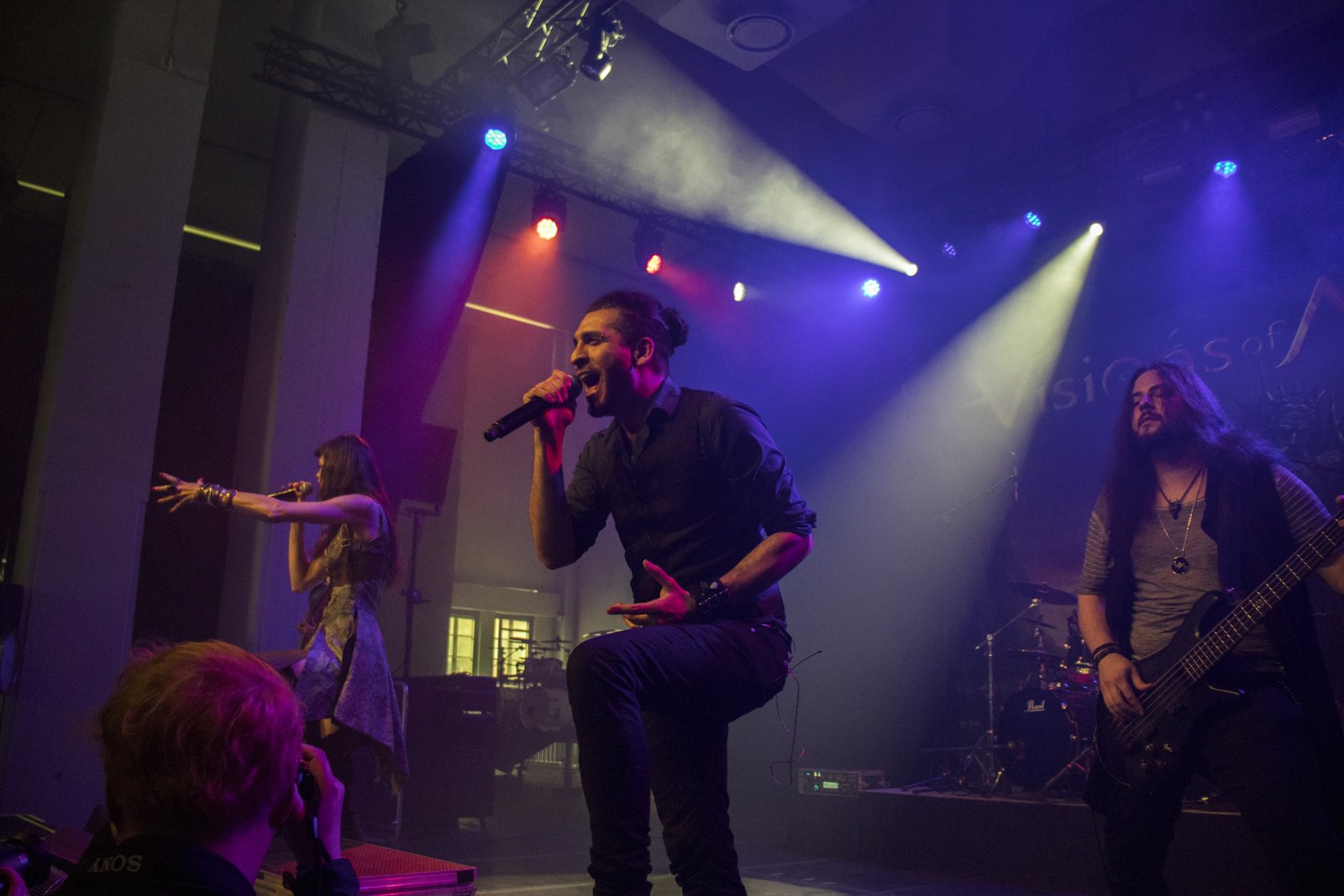
Out on Napalm on 30 August 2019, Wanderers splits the lead between Clémentine Delauney and Michele Guaitoli and credits its keyboards mostly to its producer, Frank Pitters, as a guest, so most of the symphonic layer of the record arrives from outside the five-piece that is Visions of Atlantis.
Metal Archives files the Austrians as melodic and symphonic power metal. Wikipedia lists symphonic metal, power metal and, since Pirates in 2022, pirate metal as well, and that last tag is the band hoisting a new flag over the same orchestra rather than tearing the orchestra down. Wanderers is the record that earns the place.
America, France and the largest shelf of all
Kamelot: The Black Halo (2005)
Formed in Tampa in 1987 and sung for most of its best known years by Roy Khan, a Norwegian, the American band that most lists of the style include and neither archive files under the full name is Kamelot: Metal Archives calls it progressive and melodic power metal, and Wikipedia's band page lists power metal, heavy metal, progressive metal and symphonic metal.
The Black Halo, released by SPV in March 2005, is the record to argue from: a Faust story told across fourteen tracks, with Shagrath of Dimmu Borgir and Mari Youngblood as guest voices and three short interludes laid between the songs. It sits at the meeting point of three shelves, and the oracle anybody consults will name whichever one it walked in from. Kamelot belongs anyway.
Behind it the American field is wide and almost unknown. Metal Archives lists forty five American bands with both words in the genre field, from Winter's End in Boston to Lorenguard in Indiana, while Seven Spires, the best known younger American band near the style, is filed as symphonic metal by both archives and the archives put it just outside it.
Fairyland: Of Wars in Osyrhia (2003)
Composed by Philippe Giordana on keyboards with Willdric Lievin, and sung by Elisa C. Martin, known from Dark Moor in Spain, Of Wars in Osyrhia came out in April 2003 on N.T.S. and was called Rhapsodian metal by some of its reviewers. The French band filed by comparison before it was ever filed by name was Fairyland.
Both archives agree on symphonic power metal, and the eleven-minute title track at the end of a sixty-minute record is the case. By 2009 the band had shrunk to Giordana alone with guest singers, and the keyboard that had always written the orchestra had swallowed the rest of the band whole.
Versailles: Noble (2008)
Formed in 2007 by Kamijo on vocals and Hizaki on guitar, the visual kei band that hung an orchestral backdrop and a court's worth of rococo lace over twin guitars and a double kick, at the head of the largest national shelf on the archive, is Versailles, and Noble, released in July 2008, digitally through the international iTunes stores a week before the discs, is its first full album.
Metal Archives files Versailles as symphonic and neoclassical power metal and Wikipedia's first sentence calls it a visual kei symphonic power metal band. In North America the same records were sold under the name Versailles Philharmonic Quintet. The spectacle of the stage is the visual kei half of the bargain; the double kick and the twin leads are the power metal half.
| Country | Bands | One of them |
|---|---|---|
| Japan | 85 | Versailles |
| Italy | 72 | Rhapsody of Fire |
| Russia | 48 | Imperial Age |
| United States | 45 | Winter's End |
| Finland | 36 | Amberian Dawn |
| France | 29 | Fairyland |
| Germany | 26 | None of the founders |
| United Kingdom | 23 | Fellowship |
| Sweden | 19 | Majestica |
| Austria | 10 | Serenity |
| All countries | 719 |
The newer names
Majestica: Above the Sky (2019)
Renamed on signing to Nuclear Blast in 2019 after a run of albums as ReinXeed, a solo project on which Tommy Johansson sang and played every instrument, the Swedish band that took the new name is Majestica, and Above the Sky, released on 7 June 2019, is the record that gave the new name its proof.
The title track is the Johansson method in one song: a tenor pitched at the ceiling, over a band that Metal Archives files as symphonic power metal and Wikipedia as power metal and symphonic metal both, which places the debut exactly on the line.
Imperial Age: The Legacy of Atlantis (2018)
Founded in Moscow in 2012 by Alexander "Aor" Osipov and Jane "Corn" Odintsova, both singers and composers, and brought to an audience outside Russia by Christofer Johnsson of Therion, who distributed its music and took it on tour, the band that fronts three lead voices at once is Imperial Age, and The Legacy of Atlantis came out at the turn of January and February 2018.
The video for the title song, released in December 2019, was paid for entirely by the band's listeners. The listeners bought the video. Osipov, Odintsova with her growls and Anna Moiseeva trade the lead in a metal opera, and both archives file the band as symphonic power metal without a qualifier.
Fellowship: The Saberlight Chronicles (2022)
Formed in 2019 and signed to Scarlet Records, the English quintet whose Metal Archives entry lists fantasy, camaraderie and self-worth as its themes is Fellowship, and The Saberlight Chronicles, released on 15 July 2022, is the debut that put the newest generation on the shelf, where Metal Archives files it as symphonic power metal and its own label, Scarlet Records, names Twilight Force, Rhapsody and Majestica among its influences and calls it power metal.
Set beside the wider bands of power metal, the symphonic shelf is the one that kept growing after the arena years thinned everything else out, and Fellowship is the proof that a band formed in 2019 still reaches for the strings first.
These bands share a habit rather than a sound. The double kick and the climbing chorus stay, and the orchestra goes on top of them rather than in their place. Italy wrote the habit down first, Finland gave it a soprano, Austria and Russia gave it history lessons and a cast of voices, and Japan files more bands under it than any other country.
