
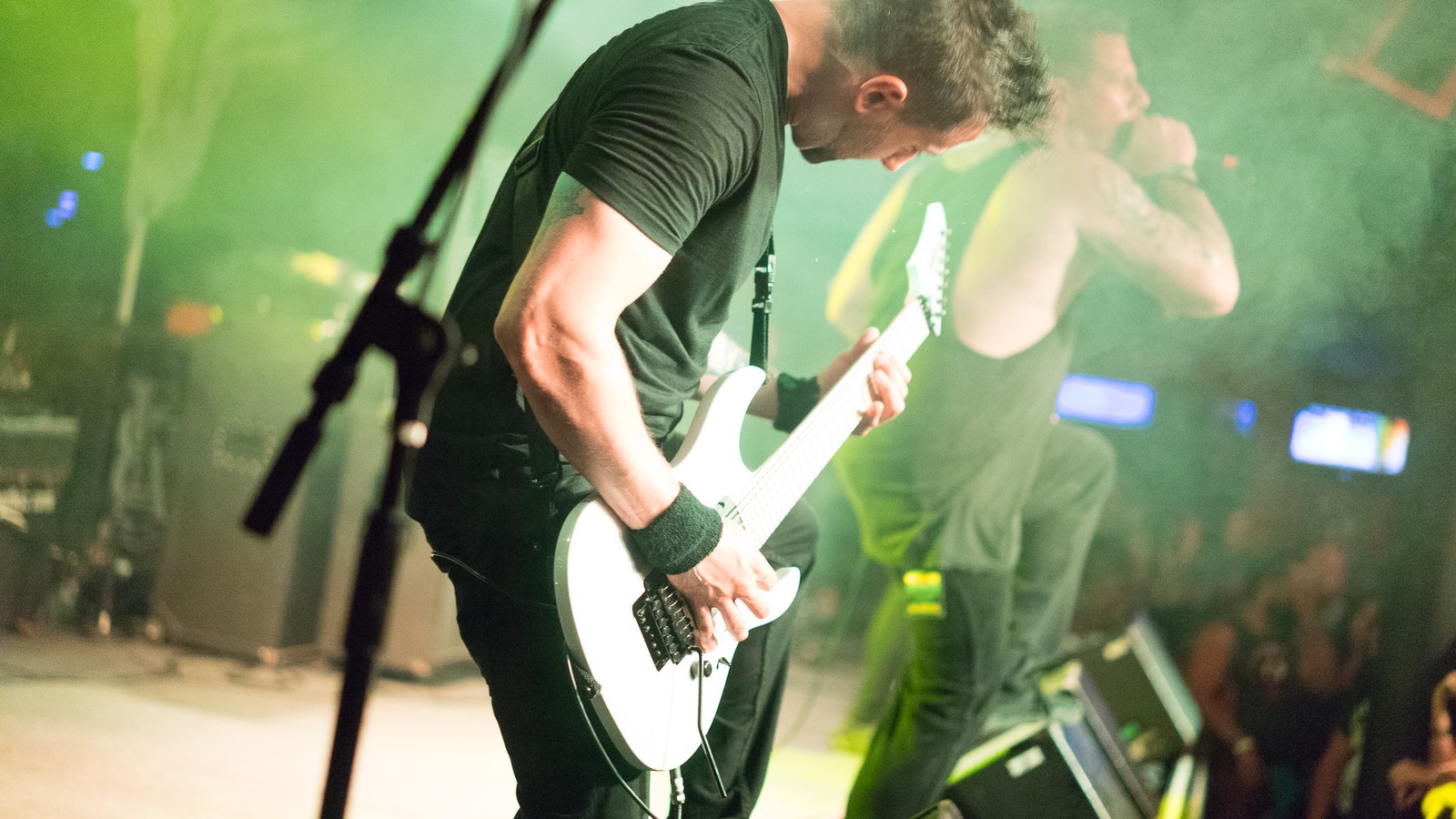
In 2012, in Hessle on the western edge of Hull, the instrumental tracks of a whole album were written, recorded and edited on recording software on one guitarist's computer, with no stage and no audience anywhere in the process, and the two-man outfit that built a record that way, a drummer and a guitarist who never needed a stage to finish a song, was Infant Annihilator.
Nobody booked a stage. Nobody needed one.
That is technical deathcore with its sleeves rolled up: sweep-picked and tapped arpeggios, odd-metre riffs and sudden tempo changes stacked so tightly that the gaps between the notes are hammered shut, all of it sitting on top of the one part the style refuses to surrender, the breakdown, which no amount of editing can replace and every band in the branch still drops on the floor. The speed is the show. The breakdown is the reason the show is still deathcore.
Picture the paper shredder in a club's back office at the end of a long season, fed every guest list, every settlement sheet and every soggy set list in a single stack, its cutters tearing the pile into a thousand ribbons a second that blow off the desk and across the floor, until the binder clip at the bottom of the stack goes into the throat and the motor drops to a growl, the blades biting through one sheet at a time and the whole desk bucking on its legs. That is the music in one machine: the blizzard of strips is the sweep, and the clip is the breakdown.
What makes technical deathcore technical
Borrowed whole from the parts bin of technical death metal, the sweep-picked arpeggio that runs through a chord one note at a time in a single stroke of the pick, the tapped run played with both hands on the fretboard, the riff in an odd metre and the tempo that changes inside a single riff, all of it played on seven- and eight-string guitars at blast-beat speed, the hardware of the style comes from death metal and the aim comes from hardcore. The low growl and the high scream still trade lines. The breakdown still arrives.
Among the types of deathcore, this one is measured in notes per second rather than in colours. A symphonic band changes what sits on top of the song and a blackened band changes the guitar's accent; a technical band changes how many events the song can hold before something gives. Every bar is overloaded on purpose. The listener's job is to keep up.
Odd metres do the rest of the damage. A riff in an odd metre behaves like a metronome kicked off the drum riser and still ticking on its side among the cables, losing a beat somewhere in every bar, so a pit that has learned to move in fours keeps stepping into a hole that is not there. Then the half-time drop arrives in plain four, and the whole floor lands on the same foot for the first time in a minute.
If you have ever played to a click, you know the other half of the method. Many of the records are edited and quantised until every hit sits on the grid with surgical precision, a sound built to machine tolerance rather than to the give of a room. The bands treat it as a tool. It is how the density gets onto tape at all.
Rings of Saturn and the sweep at full stretch
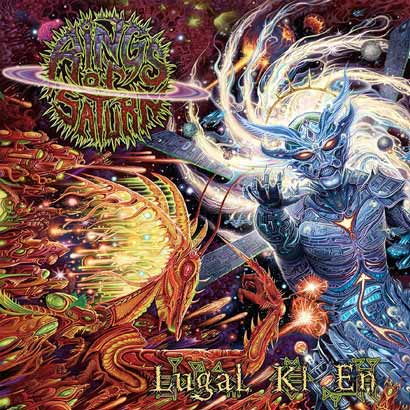
Started in 2009 as a high school studio project, self-released as Embryonic Anomaly on 25 May 2010 after sessions with Bob Swanson in Sacramento, and signed to Unique Leader that November, the vanguard that turned the sweep-picked arpeggio into a whole song form is Rings of Saturn. What earns it a place in the branch is the harmonised sweep: riffs run with an added harmony effect, so the same arpeggio races at two pitches at once.
Lugal Ki En, released on 14 October 2014, reached number 126 on the Billboard 200, the main American album chart, and its drums were laid down by a guest, Aaron Kitcher of Infant Annihilator, which tells you how small and how connected the top of this branch is. Ultu Ulla followed on Nuclear Blast on 28 July 2017 and climbed to number 76, the band's highest placing.
"Senseless Massacre", the band's first music video, came from Lugal Ki En and is the plainest demonstration of the method: arpeggios fired in volleys, the drums pinned underneath them, and the breakdown used as the place where the song finally lets the floor catch up. In April 2015 the band posted a single-take live guitar play-through of "Godless Times" from the same album, both guitarists side by side. The question of how much of these records is the edit follows every band in the branch. Rings of Saturn simply put the playing in public.
By June 2022 the band had released a self-titled instrumental album and dropped the vocals altogether, which removes the growl from the equation and leaves only the guitar density standing. That is the furthest the branch has gone toward its own edge.
Infant Annihilator and the band that never loaded in
Formed in 2012 by Eddie Pickard on guitar and Aaron Kitcher on drums, released into the world on 12 December 2012 with The Palpable Leprosy of Pollution, and pushed by a first video, "Decapitation Fornication", that went viral, the studio-born duo from Hessle is the strongest case in deathcore for the edit as an instrument. Infant Annihilator earns its place through the edit itself: the instrumentals went online first, and the singer found them there.
The speed is the show. The breakdown is the reason the show is still deathcore.
Built at home, the debut carries an American singer who found the band online. Dan Watson from Indiana sang it, left in late 2013 and went on to form Enterprise Earth in Washington, a band that took to the road. Dickie Allen took the job for The Elysian Grandeval Galèriarch, released on 29 July 2016, recorded and mixed by Jesse Kirkbride at his home studio and the band's first record to reach the Billboard Heatseekers and Independent Albums charts.
"Three Bastards", posted on 25 July 2019 ahead of The Battle of Yaldabaoth, which followed on 11 September, is the band at full load. Its breakdowns come after a gruelling run of that density and hit like the ice machine in a motel corridor off the interstate dumping its whole hopper into the tray at four in the morning, a long rattle collapsing into one crash that shakes every door on the floor awake. The band has said it may tour one day. It has never needed to.
Kitcher's reach runs further than one band. He was among the members who formed Black Tongue in 2013, a band that went the opposite way into the slowest end of the genre, and a fourth Infant Annihilator album, The Somnial Plunge into Cyclic Ebullition, was announced in October 2026 for release on 1 December. The same drummer sits at both ends of the tempo map.
Where technical deathcore meets technical death metal
The border with technical death metal runs along one part. Keep the sweeps and the blasts and drop the breakdown and the trade between the two voices, and the band has crossed into death metal, a genre with its own history of speed. Two bands make the line visible from the far side, one by crossing it and one by standing on it.
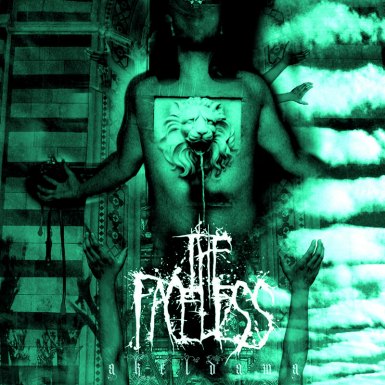
Begun in the winter of 2005 as a four-song EP, stretched into a full-length after its first drummer left the sessions, and released on 14 November 2006 as the very first record on Sumerian Records, Akeldama is the only album on which the Encino band led by Michael Keene on guitar kept the breakdowns and metalcore riffs of deathcore beside its arpeggios, though how far the record is deathcore at all is argued. That band is The Faceless, and it counts for the early record alone. On the road it was already keeping company with Necrophagist, Decapitated and Nile. Planetary Duality, released in November 2008 and entered on the Billboard 200 at number 119, is technical death metal with most of the core stripped out, which is the crossing made audible.
Formed in Montreal in the summer of 2004, on record in May 2005 with Evidence of Inequity, and taken to Prosthetic Records for Mechanics of Dysfunction on 20 February 2007, the quartet that parked deathcore's weight inside a technical death metal blast across four albums were Beneath the Massacre. Their producer was Yannick St-Amand, the same man who played guitar in Despised Icon, and the blasts on those records land as a barrage, like the sprinkler system of a packed hall going off in the middle of a set, every head in the ceiling bursting at once and hammering the crowd, the merch table and the amplifier tops with so many jets that no single drop can be told from the next.
"Society's Disposable Son", which Prosthetic released with a video, comes from the debut album, Mechanics of Dysfunction. The band is filed as technical death metal as often as deathcore. The breakdowns settle it on the records that carry them.
Within the Ruins, Aversions Crown and the breakdown that stays
Founded in Westfield, Massachusetts, in 2003 by Joe Cocchi on guitar and Kevin McGuill on drums, signed to Victory, which put out Creature in February 2009, and to eOne for Elite in 2013, the band that wrote a numbered instrumental called "Ataxia" onto five albums in a row is Within the Ruins. The riffs around those instrumentals never forget the floor, and the run stretches from Invade in 2010 to Black Heart in 2020. Phenomena, out on 22 July 2014, reached number 72 on the Billboard 200. The band is often filed under metalcore, and the breakdowns are the reason it stays on this side of the line.
Formed in Brisbane in 2009 and signed to Nuclear Blast in 2014 for Tyrant, out that November, a record produced by Andy Marsh of Thy Art Is Murder, the Queensland band that married fast, technical riffing to the weight of the Australian breakdown is Aversions Crown. Xenocide followed on 20 January 2017 and Hell Will Come for Us All on 12 June 2020, mixed by Will Putney. Its science fiction lyrics are a separate subject. The riffs are the reason it counts.
| Band | Formed | Why it counts | Record to start with |
|---|---|---|---|
| Rings of Saturn | 2009, Bay Area, US | Sweep arpeggios with an added harmony at extreme tempo | Lugal Ki En (2014) |
| Infant Annihilator | 2012, Hessle, UK | Instrumentals written and edited at home, a studio-only band | The Elysian Grandeval Galèriarch (2016) |
| The Faceless (early) | 2004, Encino, US | Arpeggios and breakdowns on one record before the crossing | Akeldama (2006) |
| Beneath the Massacre | 2004, Montreal, Canada | Technical death metal blasts with the breakdown kept | Mechanics of Dysfunction (2007) |
| Within the Ruins | 2003, Westfield, US | A numbered instrumental on five albums running, over breakdowns | Phenomena (2014) |
| Aversions Crown | 2009, Brisbane, Australia | Fast technical riffing on Australian breakdown weight | Tyrant (2014) |
One more line needs drawing, on the other side. When the accents start falling off the beat in syncopated chugs and the songs stretch out into ambient passages, the question has stopped being how many notes fit and become where they land, and that road leads to progressive deathcore and djent. Some bands keep a foot in both. The test is which of the two the riff is trying to win.
Every one of these bands passes the same test in the end. Speed alone is technical death metal, and a breakdown alone is ordinary deathcore. The branch exists where both are true in one song, the fastest playing in the genre followed by its slowest and plainest part, and the drop works harder for coming after so much motion. Take either half away and the band belongs somewhere else.

