
Founded in Montreal in January 2002, signed within months by Galy Records, a Canadian label, and driven by a drummer whose blast beats would batter snare heads flat on two continents for the next twenty years, the Quebec band that the chroniclers of the genre name among the first to play deathcore at all was Despised Icon.
Formed a month later and a continent away, in Los Angeles in February 2002, by a singer who had left Buffalo for the West Coast and turned down the microphone of another band on his way out, and named only in April, once its first shows had already been booked, the four-piece that would drag the sound of the hardcore matinee unbroken through the next two decades was Terror. Scott Vogel was the singer. He still is.
Same winter. Same half-time drop. Two genres. The question of deathcore vs hardcore has been argued at merch tables ever since, and it is settled by mechanics rather than by attitude: what the drummer plays before the breakdown, what the singer does on top of it, and what the song does once the floor has had it.
The border between them is a cattle grid. Steel bars laid across a pit in a ranch road, spaced so that a wheel rolls over and a hoof will not cross, and a band van that hits one at sixty sets every bar hammering the tires at once, a rattle that shakes the fillings in the driver's teeth and jars the cabinets loose from their straps in the back. That rattle is the blast beat. Deathcore floors it across the bars on nearly every record. Hardcore, walking its songs on two feet, stops at the gate, leans on it, and moves its floor on its own side.
The blast beat started on hardcore's side
The irony is that hardcore laid the bars. Defined by Adam MacGregor as a sixteenth-note figure at a very fast tempo divided evenly among kick drum, snare and cymbal, and counted as one from 180 beats a minute upward, the blast beat came out of the punk and hardcore scenes of the early 1980s, from a Swedish demo of 1982 to a Texas debut of 1983, before grindcore hauled it off to Birmingham and death metal bolted it to a metronome.
Then hardcore gave it away. By the late eighties the blast had moved out with grindcore and death metal, and the hardcore that came after it, the tough guy sound of New York and the heavy strain of the nineties, leaned for its drive on other beats: the punk two-beat, the thrash gallop, the stomping mid-tempo groove. The blast belonged to grindcore and death metal by then, and beatdown, the slowest branch of the family, was built on the groove. Hardcore had already fought one border war with metal over speed and riffs, and the case of hardcore against thrash was argued from the same drum stool. When deathcore arrived in the early 2000s it took the blast back from death metal and grindcore, not from hardcore.
That changes what the breakdown sounds like when it lands. A hardcore drummer heading into the drop usually comes off a fast punk beat into half time, the crash or the ride on quarter notes and the snare on the third beat, and a punk breakdown can roll on the floor toms instead, which is why its floor tends to circle rather than stamp. A deathcore drummer reaches the same half time from a blast, often with a double kick pedal pounding under the riff in between. The drop is measured against the fastest thing in the song. In deathcore that is a blast. In hardcore it is a punk beat, and the drop has less to fall from.
"Unbreakable", from the album Purgatory, went on camera when Nuclear Blast released an official drum playthrough of it, with Alex Pelletier at the kit. The encyclopaedias single him out for his frequent blasting before they mention anything else about the band, and he is the drummer on a record that Yannick St-Amand, Eric Jarrin and Alex Erian produced.
Deathcore vs hardcore in the low strings and the throat
The breakdown itself is built the same way in both genres. The guitars chug, palm muted, on the lowest two or three strings, locked to the kick drum, with the gaps between the hits left open for the room. The difference is the depth of the chug. Deathcore is routinely described as built on down-tuned guitars, and the same rhythm on a deathcore record arrives lower and heavier than the hardcore version, though plenty of hardcore bands tune down as well and the tuning alone settles nothing. Same pattern. Different floor.
The throat settles what the tuning leaves open. A hardcore singer shouts, in a chest voice pitched to carry words to the back of a hall, and the words are the point: loyalty, betrayal, the crew, the street, the scene itself. Terror's 2010 track list reads like a code of conduct, from "Your Enemies Are Mine" and "Stick Tight" to "Return to Strength" and "Keepers of the Faith", and a front row that knows the songs is expected to shout them back, unmediated, with no PA between the crowd and the chorus but a singer's arm.
The hardcore shout is a brick thrown through a window with a note wrapped round it. Deathcore throws the brick without the note.
The hardcore shout is a brick thrown through a window with a note wrapped round it, glass sprayed across the carpet and the message still legible on the floor among the shards. Deathcore throws the brick without the note. Despised Icon carry two singers, Alex Erian and Steve Marois, to cover both ends of the range, a low guttural and a high scream with the pig squeal for punctuation, and in that register the words dissolve into the riff. The voice becomes a second kick drum. Nobody in the room is asked to read it.
Fifteen songs in thirty-nine minutes: what each genre does with the breakdown
Released through Century Media in 2010 and packed with fifteen songs in thirty-nine minutes, from an opener of about a minute and forty seconds to a title track that is the longest thing on the record at three minutes and twelve, Keepers of the Faith is the hardcore song form at full strength, and the Los Angeles band that ripped through it without a single wasted bar was Terror, eight years in and still writing for the floor of a small room.
Inside a hardcore song the breakdown is a stop on a short route. Fast part, mosh part, fast part again, out. The drop is where the floor takes the song over, and the band hands it back before anyone has time to tire of it, because the next song is already counted in.
"Keepers of the Faith", the title track, went out with an official video through Century Media, and at three minutes and twelve seconds it is the band's long song on that record. A hardcore band can say everything it has to say about a breakdown inside that length. It is not a limitation. It is the form.
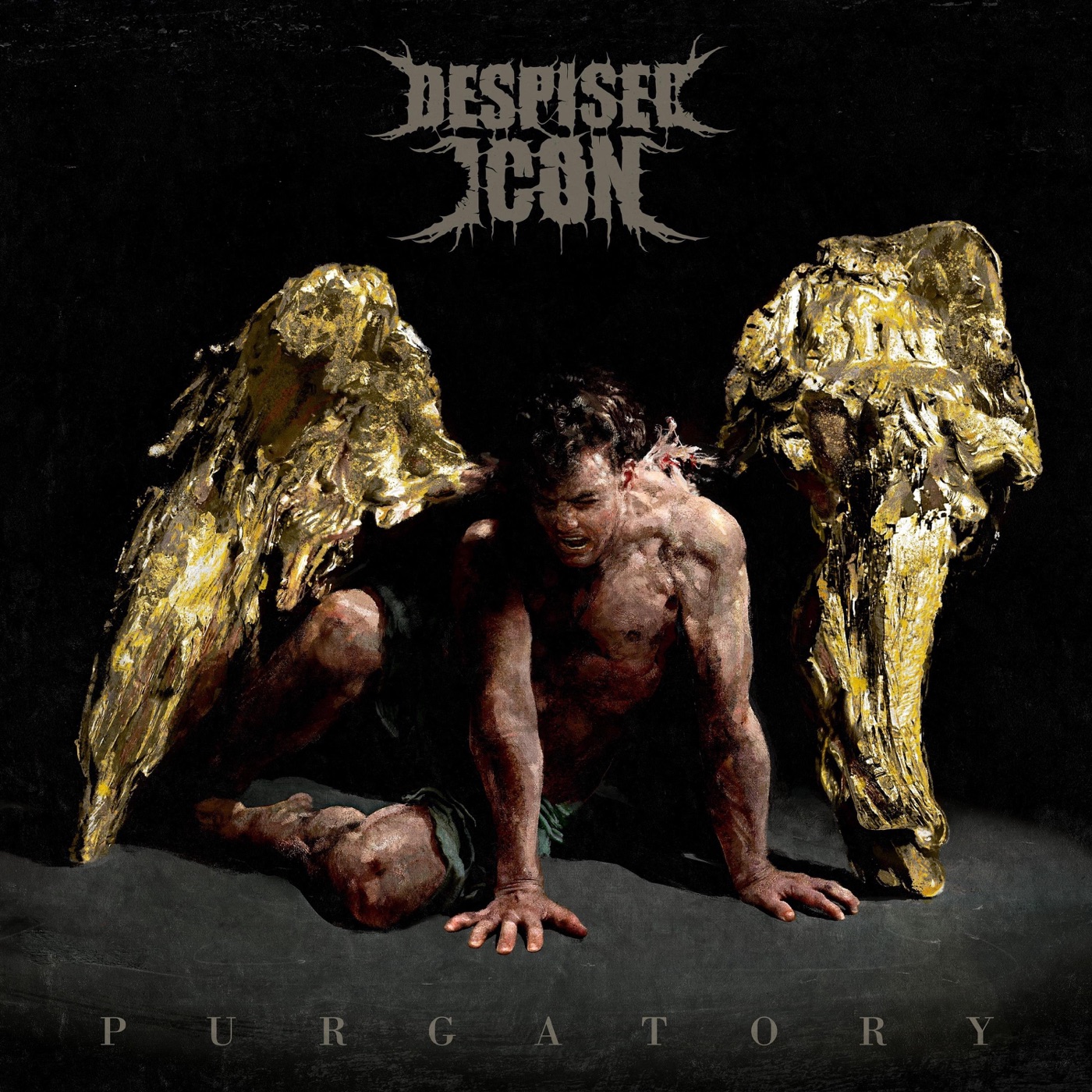
Released by Nuclear Blast on 15 November 2019 and produced by Yannick St-Amand, a former rhythm guitarist of the band, with Eric Jarrin and Alex Erian, Purgatory runs eleven songs in thirty-six minutes, from "Dernier souffle" at one minute and forty-nine to "Moving On" at four minutes and fifty-one, and the Montreal six who recorded it were Despised Icon, seventeen years after Galy, still blasting. Average the two records and a Despised Icon song runs roughly forty seconds longer than a Terror song.
The gap is smaller than the reputation, and the minutes are not where the genres part. The use of the breakdown is. In a deathcore song the breakdown is the destination: the blasts and the tremolo riffs exist to wind the room up toward it, the song is often built in blocks that each end on a heavier drop than the last, and the final breakdown, frequently slower again than the one before, is where the song stops being a song and becomes a floor. Hardcore drops to move a room. Deathcore drops to finish one.
Where beatdown sits
Beatdown is the hardcore that kept the mosh part and quit the race. Its name comes from a record, The Final Beatdown, released by Bulldoze in 1996, and its roots lie in the tough guy hardcore of late-eighties New York, where Madball leaned on heavy grooves and let the speed of earlier hardcore go. Mid-tempo grooves, breakdowns chained one after another, shouted and sometimes hip hop cadenced vocals, heavy palm muted guitars and songs stripped to the parts a floor uses.
That puts beatdown nearer to deathcore than any other hardcore stands. It shares deathcore's weight on the low strings and its appetite for the drop, and since the 2010s it has borrowed slam riffs and death metal weight as well. It keeps hardcore's drums, hardcore's shout, hardcore's crews and hardcore's rooms. The blast stays on the other side. A beatdown chug arrives the way a scrapyard baler closes on a sedan, one slow hydraulic stroke, the windscreen bursting and the roof folding down into the seats, with no run-up in front of it at all because the machine has never needed one.
Formed in Sherman, Texas, in the summer of 2009, signed to Rise Records in July 2017 and known for slow breakdowns hammered out on heavily downtuned guitars, the band filed under metalcore that plays the heavy hardcore of the early nineties at deathcore depth is Kublai Khan TX. "The Hammer" was the single from Nomad, which Rise released on 29 September 2017: ten songs in under twenty-seven minutes, three minutes and twenty-one seconds for the single. Deathcore tuning. Hardcore clock.
The side of the line the band stands on was settled in 2022. On "Swan Song", from the Lowest Form of Animal EP that Rise put out on 1 April that year, the guest voice is Scott Vogel's, the Terror singer, shouting in the register he has used since 2002. The hip hop cadence pulls beatdown toward yet another neighbour, and the case of deathcore vs nu metal turns on the bounce rather than the blast.
| Part | Hardcore | Beatdown | Deathcore |
|---|---|---|---|
| Fastest beat | Punk two-beat or thrash gallop | Mid-tempo groove, speed mostly gone | Blast beat |
| The breakdown | A stop in the middle of a short song | Chained, one after another | The destination, often slower each time |
| Guitars | Palm muted riffs, tuning varies | Heavy, palm muted, heavily downtuned | Down-tuned, death metal riffs |
| Voice | Shouted words meant to be shouted back | Shout, sometimes a hip hop cadence | Guttural, high scream, pig squeal |
| Example record | Terror, Keepers of the Faith (2010) | Bulldoze, The Final Beatdown (1996) | Despised Icon, Purgatory (2019) |
Part by part, beatdown changes sides as it goes: deathcore's weight, hardcore's drums and voice, a breakdown habit that outdoes hardcore's own. It is not a halfway house. It is hardcore pared down to its heaviest part, and the blast, the one part that would carry it across, is the part it never took. The wider map, deathcore compared with every genre it gets mistaken for, runs the same test on metalcore, death metal and the rest.
The rooms, and who holds the microphone
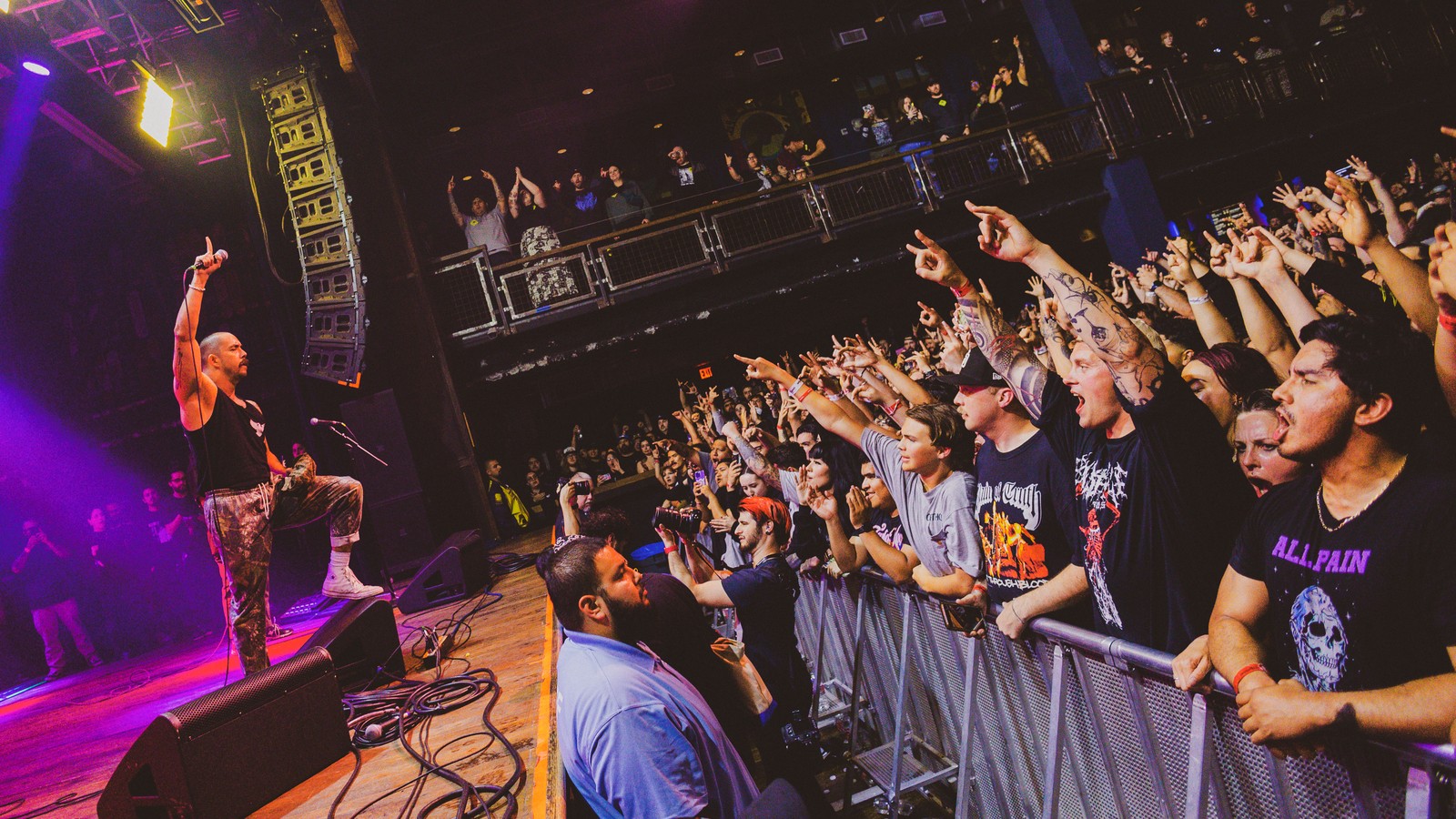
The music ends up in different rooms because it asks different things of them. Hardcore grew up in matinees, all-ages afternoons in clubs, church basements and VFW halls rented by the hour, and its stages are often open at the front: no barrier, the singer at eye level, the front row free to climb up and throw itself back off. Stereogum's Tom Breihan put it in 2026 as a rule of thumb: "If you see a stage barrier, you might not be at a hardcore show."
Deathcore grew up in the same rooms and then left a good number of them. By its second decade it was a package tour genre, sold on bills of five and six bands in clubs that bolt a steel crowd barrier across the front of the floor, a rampart of interlocking feet plates and pins that takes the surge of every breakdown on its frame while security stands behind it lifting bodies over the top. The singer is on a stage four feet up. The microphone stays with him.
The bands cross between the two kinds of room all the time, and they keep their own habits when they do. Terror spent the summer of 2005 on the first Sounds of the Underground tour, a metal package with Lamb of God and Unearth, splitting the dates with Madball, and Despised Icon toured into 2006 with Hatebreed as well as with Morbid Angel and Behemoth, then crossed the continent on the 2008 Summer Slaughter tour. Bulldoze, back together in 2010, played that summer's This Is Hardcore festival. The sweat is the same in every one of those rooms. The rules of the floor are not.
So the line runs where the parts say it runs. A song that blasts, growls and builds toward a final drop is deathcore whatever the band wears and wherever it plays. A song that runs on a punk beat or a mid-tempo groove, shouts words a room can shout back and hands the floor its breakdown on the way past is hardcore, however low its guitars are tuned. Beatdown lives on the hardcore side of that line, as near to it as anything ever gets.

