
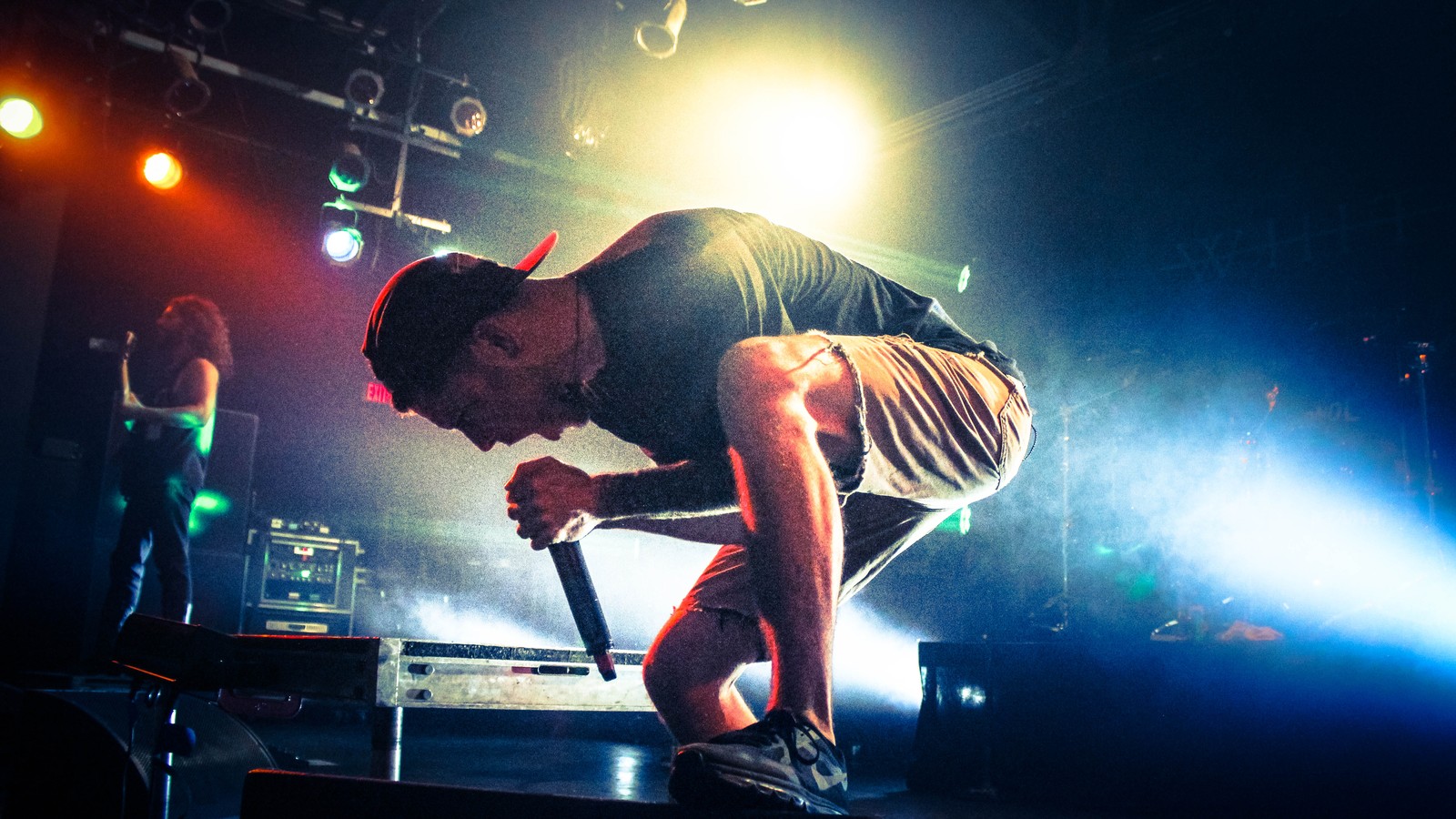
On 8 July 2008 Metal Blade Records released This Is Exile, and it entered the Billboard 200 at number 118 on 5,900 copies.
Armed with three guitars tuned low enough to shake the empty cans off a club's bar, holed up in March 2008 at Backyard Studios in Milford, New Hampshire, with Jonny Fay producing beside them, and fronted by a voice that drops from a shredded high scream to a guttural roar without one sung note in between, the Knoxville sextet that made it was Whitechapel. Less than a year earlier, on 21 August 2007, the same label had put out An Ocean Between Us, which went in at number 8 on close to 39,500 copies. The San Diego quintet that sold them, with a bassist hired in April 2007 who sang the clean choruses, was As I Lay Dying.
Same label. Breakdowns on both. Nearly seven times the sales in week one. One lineage. That gap says nothing about which band was better, and everything about deathcore vs metalcore, because what separates the two records is not the drop but what each one puts on either side of it.
Picture a basement show. Both genres play the same room, and the breakdown is the steel post in the middle of it, the one thing holding the house up: the hardcore half time drop, the palm muted chug on the lowest open string, the song built in blocks toward a moment the floor can feel coming. Metalcore bolts a staircase to that post, a Swedish guitar harmony and a sung chorus the whole room can climb. Deathcore rips the pipes and the ductwork out of the ceiling around it with blast beats and growls until the bare post is the only thing left standing in the room.
How the two came apart is part of the story from the start, the genre's history from the hardcore basements of the late nineties to the orchestral records of the 2020s. The split itself is mechanical, and you can hear it one part at a time.
The breakdown both of them own
Carried out of the American hardcore rooms of the 1990s, where a song existed to move a floor of bodies and the band dropped to half time so the floor could do it, the breakdown is the inheritance the two genres share, and the song form came with it in the same box: a verse, a riff that winds the tension tighter, the drop, and often a second and heavier drop to finish the job. Neither genre usually writes riff to riff the way death metal does. Both tend to build songs in blocks and stack the blocks toward the heaviest one.
That is where the shared descent stops. The breakdown is the same idea in both genres and it lands in different places on the guitar neck. Metalcore bands mostly tune somewhere between drop D and drop A. Deathcore bands tend to sit at the bottom of that range or below it, often on seven and eight strings, so the same chug lands several steps beneath metalcore's, deep enough that the low note stops reading as a pitch and starts reading as a change of air pressure in the room.
The drums part ways only at the edges. A breakdown in either genre usually keeps the kick locked to the guitar's rhythm, a stop and start pattern a crowd can two step to, and some deathcore bands drag it down to a slow crawl with wide gaps between the chugs. Same device. Different gravity.
Metalcore vs deathcore: where the riffs come from
Everything between the breakdowns is where the family tree forks. Metalcore's riffs come largely from Sweden. The Gothenburg bands that took the twin harmony guitar of the old heavy metal records, sped it up and packed it into three minute songs in the middle of the nineties were At the Gates and In Flames, and they handed a generation of American hardcore kids a melody they could clamp straight onto a breakdown. By the early 2000s that splice was the sound of a whole scene.

Frail Words Collapse, released by Metal Blade on 1 July 2003 as As I Lay Dying's first record for the label, is that template in its early form, and by April 2005 it had sold more than 118,000 copies in the United States. The leads reach for Swedish melody. The chug underneath belongs to both genres at once.
"94 Hours", from the same record, shows the method in a single song: a fast run over heavy double bass, with one guitar carrying a melody above the other's palm muted mosh riffs. The weight sits in the chug and the kick drum, and the melody is laid across it. It is hardcore with a melodic death metal education, and the education is Swedish.
Deathcore takes much of its riff vocabulary from the other side of death metal, from the American school of Suffocation and Dying Fetus rather than the melodic school of Gothenburg. That means tremolo picked runs and heavy chromatic riffs on the low strings, and it means the blast beat, snare and kick hammered in alternation at a speed that sounds like a coffee can of loose bolts emptied across the steel floor of a moving van. That fusillade is something a metalcore record seldom leans on. It is among the first things a deathcore record reaches for.
"This Is Exile", the title track Whitechapel put out as a video that June, a few weeks ahead of the album, opens in tremolo picked riffing and works its way to heavy breakdowns, and the record around it runs on blast beats, with Phil Bozeman switching between the low roar and the high scream. Take the blasts and the tremolo away, put a sung hook where the roar is, and what is left is a metalcore song. Leave them in and few metalcore fans would file it there.
Take the blasts and the tremolo away, put a sung hook where the roar is, and what is left is a metalcore song.
The difference between deathcore and metalcore is in the throat
Metalcore splits the singer in two. The verse is screamed, the chorus is sung, and the sung part usually carries the melody the guitars have set up, which is the shape of a record like An Ocean Between Us, a number 8 debut with a Grammy nomination for its single "Nothing Left". The clean voice is not decoration. It is the hook, the part of the song the front rows sing back with their arms around each other, and the part that helps a heavy band onto the radio.
Deathcore keeps the split and moves it down. The high voice is still a hardcore scream, but the low one is a death metal guttural hauled up from the diaphragm, and where metalcore would lift into a chorus, deathcore drags the clean vocal fader on the soundboard to the bottom of its slot and snaps the knob off, then answers the scream with a growl and punctuates the drop with a pig squeal. Three or four voices from one singer, and as a rule none of them sung.
The rule bends, and the bending tells you something. Phil Bozeman sang clean on parts of The Valley in 2019 and gave "Hickory Creek" almost wholly to singing, eleven years after This Is Exile, and the record was still reviewed as a deathcore record because the riffs and the blasts stayed largely where they were. One clean passage does not move a band across the line. A clean chorus as the point of the song does.
| Part | Metalcore | Deathcore |
|---|---|---|
| Song form | Hardcore blocks built toward the breakdown | Largely the same |
| Breakdown | Half time chug, kick usually locked to the guitar | The same device, tuned lower; some bands stretch it into a slow crawl |
| Riffs | Often drawn from Gothenburg melodic death metal: harmonised leads | Often drawn from American death metal: tremolo runs, heavy chromatic low riffs |
| Drums | Hardcore and thrash beats, double kick; blasts are the exception | Blast beats a regular feature |
| Harsh voice | Shouts and screams | Scream plus low growl, often a pig squeal |
| Chorus | Often sung clean | Seldom a sung chorus |
| Tuning | Mostly drop D to drop A | Often drop A or lower, frequently seven and eight strings |
| Reference records | Frail Words Collapse (2003), An Ocean Between Us (2007) | This Is Exile (2008); Rareform (2008) on the border |
Deathcore vs metalcore on the bands that straddle the line
The border is easiest to see where a band walked across it. Twenty years ago the Sheffield quintet that recorded Count Your Blessings at DEP International Studios in Birmingham with Dan Sprigg, put it out through Visible Noise on 30 October 2006 and took it to number 93 on the UK Albums Chart as a record most often filed under deathcore was Bring Me the Horizon. Two years later Suicide Season kept the breakdowns, left that deathcore behind for metalcore, and the reviews of the day heard it that way. The breakdown stayed. Everything around it changed.

Formed in Minneapolis in 2004 and signed to Sumerian Records, which released Rareform on 22 July 2008 after its two guitarists produced it, the Minnesota band whose drums on that record were programmed by its own rhythm guitarist is After the Burial, and the album sits so exactly on the line that its reviewers have called it metalcore, deathcore and djent by turns.
"Berzerker" is the straddle in a single track: an opening of harmonised, shredding guitar leads, an off time groove in the manner of Meshuggah, and a breakdown to finish the job. The original vocals were Grant Luoma's. On the reissue of 15 September 2009 they were recorded again by Anthony Notarmaso, and the record did not change genre when its singer did.
Two more Sumerian bands make the same point from opposite ends. Formed in 2003 in Palatine, a suburb of Chicago, and run through three other names before settling on its own in 2007, the year Sumerian released The New Reign, the Illinois band that laid breakdowns and keyboards under melodic guitar leads was Born of Osiris, filed under deathcore and under progressive metalcore with equal conviction. The San Antonio band that went the other way, from metalcore and deathcore toward groove, and took Red. White. Green. onto the Billboard 200 in 2012, is Upon a Burning Body.
None of these bands stayed on one side of the line, and they are far from the only ones to cross it. The rest of them, band by band and record by record, are taken up in is it deathcore.
Two questions for any record
Strip it down and the test takes two questions. Where do the riffs between the breakdowns come from, Gothenburg or the American brutal school? And is there a sung chorus holding the song up? Harmonised leads and a clean hook usually mean metalcore. Tremolo runs, blast beats and a growl in place of the hook usually mean deathcore. A band can mix the answers. Plenty of the best ones do.
Neither answer ranks above the other. Neither answer ranks above the other. The case for metalcore as a genre of its own starts with the larger commercial run it has had, and the clean chorus is part of the reason. Deathcore trades that chorus for weight and velocity, unsparing from the first blast to the last drop, and its audience came for exactly that trade. Both genres fill the floor. They fill it with different things.
Metalcore is only one of the neighbours deathcore gets mixed up with, and the rest of what it gets confused with, hardcore and emo among them, gets settled the same way, by mechanics rather than by taste.
Deathcore also has a second parent, and the other half of the argument, against death metal, runs the same test from the opposite side, where the riffs match and the song form does not.
