
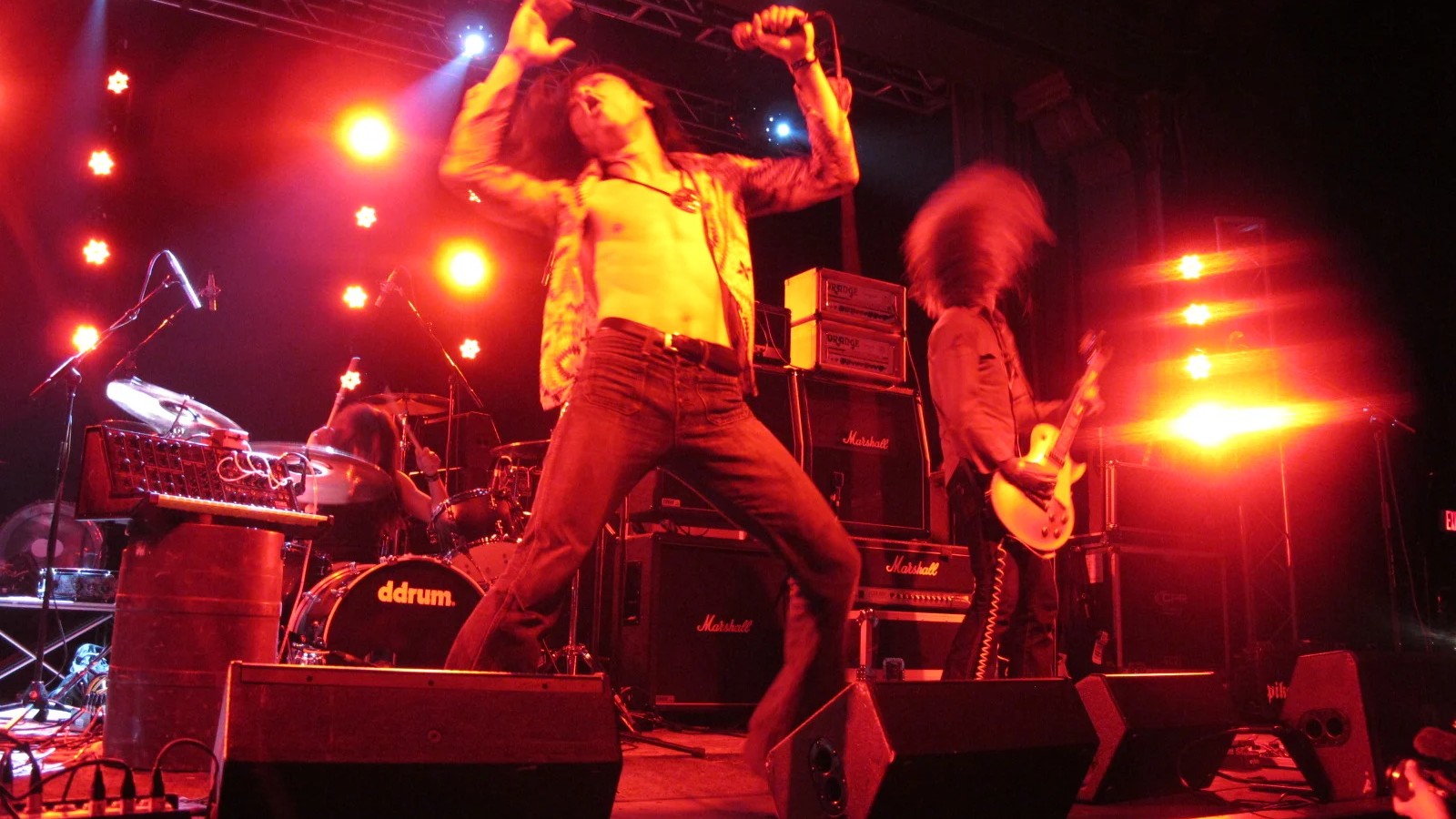
In May 2015 the live room at Polar Bear Lair in Middletown, Maryland, with Chris Kozlowski recording, held three musicians, seven songs nobody had yet recorded and a fortnight in which to record them. Arrived from Japan after sending ahead the demo tape of an album he had written alone, the bassist who founded Church of Misery in 1995 and had outlasted every line-up the band had been through since, Tatsu Mikami, found the material already learned: Dave Szulkin, the guitarist of the American doom band Blood Farmers, had practised the songs for six months, and the drummer he had brought in, Eric Little of Earthride, had rehearsed them with him. One week went on rehearsal and the other on recording. The record that came out of the room, And Then There Were None..., was released by Rise Above Records on 4 March 2016.
On paper that fortnight should not have worked. The man who wrote the parts was not holding the guitar, the man holding the guitar had never made a record with him, and the drummer was the guitarist's friend. It worked because of what had been sent across the Pacific, which was neither a chord chart nor a lyric sheet but a demo tape of songs built from riffs, the short repeated phrases a doom song is assembled from. Mikami told Japan Vibe in August 2018 that the demo tape already existed when he first wrote to Szulkin for help, and that he went to Maryland only after a message came back saying it was ready.
The riff that travels ahead of the song, the phrase first and everything else afterwards, is the subject of this piece. Everything that surrounds the music, the sleeves, the logos and the amplifiers, is followed through the culture chapter; here we take the riff itself apart as a phrase, with a contour, a rhythm and a silence, and leave the pitch the instrument is set to and the build of the chords to their own explainers.
The phrase: five pitches and a half step
Released by Vertigo on 18 September 1970, the second album by the Aston quartet first named the Polka Tulk Blues Band in 1968, Black Sabbath, carries a riff whose pitches can be counted on one hand, and the published transcriptions let it be measured rather than merely admired. The bass tablature for "Iron Man" that Musicnotes sells, published by TRO, marks the song Slow Rock at 69 crotchets a minute in 4/4 and sets it in E minor; the same publisher's guitar tablature marks it Slow Rock at 64, so the number is a transcriber's reading and not a measurement. The transcriptions agree on the riff itself: its outline runs B, then D, D, E, E, then G and F sharp rocked against each other, before the line falls back to D.
Read as intervals, the phrase is arithmetic. A minor third climbs from B to D, a whole tone from D to E, another minor third from E to G, and then comes a single half step, G down to F sharp and back, struck and struck again before the line descends. The whole riff turns on that last semitone. At 64 to 69 beats a minute a crotchet lasts between about nine tenths of a second and a little under one, long enough for two neighbouring pitches to sit against each other rather than pass as a tune going somewhere, and the phrase is short enough to be taken whole into the memory on the first hearing and dragged back round before the memory has let go of it.
The very next song, the one that opens the second side, goes slower still. The easy guitar tablature Musicnotes sells for "Electric Funeral", again published by TRO, marks it Slowly, around 62 crotchets a minute, in the same E minor, which puts almost a full second between one beat and the next. Two beats a minute under the guitar tablature of "Iron Man" is almost nothing on a metronome. What the markings record is a direction, from a march towards a cortege.
A doom riff is not slow because it is played slowly. It is slow because it is built to be walked round again.
Where the phrase stops
Formed in Los Angeles in 1978 under the name Tyrant, signed to Greg Ginn's punk label SST at a time when, by their guitarist's account, the punks hated them for their slowness and their hair, the band that dragged that sound through a decade that wanted none of it, Saint Vitus, wrote for years in the same order. Dave Chandler told The Obelisk on the day Lillie: F-65 came out on Season of Mist, 27 April 2012, that its "Blessed Night" began on the road as the riff he played for his guitar check, until the singer Scott Weinrich, known as Wino, asked him whether it was a song. Asked how writing apart compared with the old way, he went back to the years when the members lived near each other and kept a set practice time, and described a method in which the riff exists before anyone has decided how fast it should go.
I would sit at home and write the riff by myself, bring it into rehearsal, and be like, "Okay, Mark, here's the notes, and Armando, I want it fast, or slow, whatever," and we would work it out.
Dave Chandler of Saint Vitus, The Obelisk, 27 April 2012
Mark is the bassist Mark Adams and Armando the drummer Armando Acosta, and the order of that sentence is the method. The notes go to the bass first; the tempo is settled afterwards, in the room, with the drummer. A riff that can be handed over before its speed is known cannot be defined by its speed. Its identity is its outline, the rise and fall of its pitches and the places where it stops sounding, and the gaps between its notes can be lengthened without a single pitch changing. The gap is where the weight settles, sediment dropping through still water in the bar where nothing is struck, so that each return of the phrase lands on a floor a little thicker than the last.
Church of Misery: the same shape on the wheel
Released by Southern Lord in 2001 with Tomohiro Nishimura on guitar, Yoshiaki Negishi singing, Junji Narita on drums and Mikami on bass, Master of Brutality opens on the eight minutes and twenty-three seconds of "Killifornia" and closes on the eleven minutes and sixteen seconds of its title track, six songs in forty-one minutes. The musicians began changing soon after it, when Nishimura handed the guitar to Osamu Hamada and then to Takenori Hoshi. By 2023, No Clean Singing counted twenty-one of them who had passed through the band, and Mikami has said the same thing about what each of them inherited: in March 2016 he told Thomas Woroniak of Antihero Magazine that he wrote every song alone, that he had not changed his style in more than twenty years, and that if a record sounded less fuzzy and cleaner, "it's due to different players". In the same interview he called Szulkin "a riff master".
The band works like a potter's wheel turning slowly in a workshop that has changed hands many times. The clay is the riff Mikami writes alone, the wheel is the band turning under it, and every new guitarist is a new pair of hands laid against the same turning mass with the same steady pressure, pulling the same leaden shape up out of it again and again: a fuzzier wall under the guitarists before him, a cleaner lip under Szulkin's fingers in Maryland in 2015, never the same vessel twice and never a different form. The wheel does not ask whose hands are on it. It asks that the pressure be held.
On Thy Kingdom Scum, released by Rise Above in Europe on 27 May 2013 and by Metal Blade in North America on 11 June, the band tested how many turns the shape could take before it slumped: its closer, "Düsseldorf Monster", runs to twelve minutes and forty-six seconds, the longest track the band had put on a full length until then. For Born Under a Mad Sign, released by Rise Above in June 2023, the backing tracks took what, by Mikami's account to Comrade Aleks in the interview No Clean Singing published that September, they always take: one take, two, three at most, with more guitars added afterwards.
Why the shape holds
Across fifty years of slow music the doom riff has survived because it is small enough to carry. A handful of pitches lying close together, a semitone somewhere near the top of the line, a silence long enough to let the last chord ring, and a return: that is all a guitarist in Maryland needed from a bassist on the far side of an ocean, and all Mark Adams needed to be told before Armando Acosta chose the speed. Nothing in that list depends on how fast the band plays, and nothing in it depends on how low.
The register is a separate decision. The same outline can be played lower without becoming a different riff, and how far down the strings are taken, and why, is the business of doom Metal Tuning. The phrase comes first. Mikami sent it as a demo tape, Szulkin carried it in his hands for six months, and in a room in Middletown in May 2015 a bassist and two musicians who had never made a record with him took one week to rehearse the shape and a second week to pull it up off the wheel.
