
Seventeen and a half pounds. That is the pull, by the tension figures D'Addario publishes for its nickel wound strings, of a .046 string brought up to standard E at 82.41 hertz across the 25.5 inch scale of an ordinary electric guitar; slacken that same strip of steel and nickel to the A a fifth below, 55 hertz, the floor the drone bands of the last three decades have poured their music onto, and it holds not quite eight pounds, less than half of what it held a moment earlier, which is the arithmetic every doom tuning has to settle before a single note is struck.
A ship's hawser shows what happens next. Hauled hard between a bollard and a hull with a wind on the water, the heavy mooring line sings, a thin taut note running the whole length of the rope; let it out a fathom at a time and the note falls and keeps falling, until the line stops singing and starts to hum, a sound that arrives through the planks of the quay more than through the ear, and in that same moment the rope begins to belly towards the harbour and slap against the stone. Doom wants the hum. It cannot afford the sag. Thick strings, long necks and bass amplifiers wired to guitars are all ways of paying out the line without dropping it in the water, part of the load that doom, chapter by chapter, has piled onto its instruments.
Fifty-five years and thirty per cent

The baseline is fifty-five years old. Released by Vertigo on 6 August 1971, Master of Reality put the guitar and bass of Black Sabbath a step and a half below standard on "Children of the Grave", "Lord of This World" and "Into the Void", pulling Tony Iommi's lowest string down from 82.41 hertz to the C sharp at 69.30, and because the tension of a string rises and falls with the square of its frequency, that one decision stripped close to thirty per cent of the pull out of every string on the neck while the gauges stayed as they were. Why he did it, a factory, two fingertips and a guitarist in pain, is told in the culture chapter. Here we keep to the numbers.
The square is the whole problem. D'Addario's own formula for string tension multiplies the weight of a string per inch by the square of twice the scale length times the frequency, so the pull falls far faster than the pitch: halve the frequency and a string keeps a quarter of its pull. A guitarist who lowers the pitch therefore has only two ways to put that pull back, a heavier string or a longer one; a light string tuned low has none of the leaden weight the genre prizes and flaps under the pick.
A thicker cable: the gauge
The heavier string is the older answer. Built in San Jose around the bass of Al Cisneros and the guitar of Matt Pike, the trio that recorded Dopesmoker as a single piece of more than an hour, Sleep, lets the guitar follow the bass down, and Pike, speaking to the Washington site DCHeavyMetal in July 2018, described what that costs: to keep up with Cisneros in B he worked out a drop tuning that meant tuning every other string up a half step and then dropping the whole guitar. He strings with Dunlop sets from .012 to .056, as Premier Guitar listed that November. What he plays on that tuning belongs to the Doom Metal Riff, Taken Apart.
The Liverpool three-piece that calls its music caveman battle doom, Conan, pushed the gauge until the shops ran out of it. The first Conan recordings of 2006 were played in dropped B, by Jon Davis's own recollection to The Obelisk in September 2010, and the band then went down to dropped F to fatten the sound, setting the lowest guitar string at 43.65 hertz, one note above a standard tuned bass, with the bass an octave beneath it. Dunable, which builds Davis's signature R2, ships that model on an ordinary 25.5 inch scale set up with strings from .014 to .072 for drop F. No longer neck, only a thicker cable, and Davis told The Sludgelord in June 2012 that only one set of strings on the market could carry those tunings.
We can't find strings heavier than those we use on bass, so I doubt we could practically play any lower.
Jon Davis of Conan, The Sludgelord, 21 June 2012
Drop A and the .140 string
The drone duo formed by Stephen O'Malley and Greg Anderson in Seattle in 1998, Sunn O))), settled on its floor early and has never climbed off it. "We are tuned in drop A, the same as Earth," O'Malley told the webzine Metalrage in 2005, calling it a baritone guitar tuning, a baritone in drop E or a seven-string in drop D taken a little further, which lays the lowest guitar string at 55 hertz, a fifth below standard E and four semitones beneath the C sharp of 1971.
On the bass the numbers leave the guitar behind. Recorded at Bear Creek Studio in January 2025 and released by Sub Pop on 3 April 2026, the band's self-titled album put O'Malley on a vintage Gibson Thunderbird for which, as he told Joel McIver of Guitar World that April, he asked the owner for drop A with a .140 string on the A, an order that needed a new nut and puts the lowest string at 27.5 hertz, the pitch of the bottom key of a piano. Anderson, in the same conversation, put the limit where the physics puts it: the instruments and the amplification can only produce so much.
| Tuning | Lowest note | Frequency | On record |
|---|---|---|---|
| Standard guitar | E2 | 82.41 Hz | The reference every tuning is measured from |
| Three semitones down | C♯2 | 69.30 Hz | Black Sabbath, Master of Reality, 1971 |
| Drop A, guitar | A1 | 55.00 Hz | Sunn O))), in drop A by 2005 |
| Dropped F, guitar | F1 | 43.65 Hz | Conan, in dropped F by 2010 |
| Standard four-string bass | E1 | 41.20 Hz | The note Conan's guitars sit one note above |
| Drop A, bass with a .140 | A0 | 27.50 Hz | Sunn O))), Sunn O))), 2026 |
| Dropped F, bass | F0 | 21.83 Hz | Conan, a few steps above the edge of hearing |
A longer span: Primitive Man
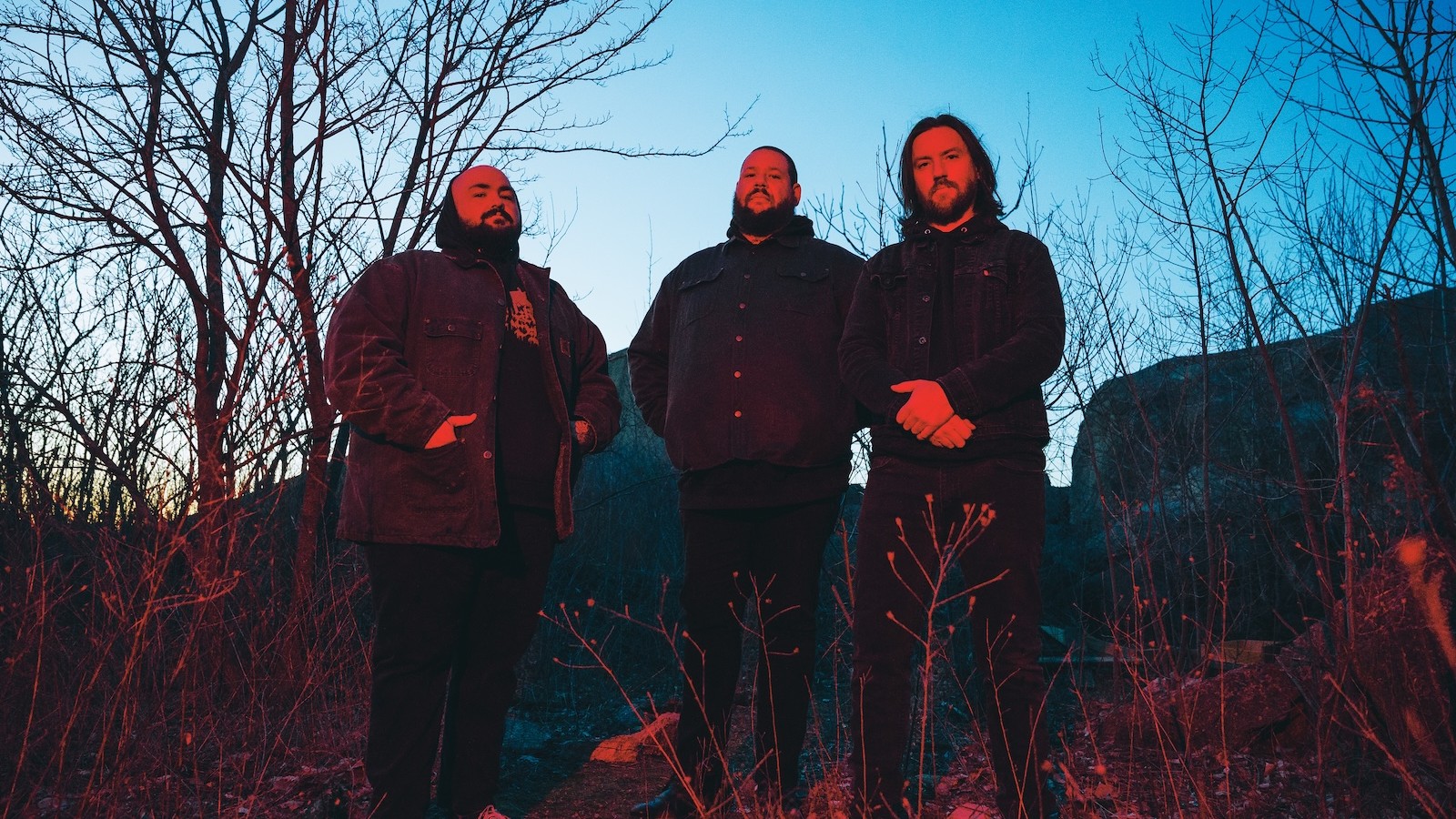
The Denver trio formed in February 2012 by the guitarist and singer Ethan Lee McCarthy, the bassist Jonathan Campos and the drummer Bennet Kennedy, Primitive Man, arrived with its rig already built for the depths, and when the blog The Sludgelord asked the band in March 2013 what it played through, the reply listed Mammoth cabinets exclusively and a Mesa Dual Rectifier Roadster head for McCarthy, and an Ampeg SVT valve head into an eight by ten cabinet for Campos.
Released by Relapse on 6 October 2017, Caustic was aimed, as McCarthy told Emily Bellino of Decibel that September, at being heavier than everything the band had released before, and that tonnage was never going to come from the fretboard alone. A slackened string has to be driven through enough amplification to shake it into the room, and McCarthy told No Clean Singing in August 2020 that the band played through a massive amount of equipment, double what had traditionally been allowed in most of the EU.
The instruments caught up with the band in 2026. In March the guitar builder Dunable announced a signature Gnarwhal DE baritone designed with McCarthy, a matte black mahogany guitar with a single Bladewolf pickup and a 27.5 inch scale, two inches longer than the guitar in the opening paragraph and limited to twelve instruments, and beside it a white 35 inch Gnarwhal bass designed with Campos, a single EMG humbucker on it, built, in the maker's words, for super low tuning. Two inches sounds like a detail. Held against D'Addario's formula it is the hawser made fast further up the quay: the same string at the same pitch pulls about sixteen per cent harder on the longer neck, tension a baritone player can spend on a lower note instead of losing it to the sag.
Halve the frequency and a string keeps a quarter of its pull.
Amplifiers that hold the hum
A tuning this low is finished at the amplifier, not at the headstock. Davis listed the Conan rig for The Obelisk in 2010 as a Matamp GT200 bass head on one guitar channel and a Sunn Model T on the other, feeding an old 4x12 and a Matamp 2x15, and in 2012 he gave The Sludgelord the logic: every piece of equipment chosen and adjusted so the band sounds as deep as it can, bass amplifiers used for guitar, high output pickups, the amps recapped regularly to keep their bass response, the presence switch simply turned off. On the 2026 album O'Malley's side of the room ran through four vintage Sunn Model T heads, and the band called one Fender 4x12 the Black Hole for its bass response.
Laid side by side, these rigs show that a doom tuning is judged by how much tension survives the descent, not by how low the note sits on a chart. A drop F on light strings is a slack rope slapping the harbour wall; the same pitch on a .072, a longer neck and a bass head with the presence switched off is the hawser at full length, humming under geological load, the tolling floor that every slow song in the genre stands on. The shapes the players stack on top of those notes, three and four strings at a time, are set out in the Doom Metal Chords.
