
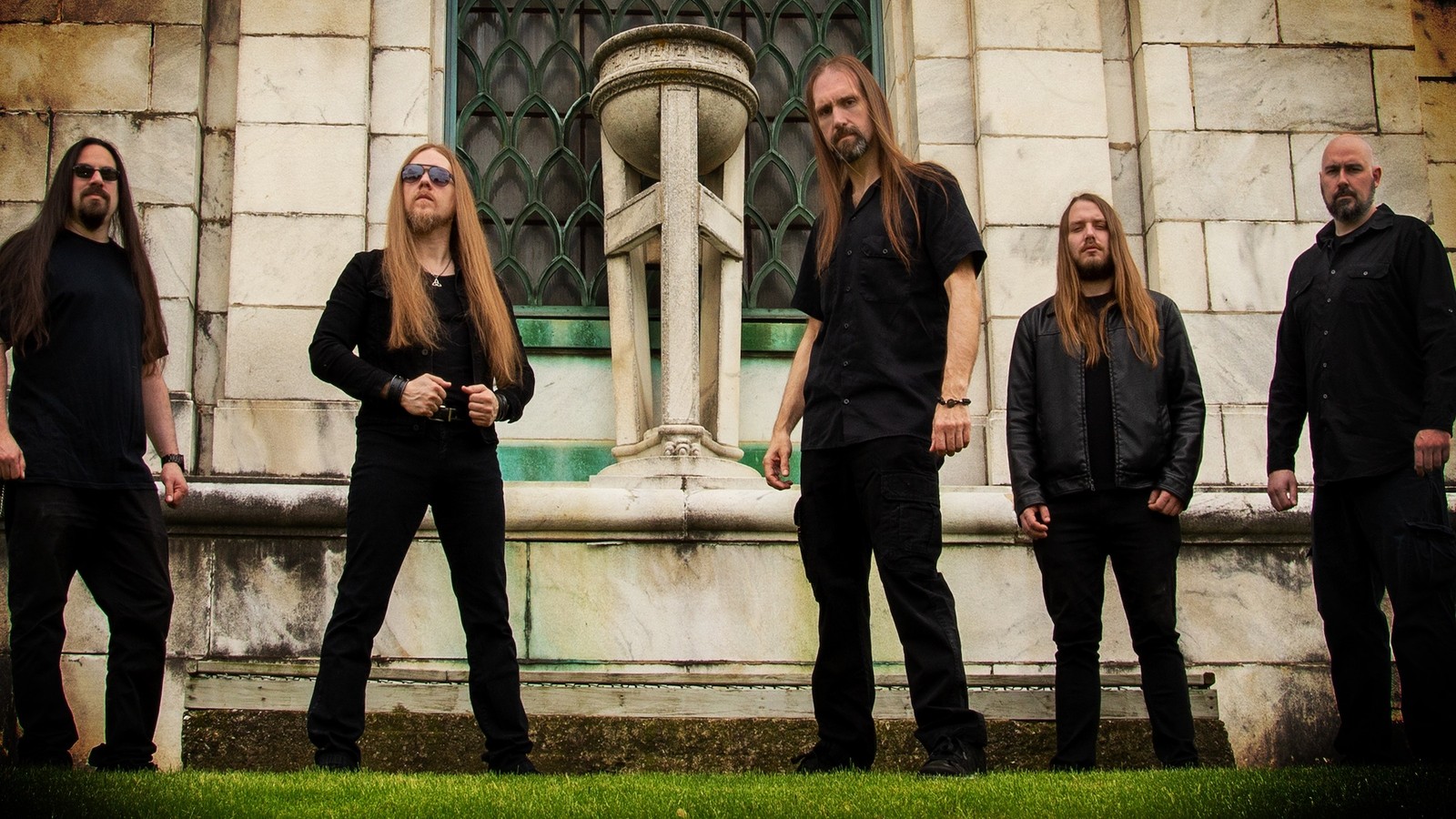
Doom metal and death metal are not two genres on either side of a wall. They are two services running on one line, and what separates them is not heaviness or the depth of the tuning, which they share, but decisions a band takes before it writes a song: how fast the music may move, whether a riff is built to be repeated or to be broken, and whether the voice sings or roars. That is our verdict, and the Chicago band that has lived on the line since 1989, Novembers Doom, is our chief witness.
Picture a single line of track across open country at night, the same rails on the same sleepers, and on it two trains that weigh the same to the tonne: a freight hauling ninety wagons of ore at a leaden walking pace, slow enough that someone at a level crossing can count the couplings, and an express of identical steel that goes through the same crossing as a pressure wave before anyone standing there has turned their head. The rails do not care which train is on them. Only the timetable does. How the track was laid, from a Birmingham record of 1970 onward, is the doom overview; this page stands at the crossing and times the trains.
Start with the steel, because it is common property. Both genres tune down, put the weight in the lowest strings and write in minor keys about decay and death, and both descend from one guitarist. Tony Iommi, by the account in his autobiography, tuned down a step and a half for Black Sabbath's Master of Reality, released on 6 August 1971, to ease the pain in fingertips he had lost in a factory accident. Identical amplifiers in an identical tuning can still produce two different musics.
The difference is the timetable. In the standard definitions, death metal is built on blast beats, tremolo picking, chromatic runs and abrupt changes of tempo, key and time signature, while doom metal is built on slow tempos and repetitive riffs in which guitars and bass often play the same figure in unison. One genre breaks a riff apart and moves on before the listener has settled into it. The other repeats the riff until the listener can think of nothing else.
You can't just call us death metal because we're not just death metal. You can't call us just goth metal cause we're more than that too.
Paul Kuhr of Novembers Doom, interviewed by J. Skeleton, Metal Plague, 23 May 2022
Tempo and the riff: broken or repeated
Recorded at Morrisound in Tampa in December 1988 and released by Earache on 12 May 1989, the debut of the Florida quartet Morbid Angel, Altars of Madness, is the express at full speed: ten songs in under thirty nine minutes, "Immortal Rites" and "Chapel of Ghouls" among them, guitar riffs that AllMusic heard as lightning fast, each figure fired like a rivet from a gun on a shipyard floor, struck once, discarded and replaced before the one before it has stopped ringing. Nothing on the record is allowed to stay.

Two years later the same label released the opposite record. Formed by the singer Lee Dorrian after he had sung on the first two albums of the grindcore band Napalm Death, the English band Cathedral recorded Forest of Equilibrium at Workshop Studios in Redditch in the summer of 1991, and Earache released it on 21 October: seven tracks across fifty four minutes, an opening track that runs a short intro into "Commiserating the Celebration" for more than eleven, and riffs hauled rather than played, each one dragged past like a loaded wagon and brought round again on the same rails. Chris Chantler of Metal Hammer heard the band's doom obsession twisted by forward thinking extreme impulses. Same label. A different timetable.
The same steel can be driven at full speed or dragged at walking pace. Heaviness is the weight of the train. Genre is the timetable it keeps.
The voice and the tuning
The voice is the clearest signal, and the older side sang. Formed in Chicago in 1978, the band with the Bible on its lyric sheets, Trouble, put Eric Wagner's voice over slow, down tuned riffs on its 1984 debut for Metal Blade, later retitled Psalm 9, and in 1986 the Los Angeles band Saint Vitus, signed to the punk label SST by Greg Ginn, made Born Too Late with Scott "Wino" Weinrich singing over riffs that AllMusic heard as sludgy and ultra slow, chords brought down one at a time like a hammer on an anvil. Death metal took the singing out. Recorded at Morrisound with Scott Burns and released on R/C Records in 1989, Slowly We Rot by the Tampa quintet Obituary set John Tardy's growls, painful sounding moans in AllMusic's hearing, over twelve songs in thirty five minutes.
The tuning divides nothing, but it pulls. Paul Kuhr told Scott Martin of Antihero Magazine on 26 February 2017 that his band began in 1989 as a thrash band, tuned down for the heaviness, and found the slack strings went floppy at speed. "It made more sense to slow the music down," he said. A low tuning is a heavy load on a light chassis. Some bands add the weight and keep the speed; others let the load set the pace.
| Question | Doom metal | Death metal |
|---|---|---|
| Tempo | Slow, held long enough for a riff to be heard as a shape | Fast, with blast beats and abrupt changes of tempo |
| Riff construction | Repeated, often guitars and bass in unison | Broken up: tremolo picking, chromatic runs, sudden shifts |
| Voice | Sung in traditional doom; growled in death doom | Growled or roared |
| Tuning | Down tuned | Down tuned |
| Lineage | Black Sabbath, then Pentagram, Saint Vitus, Trouble, Candlemass | Thrash, then Possessed and Chuck Schuldiner's Death |
| Scenes and studios | SST in California; Maryland bands on the German label Hellhound | Tampa, around Morrisound Recording |
| Labels that ran both | Earache, Metal Blade, Relapse | Earache, Metal Blade, Relapse |
| Records to hear | Born Too Late (1986), Forest of Equilibrium (1991) | Altars of Madness (1989), Slowly We Rot (1989) |
Lineage, scenes and the labels that ran both lines
The two services left from different stations. Doom took its lineage from Black Sabbath through the four bands usually named as its founders, Pentagram, Saint Vitus, Trouble and Candlemass, whose Epicus Doomicus Metallicus arrived in 1986. Death metal came out of thrash, through Seven Churches by Possessed in 1985 and Chuck Schuldiner's Scream Bloody Gore in 1987, and gathered around one studio in Tampa, where Morbid Angel and Obituary both cut their debuts. Doom gathered around Hellhound, the German label that from 1988 to 1996 filled its roster with Maryland bands, and around Rise Above, founded by Dorrian in London in 1988.
At the depots the lines converge again. Earache released both Altars of Madness and Forest of Equilibrium. Metal Blade put out Trouble's debut and has released Cannibal Corpse since Eaten Back to Life in 1990. Relapse released Onward to Golgotha by the New Jersey band Incantation on 5 May 1992, a death metal record that Decibel described in terms of swarming guitars, blasting darkness and crushing doom, the express throwing on its brakes mid song and grinding along at a freight train's crawl. The same company has put out Pentagram and The Obsessed. A label is a railway company. It runs whatever pays on its track.
Novembers Doom, the band on both timetables
Grown out of a death thrash band called Laceration in the basement of Paul Kuhr's parents' house in 1989, the Chicago quintet has lived on the line between the two services for more than thirty years. Trouble had been slowing metal down there since 1978, and Kuhr told Metal Plague that Chicago had "great, even doom bands back in the day when no one knew what that was", while naming two local bands of the late 1980s, Devastation and Sindrome, as the sound he wanted for his voice, and Russ Anderson of Forbidden, who went from a thrash bark into clean passages, as the example he meant to add. Kuhr says the band built that range in from the beginning. Its first album, Amid Its Hallowed Mirth, came out on Avantgarde in 1995.
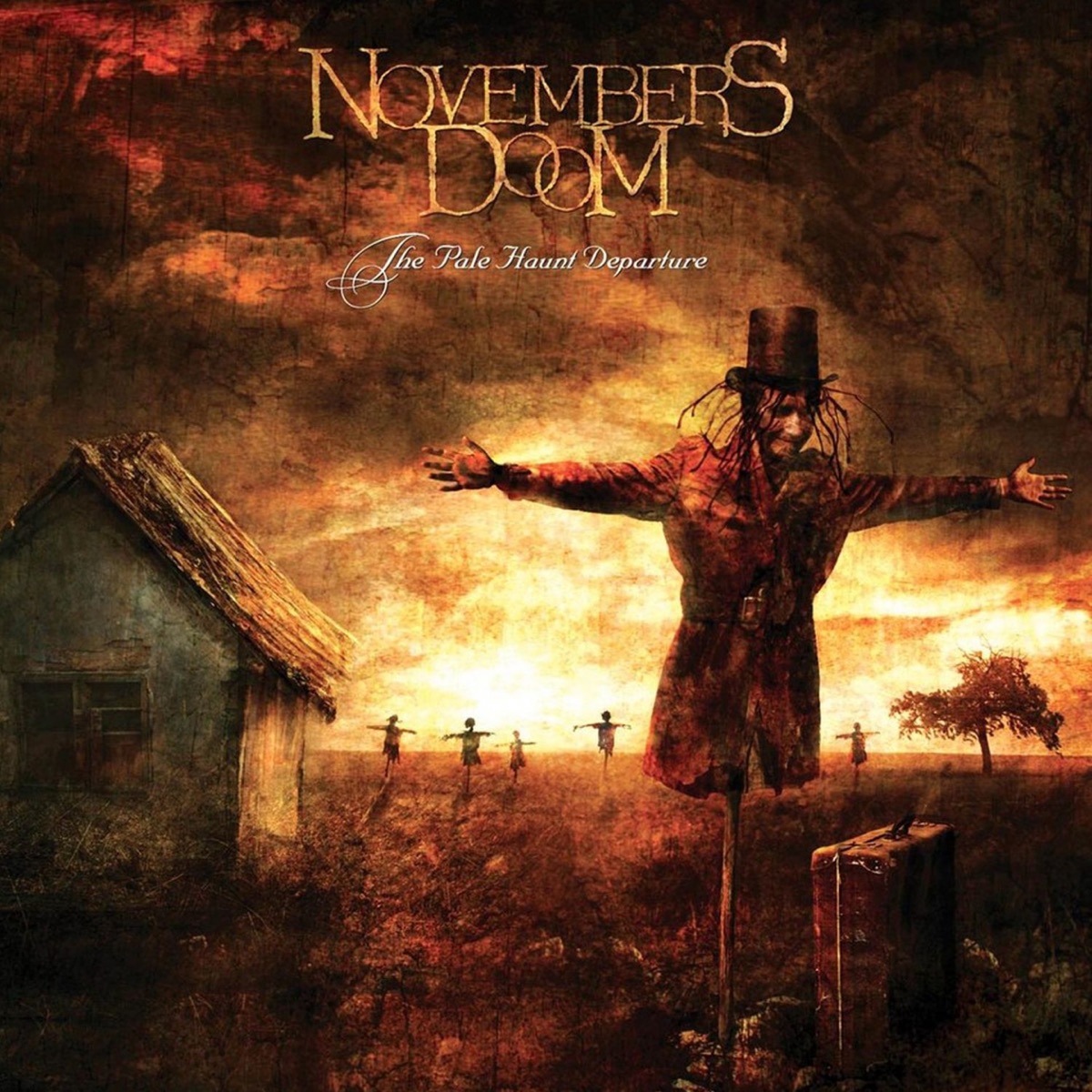
Released by The End Records on 8 March 2005, produced with Chris Wisco, with Kuhr, Larry Roberts and Vito Marchese, Mike Legros on bass and Joe Nunez on drums, The Pale Haunt Departure is the record on which the Chicago band stops choosing and runs both services on one line: "Swallowed by the Moon" and the eight minute "In the Absence of Grace" among them, with Kuhr's deep growl set beside more clean singing than the band had used before, down to a multi tracked, funereal Gregorian passage in the middle of the longer song. Blabbermouth scored it eight and a half out of ten. Hamartia followed on The End in April 2017 and Nephilim Grove on Prophecy Productions in 2019.
Major Arcana, the band's twelfth album, arrived on Prophecy on 19 September 2025 with Kuhr, Roberts and Marchese joined by Mike Feldman on bass and Garry Naples on drums, most of its songs built, as J Mays of Teeth of the Divine put it, on growled verses and clean choruses, and a record Sandy Williamson of The Sleeping Shaman called a surprisingly anthemic death/doom album, naming "Bleed Static" and "Dusking Day". In the 2022 interview Kuhr said the band does not rework its set for a death metal festival and plays its ballads there anyway. It is the freight train pulling into the express platform and unloading its cargo at walking pace.
Where the lines cross, and how to tell them apart
The crossing points are real: doom records with death metal voices, and death metal records that brake for whole minutes and never quite start moving again. That junction has its own history, told separately as the story of when doom met death metal. Here the question is narrower: faced with a record, which timetable is it keeping?
Time the riff first: repeated until it sets like pitch, the band is running freight; torn up and replaced every few bars, it is running the express. Then listen to the voice, because a roar puts a record in death metal's company however slowly the band plays, and a sung line keeps it in doom's however heavy the guitars. The label tells you least. The voice settles most arguments and carries the most assumptions about who is supposed to be singing, which is where the next page, on female Fronted Doom Metal, picks up the line.
