
Drop D tuning is the cheapest weapon a guitar was ever handed. One tuning peg turns, the lowest string falls a whole tone from E to D, the other five strings stay exactly where they were, and a riff that used to need two fingers and a stretch can suddenly be played with one finger laid flat across a single fret. Nothing is bought. Nothing is rewired.
Slackened by those two semitones, the guitar behaves like a crypt whose floor a mattock has just smashed through, the flagstones caving into a second vault that nobody knew was down there, and every riff built on the open low string drops into that vault with it, a tone deeper, a shade darker and, in the hands of a band that knows what to do with the extra room, a great deal heavier. The rest of the building stands exactly as it was.
Retuning an instrument on purpose has a conservatory name, scordatura, Italian for mistuning, and it is centuries older than the amplifier. The Bohemian violinist who, around 1676, demanded a different tuning of the violin in almost every one of his Mystery Sonatas, bending the four strings into new intervals so that the open strings rang out chords the normal tuning could never sound, was Heinrich Ignaz Franz Biber. The trick is attested. Only the volume is new.
Where the tuning sits among the other parts of the kit, the chord without a third, the forbidden interval and the gallop, is set out in heavy metal music theory, along with the first rock records that used it. Getting a guitar there takes a minute and a tuner, or a minute and a decent ear.
What drop D tuning changes, string by string
Standard tuning, from the thickest string to the thinnest, runs E, A, D, G, B, E. Drop D touches only the first of them. The sixth string comes down from E2 at 82.41 hertz to D2 at 73.42, which lands it exactly one octave below the open fourth string, and that octave is the whole secret of the tuning.
| String | Standard | Drop D | Pitch in drop D |
|---|---|---|---|
| 6th | E | D | D2, 73.42 Hz |
| 5th | A | A | A2, 110.00 Hz |
| 4th | D | D | D3, 146.83 Hz |
| 3rd | G | G | G3, 196.00 Hz |
| 2nd | B | B | B3, 246.94 Hz |
| 1st | E | E | E4, 329.63 Hz |
Read the bottom three strings of that table upward and they spell D, A, D: a root, the perfect fifth above it and the octave. In standard tuning the same three strings, E, A and D, stack two perfect fourths, a fine shape for chords but not a power chord. Lowering the sixth string turns the lower of those two fourths into a fifth, and the open strings now sound a D power chord before a single finger has touched the neck.
Drop D is not D standard, and the two are confused on every guitar forum going. In D standard all six strings come down a whole tone, D, G, C, F, A, D, so every chord shape and every riff simply sounds a tone lower than written. "Sad but True", on the Metallica album released in August 1991, was played that way. Drop D moves one string and leaves the rest of the guitar in its old key.
How to tune to drop D
Three methods do the job, and none of them needs a pedal.
- With a tuner. Pluck the sixth string and turn its peg down until the display reads D. Go slightly under the note, then bring the string back up to pitch: a string tuned up to its note holds there, while one let down onto it tends to slip flat.
- By the octave. Play the open sixth and the open fourth strings together and lower the sixth until the two merge into one note an octave apart. While they are close but not matched, the sound wobbles; that slow pulse, which acousticians call beating, stops at the moment the octave is true.
- By harmonic. Touch the sixth string lightly directly above the twelfth fret, without pressing it down, and pluck it. The bell-like harmonic sounds D3 and must match the open fourth string exactly. As a cross-check, the sixth string fretted at the seventh fret now gives A, the same note as the open fifth string.
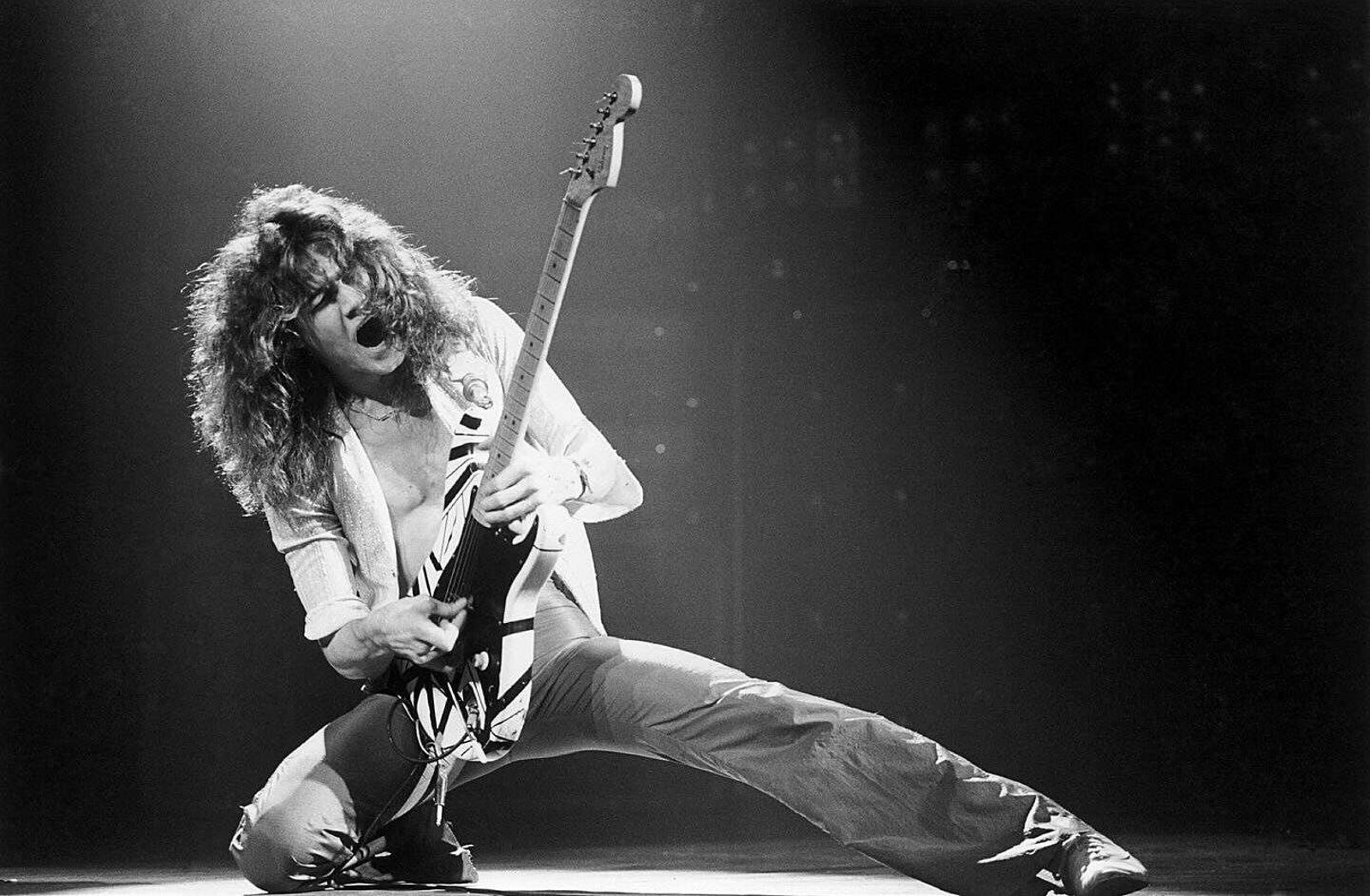
A guitar with a fixed bridge takes the change in its stride. One with a floating tremolo, the kind that balances the pull of the strings against springs in a cavity at the back, does not, because slackening one string tips that balance and drags the other five sharp, so the whole instrument has to be retuned in rounds until it settles. The guitarist who solved the problem for his own locking bridges, with a collar fitted to the low string's fine tuner that flips the string between E and D in a second, was Eddie Van Halen, and his D-Tuna has been standard equipment on his signature guitars since the early nineties. A lever on the tuning key, the Hipshot Xtender, does the same job on fixed bridges.
One tuning peg turns, and the floor of the instrument moves.
One finger, three strings
Every power chord in standard tuning is a grip of two or three fingers spread across two frets. In drop D the same chord on the bottom three strings needs one finger laid flat across one fret, the barre, and that finger then moves: at the third fret it is F5, at the fifth G5, at the seventh A5. The shape never changes. Only its height on the neck does, and the barre can be slammed up and down the fretboard like a sash window thrown open and shut in its frame, as fast as the arm can travel.
That speed changed the riff. A chord sequence that once required the fretting hand to rebuild a shape at every change could now be played as a single line, chromatic runs of power chords, slides between frets, a chord struck on every beat without a gap for the fingers to regroup, all of it with the open low D waiting underneath as a floor to fall back to between the moves. How the shape is fingered in standard tuning, and where it came from long before this tuning made it easier, is the story of the power chord.
The key changed too. With D as the lowest note on the instrument, the natural home becomes D minor or the D modes, the open fourth string doubles the bass an octave higher, and a riff can hammer the open sixth string between fretted chords the way a drummer returns to the kick drum. Two semitones is a small distance. On a guitar played loud it is a new room.
Drop D tuning in the nineties, and what it did to the sound

The tuning became a whole method only when the heavy bands of the early nineties built entire albums on it. The Seattle quartet whose guitarist Kim Thayil and singer Chris Cornell kept lowering their strings all through Badmotorfinger, released by A&M in October 1991, was Soundgarden, and the record drags the dropped string through its songs like a harrow over frozen ground, smashing up the clods of older hard rock still lying in the furrows.
"Outshined", written by Cornell and released as a single from that album, is the textbook case. Its main riff lives on the bottom string, lurching between the open D and fretted notes just above it, and the low note lands at the end of each phrase with a weight no standard tuned guitar could give it without a second instrument doubling underneath.
A year later the tuning crossed into another rhythm entirely. The Los Angeles quartet whose guitarist Tom Morello played its debut in drop D and made the open low string hit like a sampled drum was Rage Against the Machine, and on "Killing in the Name", from the album Epic released in November 1992, the riff smashes the open D against fretted power chords in a groove built as much for hip-hop as for metal. The heavier bands that followed through the decade learned it there, and their progeny kept dropping further, to C and then B, until the low string of 1992 sounded almost polite.
What the tuning changed, in the end, is the floor and the speed together. The lowest note came down two semitones, the fattest chord on the guitar became a one-finger grip, and a riff could now move as fast as a bassline while sounding as heavy as a wall of chords. Every heavier tuning since has pushed the same bridgehead further down the neck. None of them can be reached in ten seconds between two songs, on a stage, with no second guitar waiting at the side.
Drop D can. One peg, two semitones. That was always enough.

