
Around the year 900 an anonymous treatise called Musica enchiriadis told church singers how to add a second voice to a chant, running a fifth or a fourth below the melody and moving with it note for note, and the sound it described, two lines locked a fifth apart and marching in step, is the sound of every power chord riff ever pushed through an amplifier. The monks called it organum. Guitarists write it with a 5.
The composer who opened his Ninth Symphony in 1824 on a bare fifth, A and E trembling in the strings for sixteen bars with no third to say whether the key would turn out major or minor, was Ludwig van Beethoven, and when the full orchestra finally crashes down onto D minor a few bars later, the listener has spent the whole introduction in exactly the uncertainty that a distorted E5 holds an arena in. The fifth commits to nothing. That is its power.
A power chord is a chord with its middle knocked out. Struck from the triad the way a mason's hammer might drive the keystone out of a stone arch that by every rule of the trade should then collapse into the river, the third is gone, and the arch, against the rule, stays up and carries a loaded lorry, and then a stack of amplifiers on top of the lorry. The rule was wrong about fifths.
What a power chord is
An ordinary chord, a triad, has three different notes: the root, the third and the fifth. The power chord keeps the root and the perfect fifth, seven semitones above it, and usually doubles the root an octave higher. Strictly, a harmony teacher would call it a dyad, two pitch classes, and refuse it the name of chord at all. The guitar world ignored the teacher. It writes E5, A5 or G5, the letter for the root and the 5 for the only interval present.
Because the third is missing, the chord is neither major nor minor, and the same grip sits comfortably under a minor riff, a major chorus or a melody that changes its mind halfway through. Why distortion treats the bare fifth kindly and turns a full major triad to mud is set out in the theory chapter. The short version belongs to acoustics: after the octave, the fifth is the first new note in the harmonic series of any low string, so the chord adds almost nothing the string was not already sounding.
A power chord is a chord with its middle knocked out.
How to finger a power chord
Two grips cover nearly everything. With the root on the sixth string, the index finger frets the root, the ring finger goes two frets higher on the fifth string for the fifth, and the little finger can join it on the fourth string at the same fret for the octave. With the root on the fifth string, the whole shape simply moves one string over. The grip is movable: slide it along the neck and the fret under the index finger names the chord.
| Chord | Root | Fifth | Octave |
|---|---|---|---|
| E5 | 6th string open | 5th string, 2nd fret (B) | 4th string, 2nd fret (E) |
| A5 | 5th string open | 4th string, 2nd fret (E) | 3rd string, 2nd fret (A) |
| G5 | 6th string, 3rd fret | 5th string, 5th fret (D) | 4th string, 5th fret (G) |
| C5 | 5th string, 3rd fret | 4th string, 5th fret (G) | 3rd string, 5th fret (C) |
| D5 | 5th string, 5th fret | 4th string, 7th fret (A) | 3rd string, 7th fret (D) |
The open chords, E5 and A5, ring longest and sound biggest, which is why so many riffs are written in E and A. The fretted ones travel. Two details separate a clean power chord from a noisy one: the underside of the index finger rests lightly across the thinner strings so that a wide strum hits dead strings rather than open ones, and the picking hand strikes only the two or three strings of the grip. Tune the sixth string down a tone and the sixth-string grip collapses into a single finger laid across three strings, which is the whole case for drop D.
Beginners usually press too hard and strum too wide. The fifth and the root need firm pressure, the octave on top is optional, and a two-finger grip, index and ring, is often cleaner at speed than the full three. Played that way the chord is small enough to move every half beat, and moving is what it is for.
Power chord rock before heavy metal
The grip reached pop radio years before anyone called a record heavy metal. Organum had long since become a footnote in the harmony books, and the bare fifth had lived on mostly as a drone, in bagpipes and in the open strings of folk fiddles, until the electric guitar found that it could hold up a song on its own.
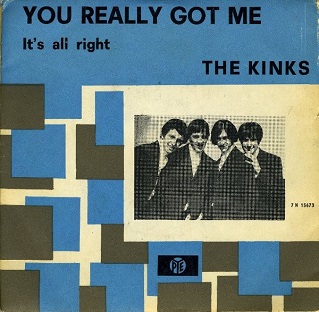
The North London four whose guitarist Dave Davies built their third single on a riff of two power chords a whole tone apart, shunted up the neck as the song climbed, were The Kinks, and "You Really Got Me", a British number one in September 1964, is among the first hit records whose hook is nothing but that grip. How its buzzing sound was made is a separate story. What matters for the fingers is that the song needs no chord with a third in it at all.
The guitarist whose riffs made the power chord the floor of a whole style rather than an accent at the end of a phrase was Tony Iommi, and the grip reached him through the British blues bands he grew up on. Black Sabbath built on it. That handover is told in the parent article. What came after it is a question of where else the chord could go.
Power chords on the bass, and what came after

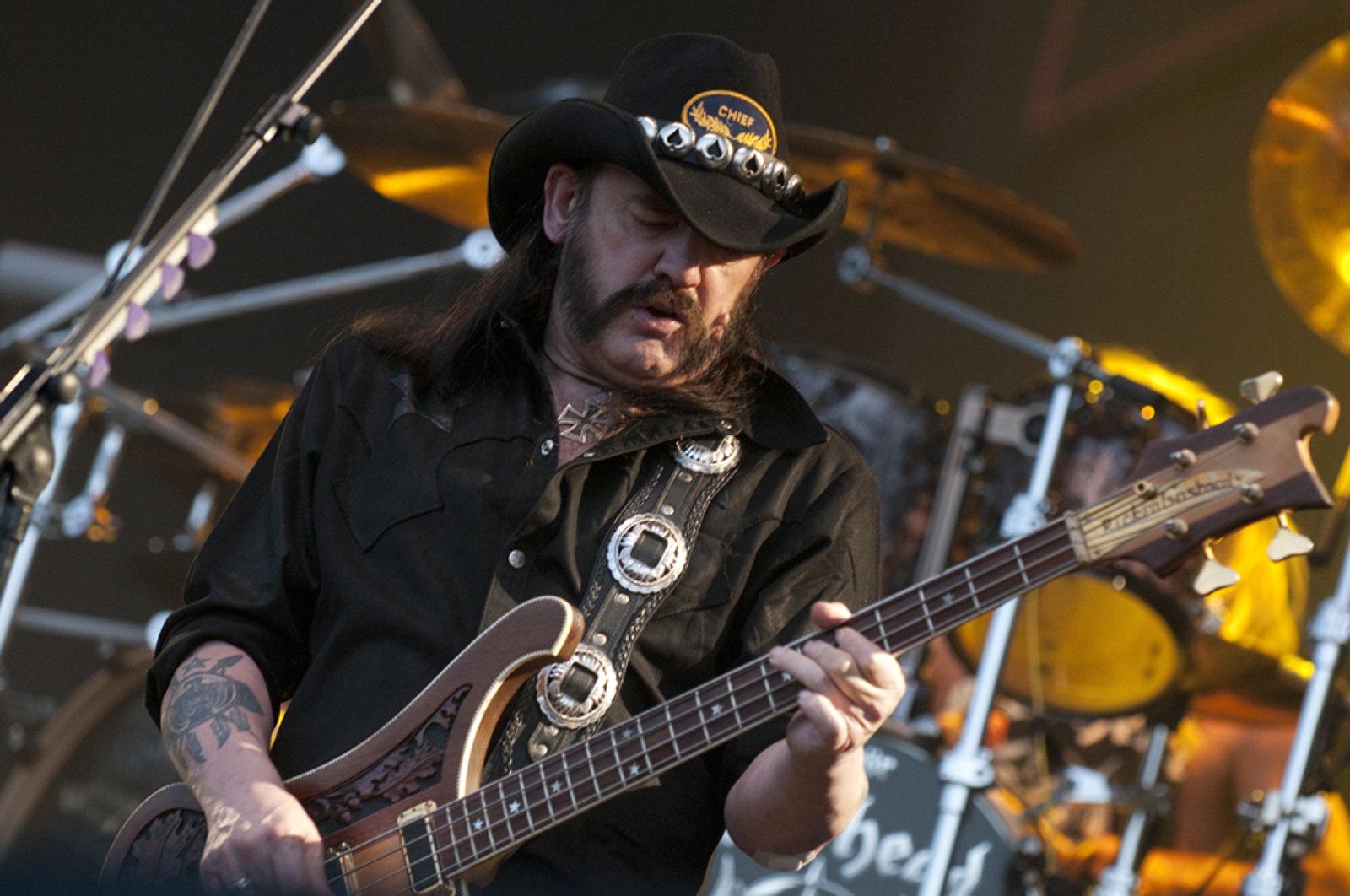
The bassist who had come to the instrument from rhythm guitar and never really agreed to the change was Lemmy Kilmister, and in Motörhead he played the bass the way he had played the guitar, chords struck with a pick rather than single lines plucked with the fingers, root and fifth and often more, driven through amplifiers set to a volume that fused the bottom and the middle of the band into one block. In a trio with one guitar, that mattered more than any solo.
On "Bomber", the title track of the album Motörhead released on Bronze in October 1979, the bass chords pour into the space under the guitar like crushed granite shot out of a hopper wagon onto a railway bed, stone smashing onto stone, until there is no gap left for air, and Fast Eddie Clarke's guitar rides on top of a surface that is already a wall. A bass chord at that volume is supposed to be mud. Played as a bare fifth, it is not.
That is the lesson the rest of the music took, by common consent, from a trio that never thought of itself as heavy metal at all. The power chord works anywhere a third would fail: on a bass, at extreme volume, under a detuned string, at the speed of a thrash downstroke. The vanguard of every later school, from the British bands of 1979 to the extreme ones of the following decade, kept it as the unit of the riff, the one article of the creed nobody thought to question.
A riff of power chords sliding along the neck is organum again, two voices a fifth apart advancing like a file of pikemen with every pike held at the same slant, so that the whole column wheels as one when the front rank turns. Fux banned exactly that motion in 1725. Metal made it the drill.
Metal did add to the grip. Players stack a second fifth on top of the first, E, B and F sharp, for a wider, more open sound; they drop the root and keep only the fifth and octave; they slide the upper note down a fret for a darker grip. That last move stops being a power chord at all. With the fifth lowered by a semitone, the stable interval turns into the most unstable one in the scale, the step from the power chord straight into the tritone, the Devil's interval.
Everything else about the chord has stayed where the monks left it. Two notes, a fifth apart, moving together. The amplifiers got louder, the strings got lower, and the grip under the index finger is the same grip a beginner learns in the first week.
Nothing in the music is older. Nothing is used more.

