
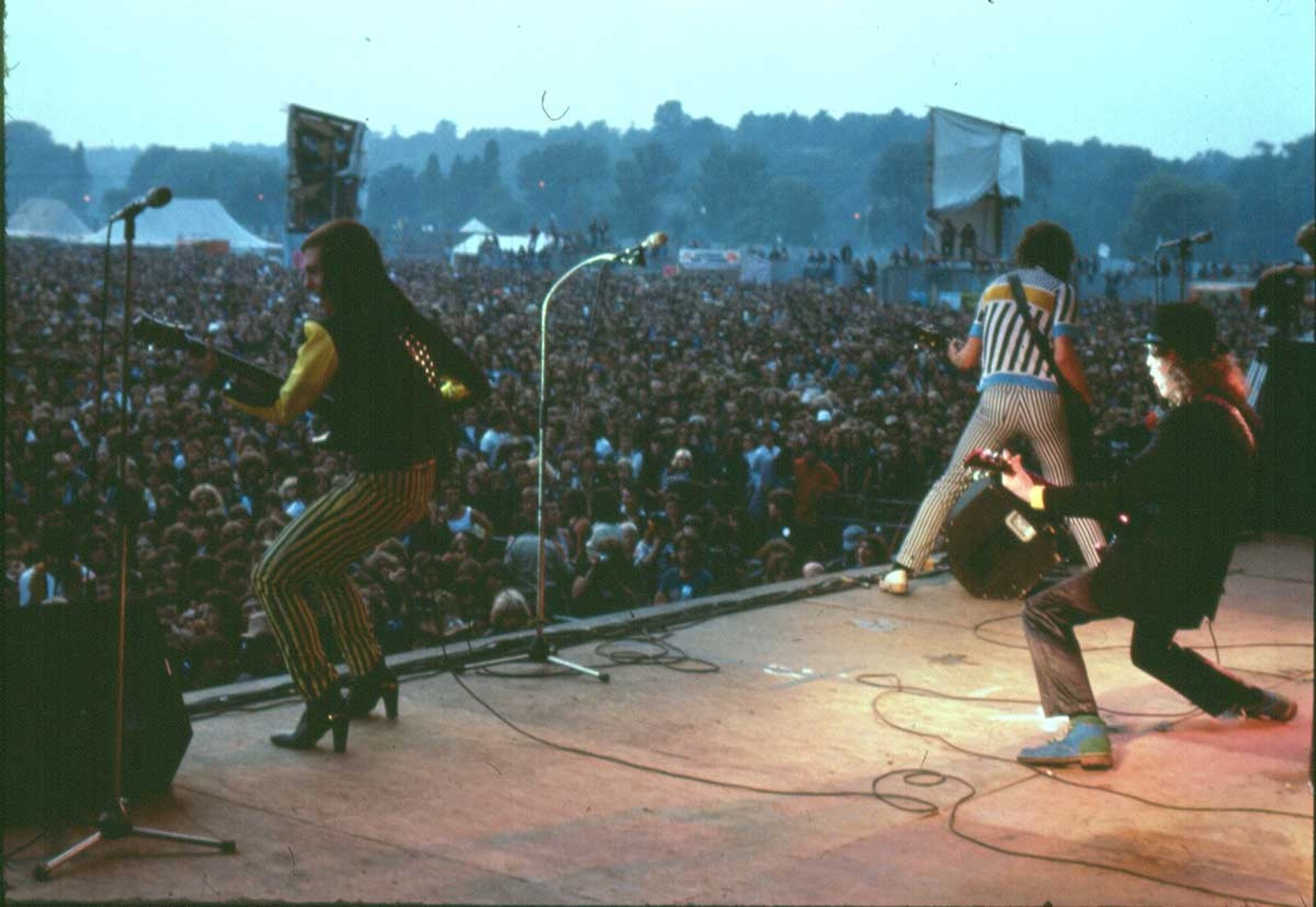
A hundred pairs of hands, hired by the night.
In the Paris opera houses of the 1820s a chef de claque sold applause by contract, and his men took their seats in the stalls with their parts learned as carefully as the chorus had learned its own: the rieurs laughed on the joke, the pleureurs wept through the death scene, and the bisseurs bellowed for the encore. A tenor who declined to pay heard the whistles start before he reached the top note. The stamping did the rest.
The claque never died. It moved into the recording studio, stopped sending invoices, and became the gang vocal: a handful of throats stitched into the chorus to show a hall of strangers exactly where to shout, and exactly how loud. The gang vocals metal inherited from glam and punk are that bargain with the fee waived, and they have been teaching crowds their part for fifty years.
The Australian five who stacked a bare, pitchless shout of oi on top of the bars of a song called "T.N.T." in 1975 were AC/DC, and the title track of their second Australian album, produced by Harry Vanda and George Young for Albert Productions that December, turned the grunt of a road crew into a hook. Nobody has to learn it. Nobody ever needed to, and the shout has been shaking the fittings loose from club ceilings on every continent since.
What the singer does above the shout, and how the hall learned to answer him night after night, is laid out in the full chapter. The shout itself is a craft with its own rules, and almost none of them are the rules of good singing.
What gang vocals metal bands actually record
A choir blends. Forty singers match their vowels, tune their thirds, breathe on the same beat and aim to pass for one very large instrument, and a choirmaster will stop a rehearsal for a single voice that sticks out. A gang does the opposite on purpose. It keeps every voice sticking out, because the sound of a crowd is the sound of disagreement.
The ear counts people by their mistakes. Each throat in a gang lands a few milliseconds early or late and a few cents sharp or flat, and audio researchers call the resulting smear the chorus effect: a listener reads it as a number of bodies rather than as one voice turned up. Double a single singer and the copies agree too well. The ear hears one man twice.
So the studio multiplies. Four or five people, the band and whoever from the crew is still standing, shout the line together round one or two microphones, then change places, change distance, and shout it again, three or four passes laid on top of each other until five throats pass for thirty. The part is pitched low, near speech, where an untrained voice can reach it at the end of a long night. The consonants are what get rehearsed. A gang that lands its first syllable together sounds like a hundred men; a gang that smears it sounds like a pub at closing time.
A túngara frog calling alone on a pond in Panama at dusk is a meal. The fringe-lipped bat hunts by ear, homing on the male's whine and chuck from the dark above the water and plucking him off the surface in its teeth, and the safest place for any male is inside a chorus of hundreds, where every neighbour who calls is one more target the bat might take instead. The gang vocal does that job for a listener who cannot sing. Inside the shout nobody is exposed, which is exactly why a whole room will join it.
In the arrangement the gang almost always takes the answer and never the call. The singer states the line, the gang throws back its title or its last two syllables, and the band stops dead or drops to the kick drum for that half bar so the shout has air around it, a device older than any amplifier, the antiphony of a psalm sung in alternating halves, bolted to a riff.
A gang that lands its first syllable together sounds like a hundred men; a gang that smears it sounds like a pub at closing time.
From a glam stomp to the thrash floor
The Wolverhampton singer who roared six British number one singles between 1971 and 1973 over a band hollering behind him was Noddy Holder, and Slade handed the hard rock chorus its first unison mob. Holder had watched a Chuck Berry crowd sing every line back at the stage and started writing the terrace chant straight into the songs, "Mama Weer All Crazee Now" and "Cum On Feel the Noize" both built round a hook the room could not help joining. Heavy metal bands of the next decade learned them there.
Punk kept the shout and threw away the glitter. The writer who in 1980 named a whole genre after a single bark, borrowing it from the Cockney Rejects' "Oi! Oi! Oi!", was Garry Bushell of the weekly paper Sounds, and by then the two syllable shout had become the signature of every band that wanted its audience on the stage rather than beneath it. American hardcore took it next. Its choruses were written for a floor of friends to scream back at the microphone, and the microphone was usually held out to them.
The New York five who dragged the hardcore gang shout onto a thrash record and never let go of it were Anthrax. On "Indians", from Among the Living, released by Megaforce and Island in March 1987, the chorus comes in unison from the whole band, and the tempo drops into the tribal breakdown the band called the war dance before the riff crashes back in and tears the floorboards out from under the song. Thrash had its catechism of speed and downpicking. Anthrax added the one article of faith that every kid in the hall could recite.
Your voices: for your voices I have fought; / Watch'd for your voices; for your voices bear / Of wounds two dozen odd.
William Shakespeare, Coriolanus, Act II, Scene 3
The choir that shouts back
German power metal took the gang vocal and gave it back its pitch. Accept had drilled the German halls in the shouted chorus since the early eighties, and the bands that followed kept the shout's weight while writing harmony underneath it, so that a hall of untrained voices found itself singing in parts without anyone having taught it a note.
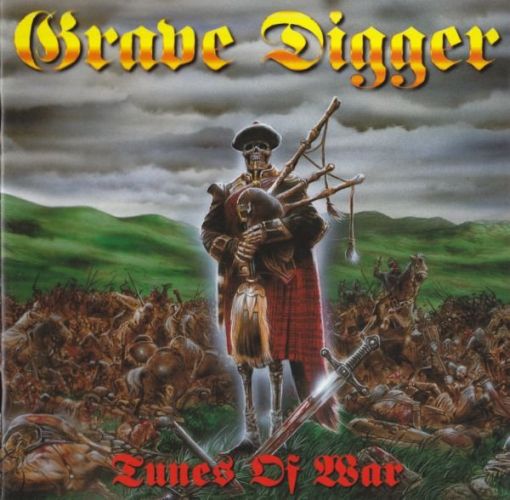
The Gladbeck band that set the long wars between Scotland and England to a riff and gave the chorus to something like a muster of the clans was Grave Digger, and "Rebellion (The Clans Are Marching)", from Tunes of War, released by GUN in 1996, is the gang vocal promoted to a choir. The chorus is harmonised, yet it keeps the gang's rough edges: nobody has rounded a vowel, and every downbeat comes down like a boot heel on a bare wooden stair.
A choirmaster would call it bad choral singing. It is perfect gang singing, and the difference is the whole argument: the part is harmonised so that the hall sounds rich, and left rough so that the hall sounds like itself. The song is a fixture late in Grave Digger's festival sets across Europe, still on the bill three decades on.
Crowd chants the band never wrote
Some of the best parts in the music were written by the audience. The band whose name became a one word chant, yelled between songs and at concerts it was not even playing, is Slayer, and the chant needs no chorus to hang on at all. It is the gang vocal with the song taken away. Only the shout is left.
The Swedish band whose German audiences chant for their singer to down another beer, and usually get their way before the next song starts, is Sabaton. The chant obeys every rule of the studio gang. It has almost no range, it sits on the beat, and its consonants arrive together from several thousand throats, which is why a field can pick it up inside one repetition.
By common consent the best chants are the shortest. A syllable or two, pitched where a tired voice can find it, landed on a downbeat the drummer is already hitting: that is the whole recipe, and the faithful have been following it without instruction since before the band walked on. Everything the hall does with its voice is answered from the boards by fire, risers and machinery, and that trade keeps its own books under the heavy metal stage show.
The singer owns the verse. The chorus was always going to belong to the room.

