
There were much glare and glitter and piquancy and phantasm.Edgar Allan Poe, The Masque of the Red Death
In the great formal gardens of the seventeenth century there was never enough water to run every fountain at once. The men on the taps worked ahead of the king as he walked, opening a jet a moment before he came round the hedge and shutting it again as soon as his back was turned, so that a visitor who went the full length of the garden came away certain he had seen a hundred fountains playing when what he had seen was thirty, kept one step in front of him. Open the whole display together and the cistern on the hill was emptied inside the hour, with the lead pipes hammered apart at their joints. Every heavy metal stage show since 1972 has been run on that principle, and the water is money.
Everything else in the trade follows from it. A band has ninety minutes, a room it does not own, a curfew written into the contract and whatever will fit in the trucks, and out of that it has to make something a man in row forty will describe to people who were not there. The stage magician who built a working guillotine, dropped the blade himself in front of a paying audience and toured nightly through 1973 and 1974 as the executioner was James Randi, and the band he was doing it for was Alice Cooper. After that the argument was over. A heavy metal show is a piece of theatre that happens to be loud.
The voice at the centre of it keeps its own accounts, and those are set out under the heavy metal voice. The machinery around the singer has an economics of its own, and almost none of it is romantic.
Fire, and what the licence costs
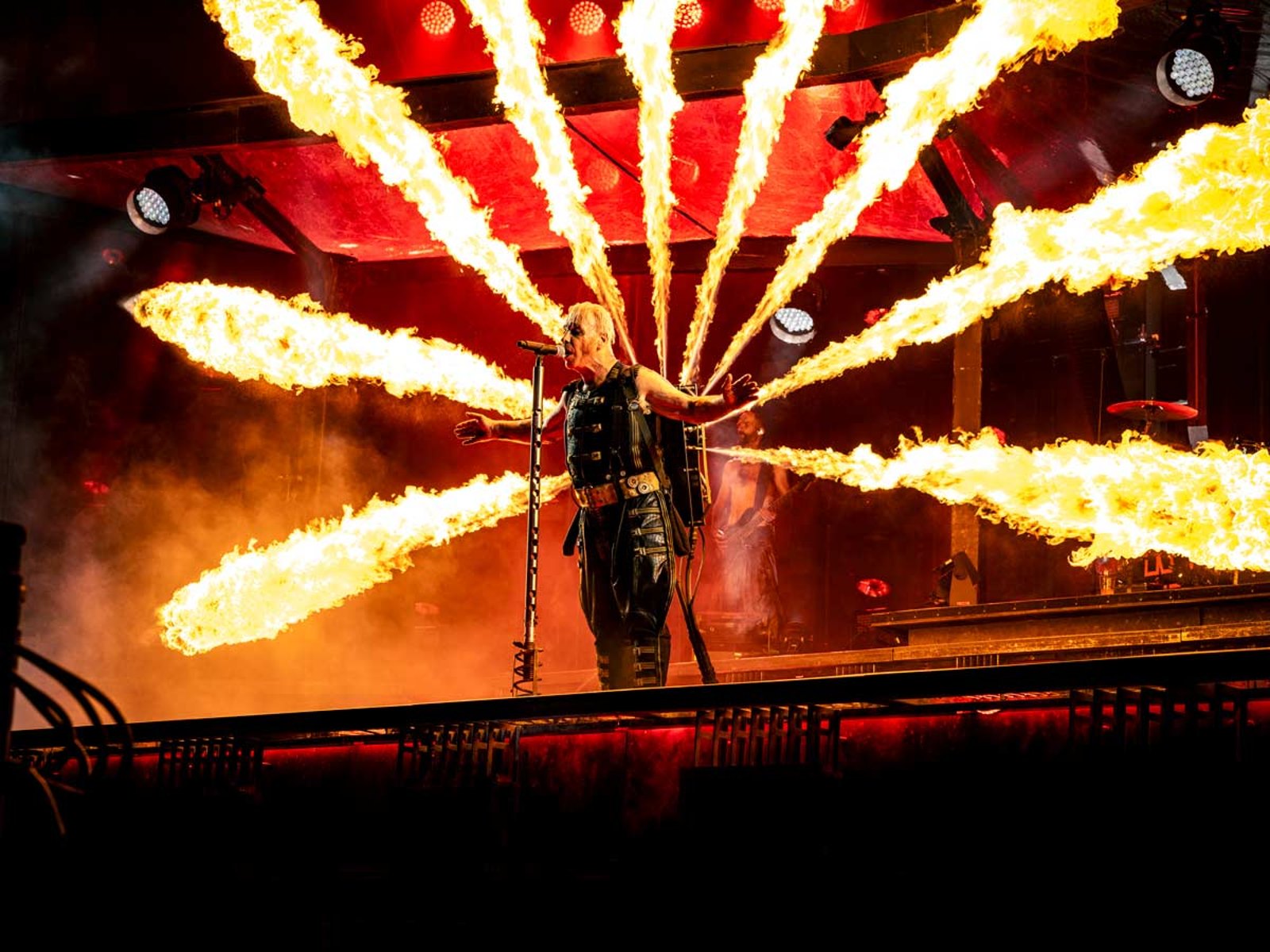
Pyrotechnics are the oldest effect in the business and the dearest to run. A flash pot is a charge fired inside a steel cup; a gerb throws a fountain of sparks on a timer; a flame projector burns gas through a nozzle clamped to the truss, and a bank of them will lift the temperature in the first three rows by several degrees. All of it is ordnance, the law treats it as such, and a charge one size too large will blow the front lip off a wooden stage.
The band that turned the last number of the night into a barrage of rockets, smoke and burning oil was Kiss, whose sets from 1976 onward ended with "Rock and Roll All Nite" fired off over a stage that had carried a smoking guitar, a blood routine and a man breathing paraffin across a lit torch since New Year's Eve 1973. Gene Simmons has set his own hair alight, by his own count, six or seven times. The spectacle was never a joke to the people carrying the insurance.
The rules that govern all of it now were written by a disaster. On 20 February 2003, pyrotechnics set off at the start of a Great White show at the Station nightclub in West Warwick, Rhode Island, ignited the soundproofing foam lining the walls, and one hundred people died. The tour manager who set off the pyrotechnics and the two brothers who owned the club were later convicted on manslaughter charges. Building codes were rewritten in several states, and indoor pyrotechnics in the United States moved permanently onto a footing of permits, licensed operators and measured distances from the audience.
The bands that kept the fire bought the qualifications. The German band whose singer trained as a licensed pyrotechnician after equipment set the stage alight in Berlin in 1996 is Rammstein, and its touring party carries FFP, a professional pyrotechnic crew, whose charges are counted into a venue in the morning and counted out again at night, with a local fire officer present for both. Nothing about it is spontaneous. That is the point of it.
A prop is a promise. The band has to keep it in every town, at the same minute, for eleven months.
Risers, lifts and the machinery under the drummer
The drum riser started as plywood on scaffolding and solved one problem, which is that a drummer at floor level is invisible past the tenth row and impossible to light. Everything since has been an argument about how much that platform should be asked to do. Raise it and the kit reads from the back of the hall; put a lift under it and the drummer arrives from below in the first bar; hang it in a frame and you have signed up to a piece of fairground engineering with a certificate, a daily inspection and a man whose whole job is the certificate.
The Californian drummer whose kit was bolted into a rotating cage that turned him upside down over the front rows was Tommy Lee, and Mötley Crüe built the 1987 Girls, Girls, Girls tour around ninety seconds of it. The machinery has kept growing since: hydraulic lifts through the deck, walkways out to a second stage in the middle of the floor, risers that travel forward on rails. Every moving part is a part that can fail with people underneath it, which is why the crew list of a modern tour reads like the manifest of a small shipyard.
Props, and the one that arrived too big
A prop earns its freight or it does not travel, and the ones that earn it are the ones a fan can draw from memory. The Billion Dollar Babies tour of 1973 is the template, because every object on that stage was there to be done to somebody: the guillotine, the straitjacket, the sword, the money. Scale came later and cost more. The band that ordered a full size Stonehenge for the stage in 1983, took delivery of a set built to measurements read in metres instead of the feet that were meant, and found that the columns alone stood taller than most of the arenas booked to hold them, was Black Sabbath, which toured Born Again with only a fraction of the set standing and abandoned the rest.
Lighting, the cheapest way to look expensive
Lighting is where a band with no budget buys a set. A PAR 64 is a sealed lamp sitting in a black can, worth very little on its own, and forty of them bolted along a truss with a smoke machine underneath will give a club stage more shape than any amount of painted board. The fanfare at the top of a show is nearly always light rather than fire, because light travels flat in a flight case and does not need a licence.
The Swedish band that rebuilt the whole apparatus for a generation raised on screens is Ghost, which opens with "Square Hammer" in front of a set of painted flats, costumed clergy and a lighting plot cued to the bar, and it does with timing what the seventies did with gunpowder. The faithful get their theatre. The insurance is a great deal cheaper.
| Year | Show | The apparatus | The problem it brought |
|---|---|---|---|
| 1973 | Alice Cooper, Billion Dollar Babies | Guillotine worked by a stage magician | A trick that has to work perfectly every night |
| 1975 | Kiss | Rockets, flash pots, fire breathing | Burns, insurance and banned venues |
| 1983 | Black Sabbath, Born Again | A full size Stonehenge | Too large for the buildings it was booked into |
| 1987 | Mötley Crüe | A drum riser that turns upside down | Certification, inspection and a crew to run it |
| 1997 | Rammstein | Flame projectors and burning costume | Licences, fire officers and a trained crew |
| 2016 | Ghost | Flats, costume and a cued lighting plot | Rehearsal time instead of gunpowder |
Who actually pays for the heavy metal stage show
No stage show of any size has ever been paid for out of the ticket alone. The cost sits in the trucks and the buses, the crew who travel with them, the weeks of production rehearsal in an empty hall before the first date, the insurance and the freight, and all of it is spent before a single person has walked through the turnstile on the opening night. The English band that chartered an aircraft, had its own singer fly it on an airline transport pilot's licence held since 2008 and painted the band's name down the side was Iron Maiden, which is the clearest statement anyone has made of what a touring production actually is, which is a haulage business with a guitar solo in it.
What balances the books is the merchandise stand, the sponsorship, the festival fee that comes with no production to build, and in the last fifteen years the ticket price itself, which has risen faster than any other part of the music. A band that tours a full production in small halls loses money on purpose and calls it an investment. Most of them are right, and a few of them never recover.
None of this travels home with the audience, which is why the recorded evidence matters so much and why the arguments about it run so hot under the best heavy metal live albums. What a show leaves behind is a description given by a man in row forty to somebody who was not there, and every guillotine, gerb, riser and moving light on the payroll exists to make that description worth repeating.

