
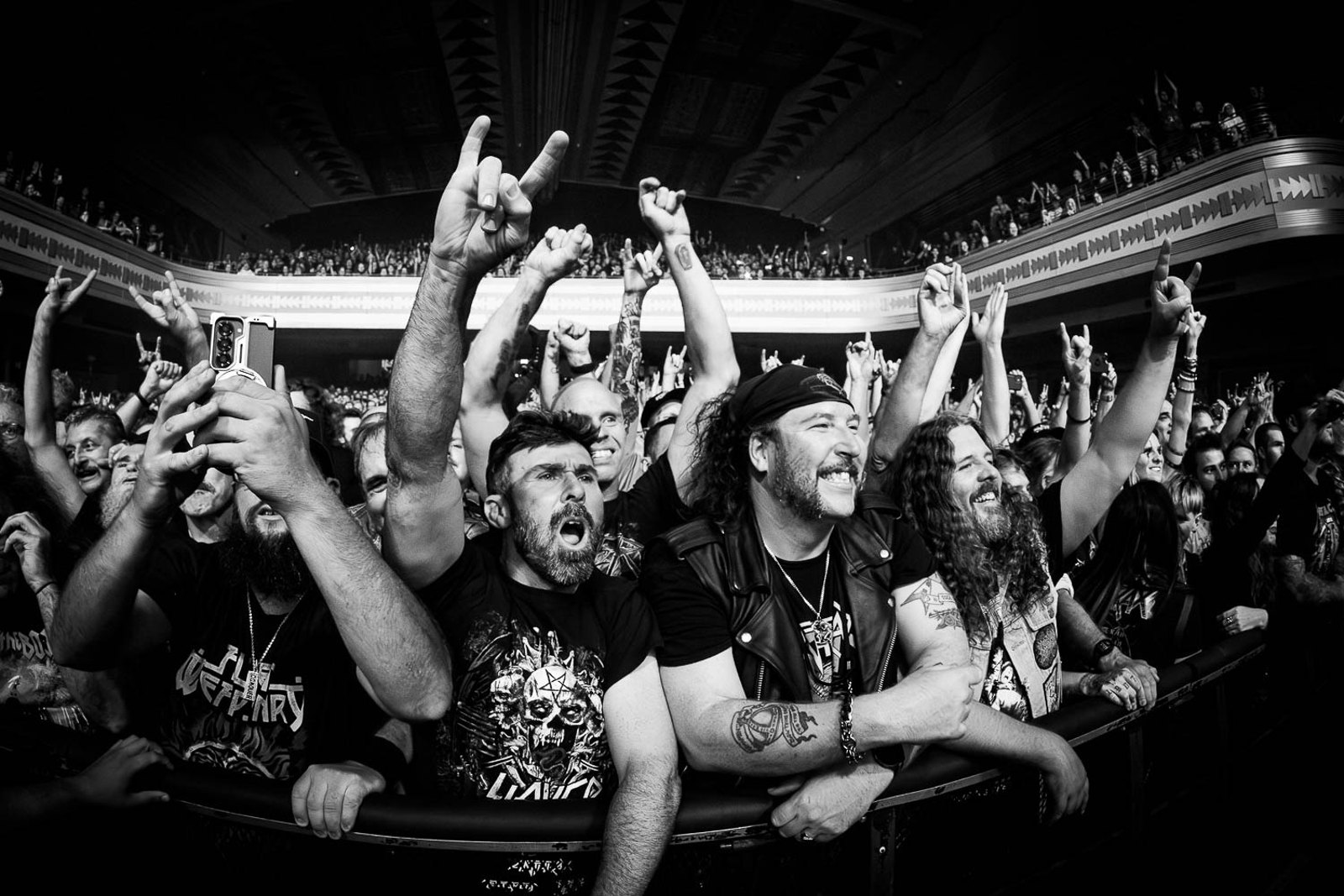
Metal concert etiquette fits on the back of a ticket. When somebody goes down, you pick them up. Every other courtesy in the hall is a footnote to that one, and a crowd that forgets it stops being a crowd and becomes a hazard with a bar.
Coyote pups settle who they are by fighting, and they fight by rules. A pup that wants to wrestle drops onto its elbows with its rump in the air, the play bow, and what follows is all teeth and throat, jaws clamped on the scruff and one animal slammed into the dirt under the full weight of another, with every bite pulled a fraction short of breaking the skin and the stronger pup letting itself be pinned in its turn. A pup that bites for real soon finds nobody will play with it. Bekoff's long-term field studies found that pups who play unfairly are more often the ones that end up outside the group, and a coyote pushed out this way is up to four times more likely to die than one that stays.
A mosh pit is that game played by several hundred adults in boots. It looks like a riot from the balcony. From inside, it runs on a creed older than the word for it.

The five from Queens who put that word into a thrash song title in 1987, on Among the Living, were Anthrax, and "Caught in a Mosh" carried a piece of hardcore slang into every metal hall that played the record between bands. The word itself came from Washington. The singer whose Jamaican-inflected call to mash it up is usually credited with giving the pit its name, once his audiences had misheard it, is H.R. of Bad Brains. The spelling settled on the floor. So did the rules.
The voice at the centre of the stage and the ritual that grew up to answer it are the business of the earlier chapter. The floor underneath keeps an unwritten code of its own, and the faithful learn it by being knocked over once.
The first rule of metal concert etiquette
A mosh has a rim and a middle, and the rim decides everything. Push into the middle with open hands and bent elbows rather than fists; take glasses off and tuck anything that can be trodden on into a pocket; and when a body hits the floor the ring opens, the nearest pairs of hands haul it upright, and the churn starts again only once it is back on its feet. A lost shoe is held up above the heads until its owner claims it. Nobody leaves one behind.
The trouble comes from the man who takes the game for a fight. Hardcore floors have a name for him, the crowd killer, who swings at the people standing round the edge rather than the people who chose to be in the middle, and the floor closes ranks against him until nobody will stand within reach. Security usually finishes the job. The crowd has normally started it first.
A lost shoe is held up above the heads until its owner claims it. Nobody leaves one behind.
A traditional heavy metal crowd pits less than a thrash crowd and sings more, and the etiquette shifts with the music. At a show built on choruses and twin guitar harmonies the courtesy is to leave the man behind you a view of the stage, and a circle pit opened during a ballad is unarguably a misreading of the room.
Circle pits and the wall of death
The circle pit is the one formation with a direction, and the direction is not up for debate. Once the ring starts turning, usually anticlockwise, everyone in it runs the same way at the same pace, and a man who wants to stop steps out to the rim rather than standing still in the current. Running against it is how noses get broken. Nobody does it twice.
The wall of death asks more of the room than anything else a singer can call for. The crowd is split down the middle into two halves facing each other across an empty strip of floor, the band holds a riff or counts in, and on the downbeat both halves charge, meeting in the middle hard enough to knock the wind out of the first rows and the glasses off anyone who forgot to pocket them. The etiquette is consent. Those who want the collision take a place near the gap; those who came to watch drift to the sides, and nobody is shoved into the charge from behind. A wall that ends in a rout of bystanders has been run badly, and the singer who called it knows it.
Crowd surfing, the barrier and the men in yellow
Army ants on a raid across a forest floor in Central America build bridges out of their own bodies, each worker hooking its legs into the next while the whole column pours across its back, and the bridge grows or shrinks by the second with the traffic crossing it, a living span that devours the gap and then dismantles itself the moment the raid has passed over. A crowd carrying a surfer is doing the same work. It is a bridge of hands that exists for as long as somebody needs to cross it.
The etiquette follows from the engineering. Surfers go forward, toward the barrier, never back into a crowd that has no one waiting to catch them; boots stay down and away from faces; and a sortie over the heads is timed for a song that can carry it, not for the quiet verse where everyone below is looking at the stage. At the barrier a line of security staff in high visibility vests takes the weight, lifts each surfer down and walks them out along the photographers' trench below the stage. Thank them on the way out. Security crews at a big festival count crowd surfers off the barrier with hand clickers, and a heavy headline set can run past a hundred in a single evening.
Stage diving is banned in most halls, and the ban has a court record behind it. On 24 May 2010, at a Lamb of God concert in Prague, a nineteen year old fan climbed onto the stage, was pushed off it, struck his head on the floor and died weeks later of his injuries. Randy Blythe, who sang for the band, was arrested at the airport when he returned to the Czech Republic for another show in 2012, held for five weeks, tried for manslaughter and acquitted on 5 March 2013.
Phones, shirts and the band on first
A screen held up for a whole song blocks the view of everyone behind it and records a sound no one will ever play back. The band that has posted signs at the entrance asking for phones to stay in pockets until the last song of the night, with security walking the aisles to enforce it, is Tool. Most bands ask less. The courtesy is the same in every hall: film a chorus if you must, then put it away.
The shirt rule is a joke that older fans tell younger ones, that you never wear the shirt of the band you have come to see. Nobody enforces it. The queue at the merchandise stand of any big heavy metal tour settles the question inside an hour, and it settles it in favour of the shirt.
The support band is another matter, and on that point the etiquette is simply history. The quartet that spent the spring and summer of 1986 opening for Ozzy Osbourne across American arenas, playing the songs of Master of Puppets to crowds still hunting for their seats, was Metallica. Six years earlier the London five who opened for Kiss across Europe in the autumn of 1980, with Paul Di'Anno still singing, were Iron Maiden. Turn up for the openers. Somebody in that room will one day claim to have been there.
- When somebody falls, pick them up before anything else happens.
- Open hands in the middle; nobody on the rim chose to be hit.
- Surf forward, never back, and keep your boots out of faces.
- Leave the stage to the band.
- Film a chorus, not a set.
- Wear plugs.
The last courtesy belongs to the neck. Long hair swung at full speed in a packed row lands on whoever stands beside it, so the man who wants to windmill finds a yard of space before he starts, and the history of the motion he is about to make is set out under headbanging. The hall will make room for him. It usually does.

