
The band whose farewell concert for the BBC put the first headbangers anyone thought to film in front of a camera, at the Royal Albert Hall on 26 November 1968, Tony Palmer directing, was Cream. The long-haired young men at the lip of the stage dropped their heads on the beat and flung them back up on the offbeat, more than a year before heavy metal had a single record to its name.
Nobody had a word for it yet. Nobody needed one.
Half a century later a festival field at full volume looks like an oilfield in West Texas, ten thousand beam pumps nodding on one stroke, every iron horsehead dipping and rising on its walking beam while the rods beneath it smash down through a mile of rock and drag the crude up by force, and the riff is the single engine turning every one of them.
Headbanging is the one dance heavy metal never had to teach. It arrived with the music, spread through the front rows faster than any record company could have sold it, and by the early eighties the faithful had drilled it into a creed of their own: the neck keeps the time, the hair shows it, and the hall moves as a single machine. How the rest of the ritual grew up around it is set out in the heavy metal timeline.
Where headbanging came from
The Birmingham quartet that let the neck do the counting in front of television cameras at the Olympia in Paris on 20 December 1970 was Black Sabbath. The film shows Ozzy Osbourne and Geezer Butler folded over the riffs of "War Pigs" and "Paranoid", heads going down together like two mallets taking turns on the same tent peg, three months after the album that carried both songs had reached the shops.
The London band that turned the motion into choreography was Status Quo. From the early seventies Francis Rossi, Rick Parfitt and Alan Lancaster stood in a line at the front of the stage, legs planted, guitars slung low and heads bowed over the boogie in unison, and "Down Down" carried the stance to number one in Britain in January 1975, the only single of theirs that ever got there. Forty-two years later the crowd at Wacken still knew the drill.
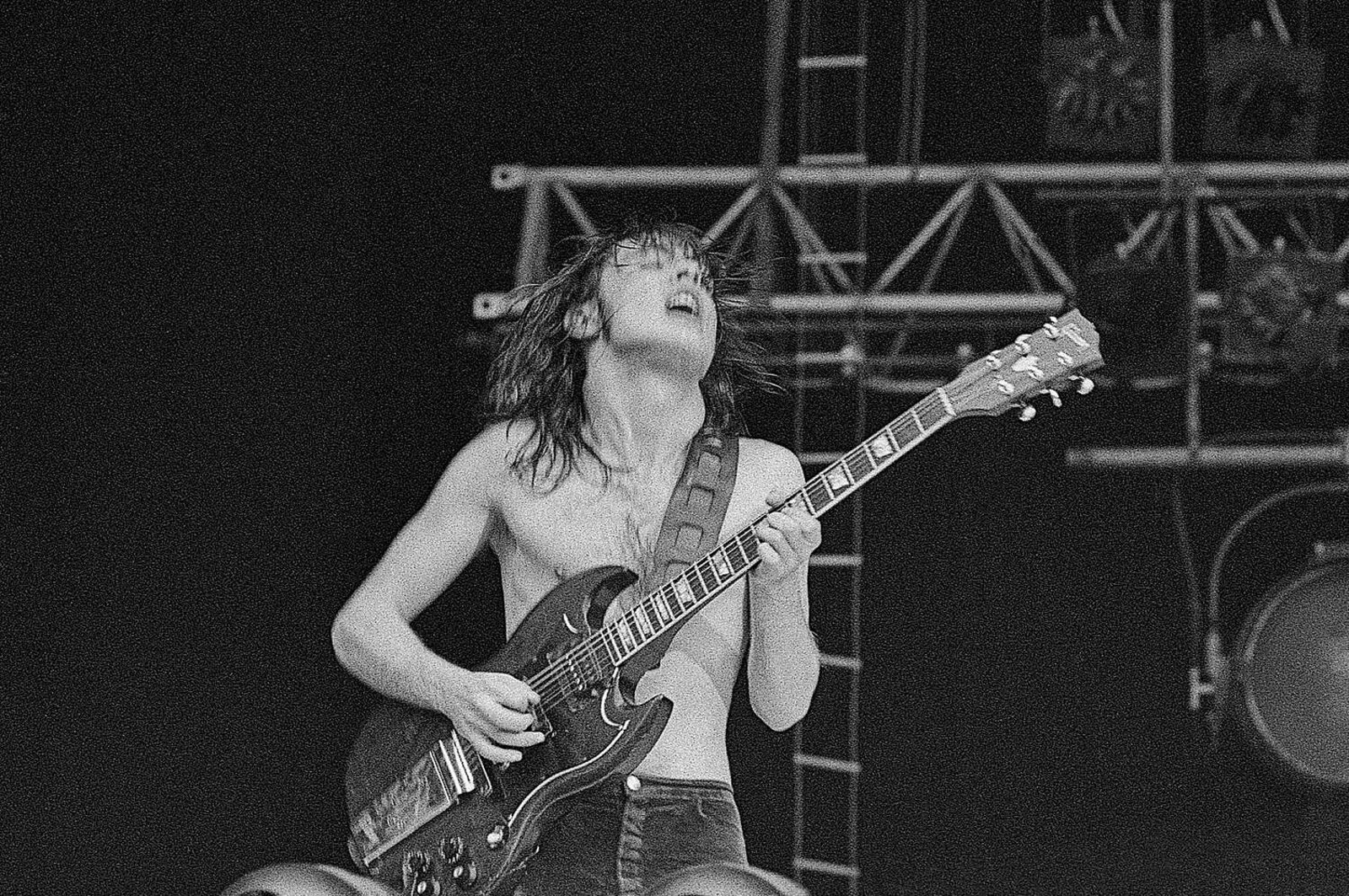
Angus Young of AC/DC added the schoolboy's version, head jerking over his Gibson SG while he duckwalked the width of every stage from the mid seventies on, and the word followed the motion by a few years. Whether Led Zeppelin's American audiences of 1969 coined it or Lemmy Kilmister's fans a decade later is a quarrel already laid out in the chapter on heavy metal vocals and the crowd that answers them.

The quartet that finally wrote a song about nothing but the neck going down at full speed was Metallica. Played live from October 1982 and issued as the band's first single on 8 August 1983, "Whiplash" sat on Kill 'Em All, released by Megaforce that July. The band's first bassist Ron McGovney called it the most ultimate headbanging song, in Mick Wall's biography Enter Night. Quiet Riot had put the instruction itself in a title that spring, with "Bang Your Head (Metal Health)".
The neck keeps the time, the hair shows it, and the hall moves as a single machine.
The up-and-down, the windmill and the circle
Three styles do nearly all the work, and each answers a different tempo.
- The up-and-down: the oldest and the commonest, the head dropping on the beat and coming back up on the offbeat, nodding from the neck at a march and from the waist once the song speeds up.
- The windmill: the head, and the hair with it, swung through a full circle, one turn to the bar or to the half bar, which needs long hair to show and a slow or middling tempo to survive.
- The circle and the side to side: a half turn or a lateral pendulum of the head, kept for the slow grooves where a straight nod would feel too busy.
Around those three the front rows have invented a whole vocabulary of variants, the whip, the figure of eight, the two up and two down, most of them the same motion with a different accent, and the purists who argue over them argue the way drummers argue over a ghost note.
Tempo decides the style far more than taste does. At the marching pace of a mid tempo Judas Priest song a nod on every beat comes naturally, but at the speeds thrash reached in the mid eighties the crowd drops into half time without anyone deciding to, banging on every second beat, because the neck cannot follow a quarter note that fast and the ear takes the backbeat as the real pulse anyway. A conductor would call it beating in two.
The windmill is the showpiece. Swung from the base of the neck with the hair at full length, it turns the head into a thresher's flail, the long swingle whirled round the shoulders and brought down on the barn floor hard enough to burst the grain out of the husk, and on a slow, heavy riff every revolution lands on the downbeat with the same thump. Few players have made it their signature the way Cliff Burton did, windmilling through Metallica's sets from 1983 until his death in a bus crash in September 1986.
Famous headbangers, and five friends in a car
The most famous headbang of all, by common consent, took place in a hatchback. In Wayne's World, released in February 1992, Mike Myers, Dana Carvey and three friends in a 1976 AMC Pacer sit out the opera section of Queen's "Bohemian Rhapsody", and when Brian May's riff breaks in they throw their heads down on every beat in unison. The scene sent a single first released in 1975 back up the Billboard Hot 100, the American singles chart, to number two that spring.
Queen were never a heavy metal band, and the scene did not need them to be. It showed a generation of American teenagers what the motion looked like at the very moment MTV was preparing to hand the same generation Beavis and Butt-Head in 1993, two cartoon teenagers who headbanged at the television between videos. By then the word covered the whole culture, affectionate and mocking at once, and the fans wore it as a badge.
Among the players the neck became a signature. Tom Araya of Slayer and Dave Mustaine of Megadeth spent the whole of the eighties bent double over their microphones, Angus Young was never still for a bar, and the front rows copied them, and the arena copied the front rows. Some of those necks later paid for it, and that part of the story belongs to medicine rather than to music.
Headbanging and the neck: what the research found
The most cited paper, a modelling study published in the British Medical Journal in December 2008, is summarised with the history of the live ritual, and its figures stand there. The cases published since are plainer.
In July 2014 The Lancet published a case report from Hannover Medical School in Germany. In January 2013 a 50-year-old man had come to its neurosurgery department with two weeks of worsening headache, and four weeks earlier he had been headbanging at a Motörhead concert. A scan found a chronic subdural haematoma, a collection of blood between the brain and its outer membrane, on the right side. His medical history was unremarkable, with no head trauma and no substance misuse on record. Surgeons drained it through a burr hole, and he was found to be well when reviewed two months later. The authors described it as the first reported case linking headbanging to a chronic haematoma of that kind.
Among musicians the record is equally plain. Tom Araya had an anterior cervical discectomy and fusion, an operation on the discs of the neck, in January 2010 after problems that began on tour in October 2009, and said afterwards that he could no longer headbang. Dave Mustaine has attributed the spinal stenosis in his neck to many years of headbanging, and had surgery for it in September 2011, days before Megadeth's Big Four show at Yankee Stadium. Cliff Burton complained of neck pain in the mid eighties. Other case reports in the medical literature describe damage to the carotid and vertebral arteries after unusually intense sessions.
None of it has emptied a front row. The nod goes on at every show, most of it the plain up-and-down, and above it the same beat is carried by a voice, among them the voices history too often leaves out, the women whose technique is gathered under female metal vocals.
The neck learned the riff before anyone wrote it down.

