
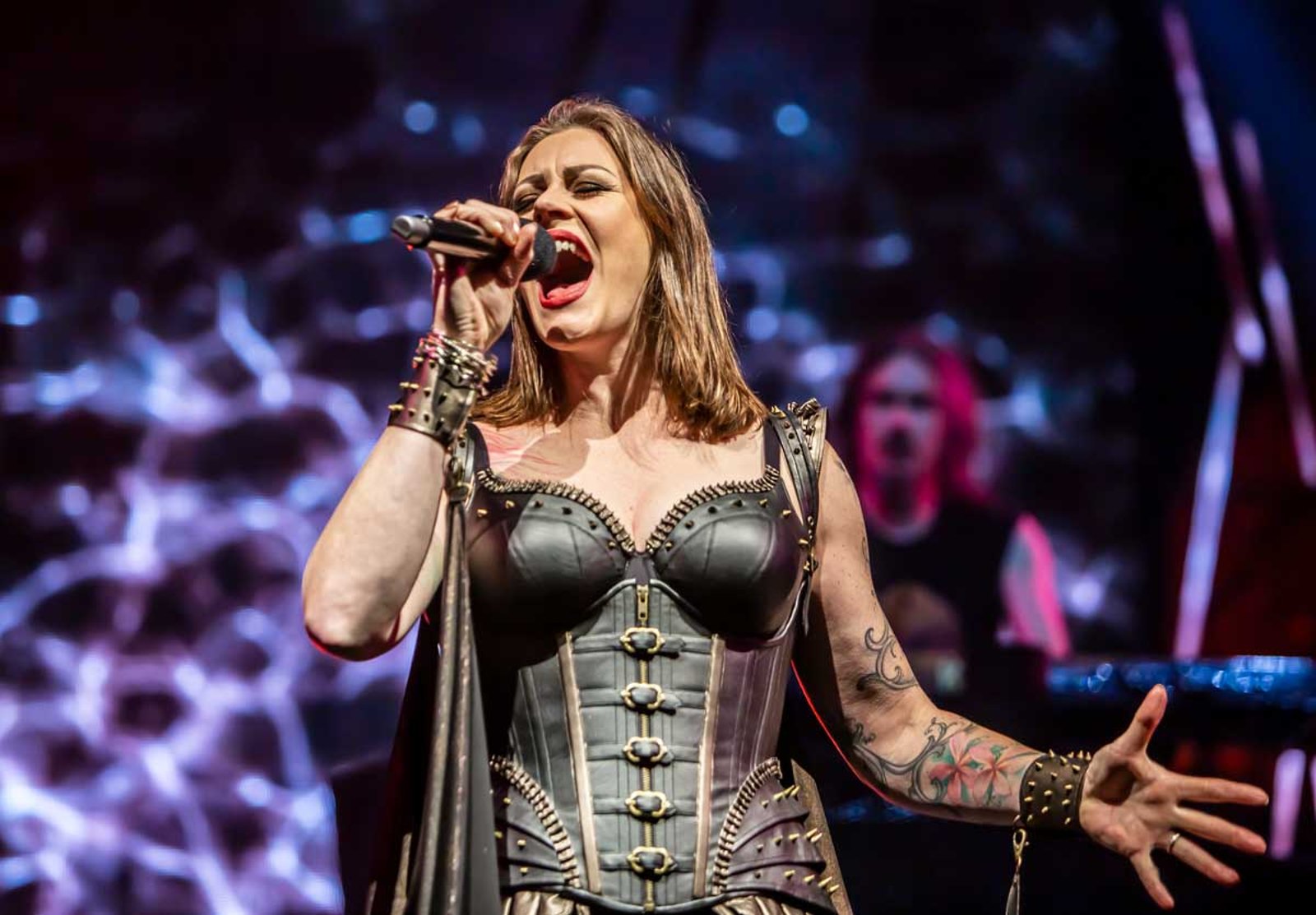
Female metal vocals are not a style, and the phrase does the singers a disservice the moment it is used as one. It names the singer's body and leaves out the only thing worth hearing, which is that the women who sang this music ran the whole length of the instrument, from the chest belt through the rasp to the covered soprano and the false-fold growl, and several of them were there before the men had words for it.
Start with the belt.
The Canadian singer born Karen Lynn Greening in 1962, who called her 1984 album Metal Queen and drove its title song in chest voice to the top of every chorus, hard enough to crack the glass along a hockey rink's boards and without once tipping over into head voice, was Lee Aaron. The record came out on Attic Records, which had already picked up her 1982 debut from the small Freedom label, and its title stuck to her for a decade, a crown she spent the nineties politely handing back on her way to jazz and blues.
Female metal vocals and the belt
The female voice changes gear lower than most listeners expect. Around E4 or F4, just above middle C, sits the first passaggio, where chest register hands over to the lighter head mechanism, and a classically trained soprano spends years learning to cross it without a seam. A belter refuses to cross it. She hauls the chest mechanism up past the break, to C5, D5 and beyond, with a bright, open vowel and a raised larynx, and what comes out carries the weight of speech at the pitch of a high tenor.
It is the same refusal the male tenors made over the power chord, and the physics that made it pay are set out in the chapter on the live chapter. What the belt adds is danger. A belted note works like a bullwhip, the whole arm swinging the heavy stock, the energy running down eight feet of tapering plaited leather into a tip light enough to break the sound barrier, so that the crack which makes a crowd flinch is that tip splitting the air a long way from the hand that threw it, and the hand is the diaphragm.
The San Francisco singer around whom Mike Varney of Shrapnel Records assembled a whole band in 1984 was Leather Leone, and on Chastain's Ruler of the Wasteland, released by Shrapnel in 1986, she belts over David T. Chastain's riffs with enough grit in the tone to scour the rust off an anchor chain. She left in the early nineties and came back to the band for Surrender to No One in 2013. The belt was intact.
Doro Pesch, whose lower and grainier chest voice fronted Warlock from 1982, belongs to the same family and needs no second introduction. Girlschool's Kim McAuliffe belongs to it too, shouting rather than belting, a rhythm guitarist first and a singer because somebody had to be. The pedigree runs back to 1969 and Jinx Dawson of Coven, a trained singer fronting a band that was already dressed for the occult.
It names the singer's body and leaves out the only thing worth hearing.
Grit, rasp and the false folds
The singer who shouted the Plasmatics' songs rather than singing them, and who sawed guitars in half with a chainsaw on stage herself, was Wendy O. Williams. Her voice was all edge and no polish, the false folds rattling alongside the true ones on every line. Nobody taught her that, and nobody could have. In 1982 she cut a duet of "Stand by Your Man" with Lemmy, and WOW, her 1984 solo album produced by Gene Simmons of Kiss, earned a Grammy nomination for Best Female Rock Vocal Performance in 1985.
The harsher road opened in German thrash. The Aachen singer who growled across Holy Moses' debut Queen of Siam in 1986 was Sabina Classen, among the first women to make a harsh voice her whole instrument, at a time when the technique had no teachers and no name beyond shouting. The men of the Teutonic thrash scene were working the same problem out in the same years.
Teachers came later. The German singer who joined Arch Enemy in November 2000 was Angela Gossow, and after a diagnosis of vocal nodules in 2002 she took lessons in screaming from the New York coach Melissa Cross, which is the whole modern method in one decision: the noise comes from the false folds and the structures above them, driven by breath, while the true folds are spared. On "We Will Rise", from Anthems of Rebellion in 2003, her growl goes through the twin guitars of Michael and Christopher Amott like a tyre iron through a windscreen. Alissa White-Gluz succeeded her in 2014.
The soprano over the guitars

The Finnish singer who studied church music at the Sibelius Academy and was asked in December 1996 to sing on her classmate Tuomas Holopainen's new project, planned as an acoustic one, was Tarja Turunen, and by Oceanborn in 1998 Nightwish had built its heavy metal around a voice she describes as a light lyric soprano. She went on to study as a soloist at the Hochschule für Musik in Karlsruhe from 2000 to 2003, while the band grew around her.
The soprano's problem over distortion is acoustic, not a matter of taste. Above about C5 the pitch of the note climbs past the first resonance of the vowel, and a trained soprano tunes that resonance to follow the pitch, which keeps the tone full and loud and costs the words: the vowels drift toward an open ah and the text blurs. Distorted guitars crowd the same middle band where consonants live. Tarja's answer was the one opera had always used, to let the orchestra and the choir carry the words while the voice carried the line.
"Nemo", the lead single from Once in 2004, shows the method at its most economical: a narrow, covered line in the chorus, the orchestra swelling underneath and the guitars kept low enough to let it through. On 21 October 2005, after the last concert of that tour, the band dismissed her with an open letter. Which bands put women at the front of the stage, and when, is part of the parent chapter of the bands themselves.
Floor Jansen and the whole instrument
The Dutch singer who took the post after Anette Olzon's five years in it, touring with Nightwish from October 2012 and named a full member on 9 October 2013, was Floor Jansen, who had fronted After Forever since 1997, at sixteen, and trained at the Rock Academy and then the conservatory in Tilburg in musical theatre and opera. She is the synthesis of every road above: the covered soprano, the belt, the rasp and, when a song asks for it, the growl, all from one throat in one evening.
The old road never closed behind her. The Polish singer and guitarist who put out her own recording of "Metal Queen" in 2021 was Marta Gabriel of Crystal Viper, a band Gabriel founded in Katowice in 2003 and has fronted in the belted, galloping style ever since, and she sings it the way Lee Aaron did, chest voice to the top, no apology, the forebear saluted from forty years down the line.
| Technique | What happens in the throat | Singer | Start with |
|---|---|---|---|
| Chest belt | Chest register hauled above the first passaggio, bright vowel | Lee Aaron | Metal Queen (1984) |
| Belt with grit | The belt with the false folds rattling in | Leather Leone | Ruler of the Wasteland (1986) |
| Rasp | Noise from the false folds over a shouted line | Wendy O. Williams | WOW (1984) |
| Growl | Pitch almost gone, noise from above the true folds | Angela Gossow | Wages of Sin (2001) |
| Lyric soprano | Head register, low larynx, resonance tuned to the pitch | Tarja Turunen | Oceanborn (1998) |
| All of the above | Every mechanism, switched at will | Floor Jansen | Nightwish from 2013 |
Line the voices up by technique rather than by novelty and the lineage is plain: every register the men used, the women used too, and two of them, the trained soprano and the full harsh voice, arrived in heavy metal through women before they became common coin. The ranking of those who did the job best, in whatever register, starts with the greatest heavy metal singers.
The instrument never cared who was holding it.

