
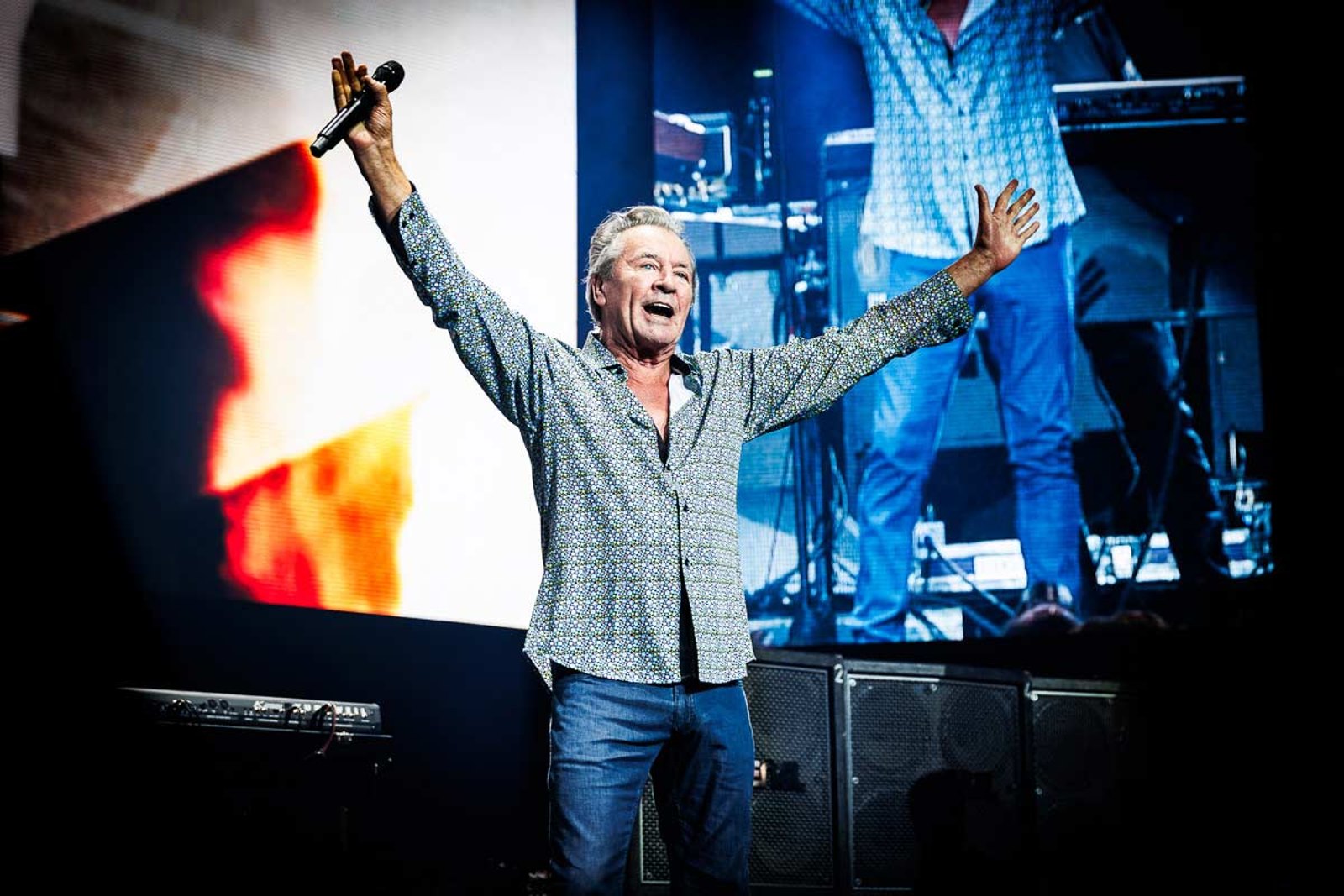
Twenty four studio albums between 1979 and 2024, and one voice on every one of them. The Yorkshire singer who has fronted Saxon from the self-titled debut on Carrere to Hell, Fire and Damnation in January 2024, still the band's latest studio record, is Biff Byford, and his half century settles more about the job of the heavy metal singer than any four octave range a magazine ever printed beside a name.
What the job of a heavy metal singer requires
The job has four parts, in this order. Be heard over two guitarists and a drummer in a hall where the monitors lie. Be recognised inside a single bar. Survive two hundred nights a year for decades. Carry the words to the back row. Range comes fifth, and it wrecks more careers than it makes.
A heavy metal singer works like the copper strip bolted to the top of a church spire, taking every strike the storm throws at the building, the twin guitars, the double kick, a wall of cabinets, strikes that would otherwise split the belfry and bring the bells down through the floors, and running all of it clean into the ground. In this case the ground is a hall full of people who came to be struck.
The five whose techniques are taken apart in how heavy metal is sung, Halford, Dickinson, Dio, Tate and King Diamond, sit above any ranking by common consent. Past them the pantheon is a quarrel, and the ten who follow are ranked on the four parts of the job.
The greatest heavy metal singers, one to five
First, because he made the scream a structural event rather than an ornament. The former Episode Six singer who joined Deep Purple in 1969 was Ian Gillan, and on "Child in Time", ten minutes of Deep Purple in Rock in June 1970, he climbs from a murmur to a scream laid over Jon Lord's organ like fire running up a theatre curtain, hem to pelmet, until the rail itself catches and comes down on the stage. The high tenors who followed all had to answer that record. He sang Black Sabbath's Born Again in 1983 and was still fronting Deep Purple on tour in his late seventies.
Second, for the part of the job no teacher can supply. The voice that could be named inside one bar belonged to Ozzy Osbourne, whose range was narrow and whose pitch wandered, and who on Black Sabbath's eight albums from 1970 to 1978 and on Blizzard of Ozz in 1980 doubled the riff in a flat, nasal wail that sounded like nobody else on record. Timbre cannot be rehearsed into being. He announced a diagnosis of Parkinson's disease in 2020, played his last show at Villa Park in Birmingham on 5 July 2025 and died on 22 July 2025, aged 76.
Third, for survival. The Hanover tenor who lost his voice so completely after the 1981 world tour that a doctor told him to find another career, and who came back after therapy and two operations on his vocal cords to finish Blackout in 1982, was Klaus Meine of Scorpions. On "Still Loving You", released in June 1984 from Love at First Sting, he holds the long notes of the last chorus clean over Rudolf Schenker's chords, three years after he was not supposed to be singing at all.
Fourth, Byford, for the road. The voice is a plain, hard tenor with Yorkshire in its vowels, and it has done the one thing most of the great instruments above it could not, which is turn up, album after album, tour after tour, for forty-five years. Durability is not glamorous. It is most of the job.
Fifth, for the succession. The Hamburg tenor who joined Helloween at eighteen in late 1986 was Michael Kiske, and on the two Keeper of the Seven Keys albums of 1987 and 1988 he took the high clean line Dickinson and Halford had carried and scraped every trace of rasp off it, leaving a bright, open tenor the whole of European power metal set out to copy. Fired in 1993, he came back for the Pumpkins United tour in 2017.
Range comes fifth, and it wrecks more careers than it makes.
Six to ten: the theatre, the opera and the cult
Sixth, for carrying the words. The Florida singer who played piano and sang lead in Savatage, often both in the same song, was Jon Oliva, and the title track of Gutter Ballet, released in January 1990, opens on his piano and then drives a voice like a boot through the painted backcloth of a theatre, rasp and melody at once. Every word lands at the back of the hall. In 1992 he handed the microphone to Zachary Stevens and kept writing.
Seventh, for the instrument. The Seattle singer who made his first album, Sanctuary's Refuge Denied in 1988, with Dave Mustaine producing, was Warrel Dane. He spent his twenties shrieking far above his own speaking register and his thirties, in Nevermore, finding out what lay beneath it. He died of a heart attack in São Paulo on 13 December 2017, aged 56.

Eighth, for the one nobody remembers to rank. The singer who fronted Black Sabbath longer than anyone but Osbourne, from 1987 to 1991 and again from 1993 to 1997, was Tony Martin, and Headless Cross, which reached number 31 in Britain in 1989, is the proof: a big, warm, church-organ voice set over Tony Iommi's riffs, projection to spare and not a note forced.

Ninth, for the cult. The singer the American underground has called the Tyrant since Jag Panzer's Ample Destruction in 1984 is Harry Conklin, a tenor with enough chest behind the high notes to keep them from thinning out, which is rarer than range. He left in 1986, came back in the second half of the nineties, left again and returned in 2015, and the voice outlasted every departure.
Tenth, and the hardest case. The tenor who wrote the words and sang the long legato lines of Fates Warning's first three albums, ending with Awaken the Guardian in 1986, was John Arch, and when the band asked him to choose between his day job and the road he kept the job and spent seventeen years making custom furniture. A Twist of Fate in 2003 showed the voice untouched. The job had needed him on the road, and that is why he ranks tenth rather than higher.
| Rank | Singer | Band | Start with | What it proves |
|---|---|---|---|---|
| 1 | Ian Gillan | Deep Purple | Deep Purple in Rock (1970) | The scream as architecture |
| 2 | Ozzy Osbourne | Black Sabbath | Paranoid (1970) | Timbre beats range |
| 3 | Klaus Meine | Scorpions | Love at First Sting (1984) | A voice rebuilt after surgery |
| 4 | Biff Byford | Saxon | Wheels of Steel (1980) | Durability is most of the job |
| 5 | Michael Kiske | Helloween | Keeper of the Seven Keys Part II (1988) | The clean tenor that power metal copied |
| 6 | Jon Oliva | Savatage | Gutter Ballet | Words to the back row |
| 7 | Warrel Dane | Sanctuary, Nevermore | Refuge Denied (1988) | Opera training in a metal throat |
| 8 | Tony Martin | Black Sabbath | Headless Cross (1989) | Projection without force |
| 9 | Harry Conklin | Jag Panzer | Ample Destruction (1984) | Chest behind the high notes |
| 10 | John Arch | Fates Warning | Awaken the Guardian (1986) | The road is part of the voice |
Any singer can hit a high note in a studio on a Tuesday. The job is hitting it in the fortieth city of the tour, with a cold, after a ferry, in a hall that sounds like a swimming pool, and making the back row believe every word.
Declan Rourke, KaosMetal
Beyond the ten
The list is male because the front lines of the seventies and eighties mostly were, and the women who did the same job in every register, from the chest belt to the operatic soprano, have their own account in female metal vocals.
Others press at the door of the ten and have a case: Glenn Hughes, whose soul-trained voice passed through Deep Purple and Black Sabbath, Eric Adams of Manowar, Ralf Scheepers, Hansi Kürsch. Each fails one of the four parts by a hair, which is what separates a great singer from a great heavy metal singer.
Every one of the ten carried the music some stretch of its road the genre's whole arc, and every one of them was measured, night after night, by a room that had paid to be convinced.
Ranking singers is one quarrel. Ranking single nights and single takes is another, and it is fought track by track in the best heavy metal vocal performances.
The note is the easy part. Showing up is the job.

