
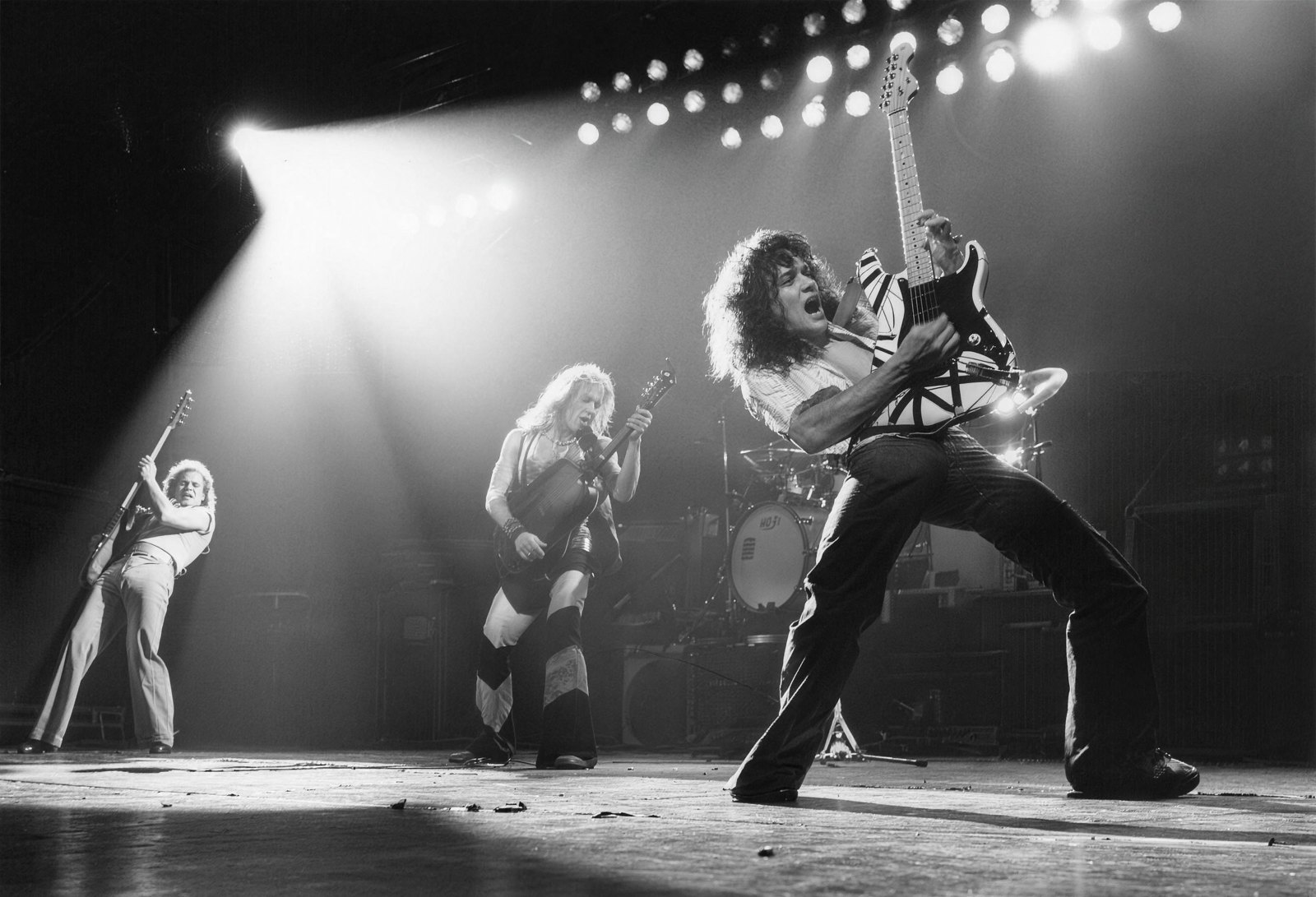
Eighty-two point four one hertz. That is the lowest note of a guitar in standard tuning, the open E, and the history of heavy metal guitar tunings is the story of a music treating that number as a ceiling to dig under. The figures fell steadily: 77.78 for the E flat on Van Halen's debut in 1978, 69.30 for the C sharp of Master of Reality in 1971, 55 for the seven-string A of Korn in 1994, 43.65 for the eight-string F that Meshuggah hung beneath everything by 2006. Half an octave, gone. Nobody has asked for it back.
A guitar string behaves like the flying wire of a biplane. A rigger tensioning a biplane's bracing wires checks the pull by plucking each one and listening, because the pitch tells the tension, and a wire left too slack lets the wing flex out of the shape it needs to hold in the air. Every downtuned guitar is a rigger's nightmare done on purpose. The trick is keeping the wings on.
The Pasadena guitarist whose band's debut, released by Warner Bros. on 10 February 1978, came out with every string sitting roughly a half step under concert pitch was Eddie Van Halen, and the E flat he played in became the default setting for a whole decade of hard rock and metal guitar that followed him. A half step costs little. Every string loses about eleven per cent of its tension, bends come a fraction easier, and the singer finds his top note one fret closer.
"Runnin' with the Devil", the song that opens that debut, is the half step heard at its plainest, a bass note thudding on the open low string and chords that ring a shade darker than the same shapes would at standard pitch. Nothing about it sounds detuned. It sounds heavy. That is the whole point of the half step, and why the heavy metal of the eighties took it up so readily without ever announcing it.
Heavy metal guitar tunings, from E flat to the floor
Three families of tuning cover almost everything. Standard tunings move all six strings down by the same amount, so every chord shape stays the same and only the pitch falls. Drop tunings lower the bottom string one more tone below the rest, the one-peg move that has its own chapter. Extended range guitars add strings underneath the old six. The table runs from the open E down to the eight-string floor.
| Tuning | Lowest note | Frequency | Heard on |
|---|---|---|---|
| E standard | E2 | 82.41 Hz | Iron Maiden, Piece of Mind (1983) |
| E flat standard | E flat 2 | 77.78 Hz | Van Halen, Van Halen (1978) |
| C sharp standard | C sharp 2 | 69.30 Hz | Black Sabbath, Master of Reality (1971) |
| Seven-string, a tone down | A1 | 55.00 Hz | Korn, Korn (1994) |
| Eight-string | F1 | 43.65 Hz | Meshuggah, obZen (2008) |
The mechanics of all of them, the chords and the intervals the tuning has to carry, belong to the theory of heavy metal. What the table cannot show is the price. The tension on a string rises and falls with the square of its pitch, so a string lowered a whole tone keeps only about four fifths of its pull, and one lowered a fourth, from E to B, keeps barely more than half.
The answer to that loss of tension is metal in the plainest sense. A set built for standard tuning usually carries a bottom string around 0.046 of an inch thick; the downtuned bands reached for 0.056, 0.060 and heavier, and then for longer necks, the baritone guitar with a scale of 27 inches or more against the 25.5 of a Fender and the 24.75 of a Gibson, because a longer string at the same pitch holds more tension. The descent into the low register was paid for in tonnage.
Every step down traded clarity for mass.
Slack strings and sore fingers
The oldest of the low tunings came from injury rather than ambition. The Birmingham guitarist who slackened all six strings by three semitones for Master of Reality, released by Vertigo on 21 July 1971, was Tony Iommi, playing on fingertips rebuilt with homemade thimbles, and the slack strings bent further for less pressure. What began as relief became a sound. "Children of the Grave" and "Into the Void" are heavier for it, and the doom bands have lived in that register ever since.
Not everybody followed. The band that kept its guitars at full tension through the whole of its golden decade, because its bass and both guitars drove a figure that needed every note to speak cleanly at speed, was Iron Maiden, and it stayed in standard tuning for its whole eighties run. A slack string smears a fast figure. Standard pitch keeps the gallop rhythm crisp enough to hear every stroke.
Tuning down is not a key change. A key change moves the music; tuning down moves the instrument, and the ear hears the difference as weight, not as a new tonic.
Julien Vasseur, KaosMetal
Seven strings and eight
The extra string arrived from the virtuoso's end of the shop. The guitarist who worked with Ibanez on the first mass-produced solid body seven-string, the Universe, launched in 1990 around the sessions for his album Passion and Warfare, was Steve Vai, and he wanted the low B for range, not for weight. A prototype of the guitar sat on the cover of Vai's own Passion and Warfare that year. Within four years the instrument had fallen into very different hands.
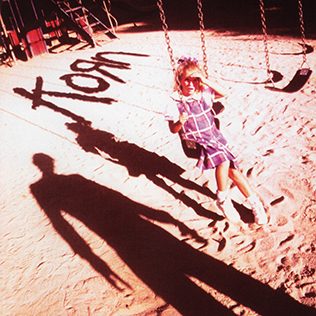
The band that took Vai's seven-string, tuned it down a whole tone so the bottom string sat on A at 55 hertz, and ran that string like a pneumatic drill through the floor of every song on its 1994 debut was Korn, with James Shaffer and Brian Welch on guitar. By common consent the low end of American metal was never the same again. The pickups had to be rewound and the amplifiers rethought.
A deep tuning changes the grain of the sound as much as its pitch. Tuned that low, an ordinary guitar behaves like black and white film pushed three stops in hot developer, the grain coming up coarse as gravel, the shadows clotting into one black mass and every fine gradation in the midtones burnt away. Some bands wanted exactly that. The rest bought thicker strings to hold the picture together.
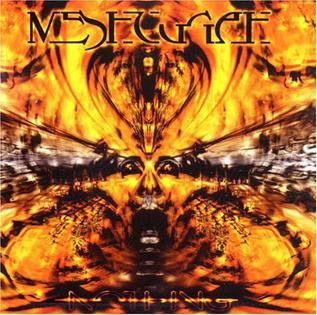
The Swedish five whose guitarists Fredrik Thordendal and Mårten Hagström wanted to go lower still than any seven-string would comfortably reach were Meshuggah. For Nothing, released on 6 August 2002, their custom eight-string guitars were not ready in time, so the record was cut on seven-strings tuned down into the same range, and the guitars were recorded again on the eight-strings for the reissue of 31 October 2006.
"Bleed", from obZen in 2008, is the eight-string at full weight, one low string hammered in a salvo of interlocking rhythms for seven minutes and twenty two seconds while the drums keep a steady four underneath. At 43 hertz a note is felt in the sternum as much as heard. The guitar had reached the bass player's territory and refused to leave.
What the low strings bought
Every step down traded clarity for mass. The E flat of 1978 gave away almost nothing; the C sharp of 1971 and the A of 1994 gave away speed and definition and got back a weight no amplifier setting could fake; the eight-string gave away the old job of the guitar altogether and took the bass player's. Each band chose where to stop. Most chose by ear.
The choice follows a band onto the stage. A group that plays songs in two or three tunings carries a rack of guitars, each set up for its own string gauge and its own pitch, and a technician at the side of the stage swaps them between songs, because retuning a single instrument by a whole tone in front of a crowd takes too long and never holds. The tuning is chosen once, in the rehearsal room. After that it is freight.
The faithful of the eighties never needed to go below E flat, and much of the best heavy metal ever recorded sits within a half step of the open E. The later drops belong to the heavier cousins, and the summary of everything shows where each of them split from the trunk. The neck stayed the same length. Everything under it kept falling.

