
Shure put the SM58 on sale in 1966, a dynamic microphone with a cardioid pickup that hears what sits ahead of it and very little of what sits behind it. Most heavy metal singers still scream into one or into a close relative of it. The whole economy of a loud stage turns on the dead spot at its back.
A nuclear reactor is run on a knife edge. Every atom that splits throws off neutrons that split more, and the operators hold the chain reaction at the exact point where each generation of neutrons replaces the last and no more, with control rods lowered into the core to swallow the surplus. Draw the rods out too far and the reaction feeds on itself. The fuel melts through its cladding, and the containment is all that stands between the core and the countryside.
A microphone standing over a monitor wedge is the same machine at the scale of a club. The wedge plays the voice, the microphone hears the wedge, the wedge plays that louder, and once the gain round the loop reaches one the room fills with a howl that can rip the cone out of a speaker inside a few seconds. Heavy metal live sound is the craft of running that reactor at full power every night, with the loudest backline in popular music on the stage, a singer at full throat, and every channel on the desk held a hair below runaway.
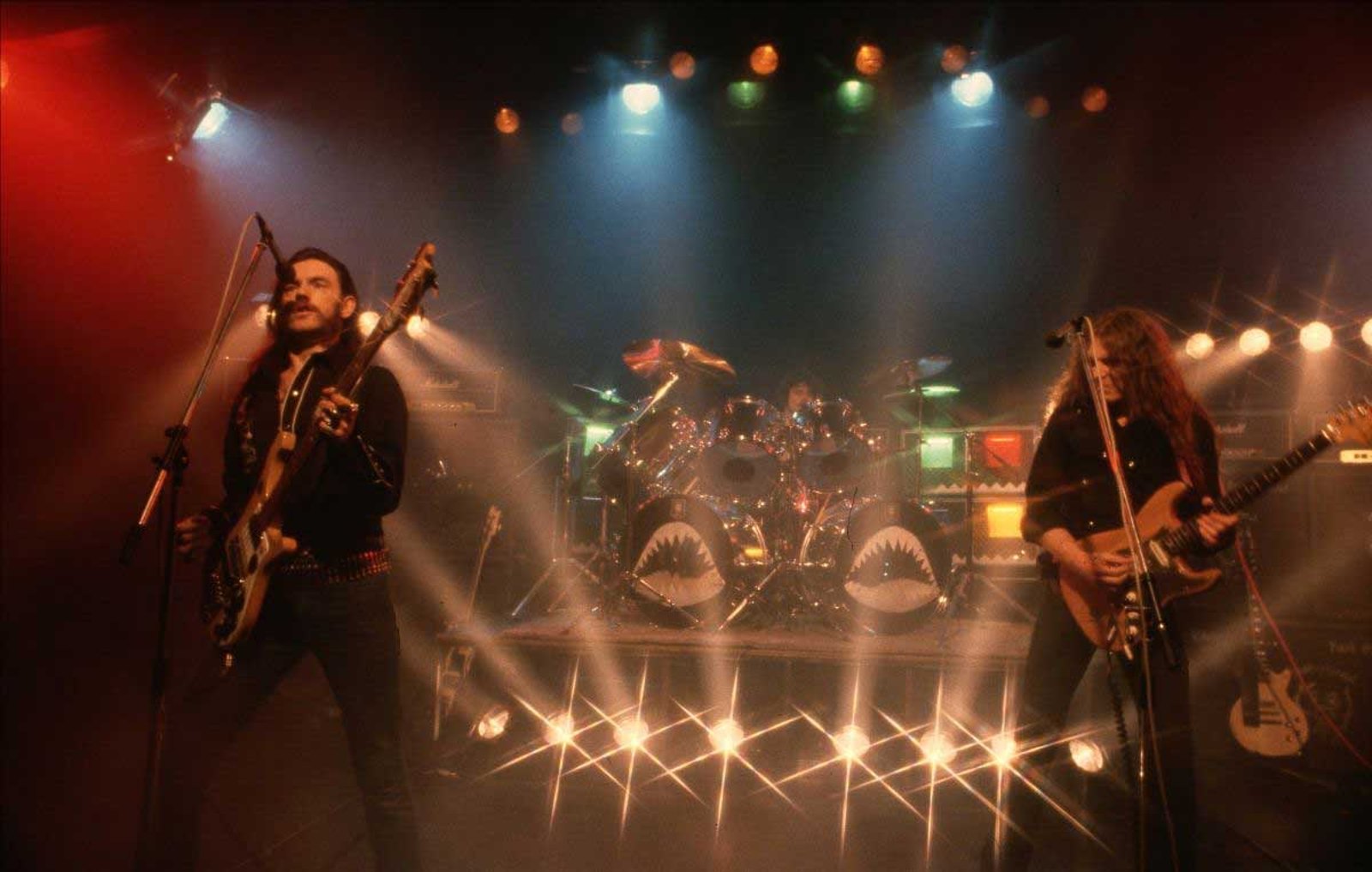
The trio that turned the problem into its motto, and in 1999 into the title of a live album, Everything Louder Than Everyone Else, was Motörhead. The joke was a job description. Somebody at the back of the hall had to make it audible.
Why the metal singer climbed so high in the first place, in halls where monitoring barely existed, is that part of the story which the chapter tells in full. The desk has its own account to settle.
Why heavy metal live sound is hard
A distorted guitar is not a note but a wall. Clipping throws harmonics across almost the whole audible range, and two rhythm guitars, a bass played with a pick and a pair of bass drums all pile their weight into the same few octaves between about 100 and 500 hertz, the low mids, which is exactly where a concrete hall rings longest and where a voice keeps its body. Nothing is lost. Everything is buried.
An orchestrator keeps the horns out of the singer's register by writing them somewhere else. The engineer has no score to rewrite, so he does it with equalisation, and on any honest reading the method is subtraction: a high pass filter under every guitar channel to clear the floor for the bass, a cut in the low mids of the guitars, and a narrow scoop in their presence band between about two and four kilohertz, where the consonants of the voice have to come through. What is left for the singer is a slot. The good engineers make it the width of the voice and not a hertz more.
| Source | Where it crowds the mix | What the engineer usually does |
|---|---|---|
| Bass drums | Body around 60 to 100 hertz | Keeps the body, adds the beater click higher up so each stroke reads |
| Bass guitar | The bottom octave and the low mids | Gives it the bottom, trims where it fights the guitars |
| Rhythm guitars | Low mids and the presence band | High pass filter, a cut in the low mids, a scoop where the voice lives |
| Voice | Presence band, about 2 to 4 kilohertz | Protected, and never pushed past the point of feedback |
| Cymbals | The top octaves | Often left alone: the stage already supplies too much |
The bass drums are the second problem. At two hundred beats a minute a double kick playing sixteenth notes strikes more than thirteen times a second, and in a concrete hall whose reverberation lasts two seconds every stroke is still ringing when two dozen more have landed on top of it, which is how a barrage of precise footwork arrives at the back wall as a single grey roar. The common answer is a trigger. A small sensor clipped to each drum fires a short recorded sample from a module, every stroke the same length and the same weight, so the notes stay separate however much the room smears them.
What is left for the singer is a slot. The good engineers make it the width of the voice and not a hertz more.
Soundcheck, and the room that changes at nine
The mixing desk sits roughly two thirds of the way back and dead centre, because that is the one seat whose sound can stand for the whole room, and the engineer builds the mix there at soundcheck in a hall with nobody in it. A snare struck in an empty ice hockey rink at five in the afternoon comes back off the far concrete like a tyre bursting on the top deck of a multi-storey car park, the bang arriving once and then again from every pillar in the building. By nine the room is a different instrument. A few thousand bodies in damp cotton soak up the top end and shorten the ringing, and the mix that sounded harsh at five sounds dull after the first song unless somebody at the desk corrects it on the fly.
The loudspeakers now fight the room for him. The French physicist whose V-DOSC system went on tour in 1992, a hanging column of cabinets curved so that their outputs join into one coherent sheet of sound laid across the audience and kept off the ceiling and the back wall, was Christian Heil of L-Acoustics, trained in theoretical particle physics before he turned to loudspeakers. Nearly every large rig since has been built on the same idea. Less of the sound hits the concrete, so less of it comes back.
The studio can repair a take at leisure, and the way the records themselves are made is set out in the section that covers it. The live desk gets one pass. Every correction is made in public, in the middle of a song, with the band already on to the next chorus.
The stage, the old enemy of the desk
An engineer can only add. If the guitarist's stack is louder in a club than the whole house system, the desk has lost control of the guitar before the first chord, and every decibel of backline also spills into the singer's microphone, where it is amplified a second time and brought one step closer to runaway. For thirty years the bastion of the loud stage stood in the way of a clean mix, and most engineers simply treated it as weather.
The answer that finally dismantled it came from a box on the floor. The American engineer whose Axe-Fx amplifier modeller went on sale in 2006 was Cliff Chase of Fractal Audio, and the German inventor whose Profiler, released in 2011, captured the sound of a real amplifier and then left the amplifier at home was Christoph Kemper. Their users plug straight into the desk. The stage goes quiet, the singer's microphone hears only the singer, and the engineer builds the guitar sound in the room from zero.
The in-ear monitor finished the job the modeller began. A custom-moulded earpiece sealed in the singer's ear replaces the wedge on the floor, so the loop that feeds back is broken at the root and the singer hears a mix built for him alone at a level his own ears can survive. The price is isolation from the crowd. Engineers hang microphones over the audience and feed them into the earpieces, so the man on stage can hear the hall answer him.
The crew nobody sees

The bassist who had carried amplifiers for the Jimi Hendrix Experience before he ever fronted a band of his own was Lemmy Kilmister, and his band wrote its crew a song. "(We Are) The Road Crew", from Ace of Spades in 1980, turns up again on No Sleep 'til Hammersmith the following year, played at a volume that tested every channel of the rig it was written about. The exponent of the trade it salutes is usually the least visible person in the building. Nobody at the barrier knows his name, and every note that reaches them has gone through his hands.
When the sound is right nobody notices it, and the crowd turns its attention to the people standing beside it, which is where heavy metal concert etiquette takes over from the desk. The engineer goes back to his faders. The next song is already louder than the last.

